The conventional advice for small spaces — scale everything down, choose petite furniture, opt for visual lightness — is broadly right but specifically wrong about rugs. A small rug in a small room reads as a postage stamp; a generously-sized rug in the same room visually extends the floor plane and makes the space feel larger than it is. The right small-space rug is bigger than instinct suggests, lighter than instinct suggests, and oriented to the room's longest axis.
TL;DR
- In small spaces, choose the largest rug that respects the 18-inch wall margin — typically a 6×9 or 8×10 in a studio, never a 4×6 in a living zone
- Orient the rug along the longest dimension of the room to visually extend the space
- Lighter grounds (cream, ivory, soft beige, pale grey) and tonal palettes expand small spaces; high-contrast or busy patterns can shrink them
- Low-to-medium pile reads less visually heavy than thick high-pile in tight quarters; flat-weaves work especially well
- Layering one larger neutral with one smaller patterned accent is the apartment alternative to two separately-sized rugs
Why small spaces want larger rugs
Visual perception of a room's size is driven heavily by floor-plane continuity. A single rug that covers most of the floor — with a consistent 12-18 inch margin to the walls — reads as one continuous grounded surface; the eye registers the full floor area as the room. Two small rugs, or one small rug with lots of bare floor around it, fragments the floor visually and the room reads as a series of zones rather than one space. This is why a 5×7 in a 10×12 living room makes the room feel smaller, while a 6×9 in the same room makes it feel larger. The counterintuitive rule: rug coverage expands rooms; rug fragmentation contracts them.
Sizing for studios and one-bedrooms
Studio apartments are typically 350-600 square feet with one open zone serving as living, sleeping, and dining. The sizing logic: identify the single anchor function (almost always the living/seating zone) and size for it. A 6×9 or 8×10 anchored under the sofa with front-legs-on placement is the standard studio rug. The bed zone usually gets a smaller accent rug — a 3×5 at the foot of the bed, or two narrow runners on either side — or is left bare to let the larger living-zone rug do the work. Avoid the temptation to place a separate small rug in every functional area; this fragments the space.
Sizing for small living rooms (10×12 to 12×14)
Small living rooms benefit from the largest rug that respects the 18-inch wall margin. For a 10×12 room, this typically means a 6×9 (96″×72″ with 18″ margin on the short dimension and 24″ on the long); for an 11×13, a 7×10; for a 12×14, an 8×10. The front-legs-on placement remains correct — sofa and accent chair front legs sit on the rug; back legs are on bare floor. The 5×7 or smaller, often suggested for small rooms, looks like a sample swatch rather than a rug.
Orientation: align with the longest sightline
In rectangular small rooms, the rug should be oriented with its long dimension along the room's long dimension. This extends the visual depth of the space rather than fighting it. A long, narrow living room with a 6×9 rug placed crosswise (9 feet across the narrow dimension) reads as more cramped than the same room with the same rug placed lengthwise. The principle holds for runners in hallways and entryways — orient with the corridor, not across it.
Palette for small spaces
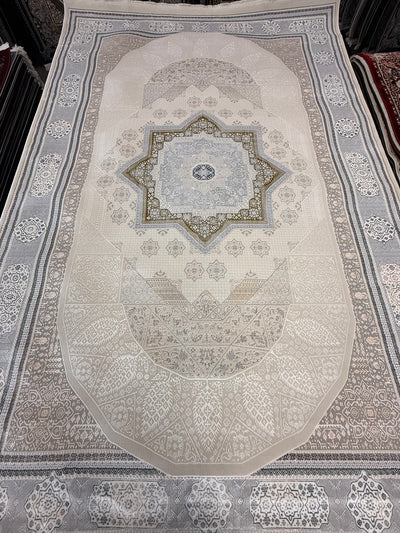
Light, tonal palettes expand small spaces; dark, high-contrast palettes contract them. The visual logic: the eye reads light surfaces as receding and dark surfaces as advancing, so a light rug pushes the floor visually away while a dark rug pulls it forward. For studios and small rooms aiming to feel larger, choose cream, ivory, soft beige, pale grey, or muted sage as the ground color, with subdued accents. Heavy contrast and saturated darks still work in small rooms intentionally designed as cozy and enveloping — but the design intent should be deliberate, not accidental. For the full palette framework see light vs. dark rugs and the size of the room.
Pattern in small rooms
Pattern density and pattern scale both affect how a rug reads in a small space. Dense, busy patterns crowd small rooms visually; sparse, open patterns or tonal allover designs expand them. Pattern scale matters too — a very small-scale repeat in a small room can look fussy, while a medium-to-large scale motif (one or two central elements rather than dozens of small ones) often reads more architecturally coherent. The decision between patterned and solid in small spaces is genuinely a design choice; see patterned vs. solid rugs for the full framework.
Layering in small spaces
Layering — a larger neutral rug with a smaller patterned accent on top — can work in apartments where you want pattern but the space can't support a fully patterned rug. The protocol: the bottom rug should be a quiet, neutral, low-pile or flat-weave (jute, sisal, cream wool, pale flat-weave); the top rug should be smaller (typically 2/3 the dimensions of the bottom), pattern-forward, and positioned to anchor the seating group. The combination reads as one composition rather than two separate rugs and works in small spaces where two equally-sized rugs would compete. See layering rugs — when to do it for the full layering protocol.
Pile height in tight quarters
Visual weight matters in small spaces. A thick high-pile rug (think shaggy Berbers or deep handknotted wool over 1 inch tall) reads heavier and more space-consuming than a low-pile or flat-weave. For studios and small living rooms, low-to-medium pile (1/4 to 1/2 inch) hand-knotted or hand-tufted wool, or flat-weaves like kilims and dhurries, often work better than the densest high-pile constructions. The exception is bedroom comfort zones (under or alongside the bed), where higher pile underfoot remains worth the visual weight. See high pile vs. low pile by room.
Furniture-rug interaction in small rooms
The relationship between rug and furniture is tighter in small rooms because there's less margin for error. Two principles: the rug should be large enough that the front legs of all major seating sit on it (this anchors the seating group as a unit); and the rug should not be so large that it forces furniture flush against the walls (a small amount of breathing room between the back of the sofa and the wall reads more designed than wall-to-wall furniture). For sofa-color pairing in small spaces see how to pair a rug with a sofa (Cluster 6 pillar).
From our Sacramento showroom
Small-space sizing is a significant share of consultations from customers in midtown Sacramento condos, downtown lofts, R Street apartments, and Folsom and Roseville townhomes with smaller-than-suburban living rooms. The standard recommendation: bring measurements of the room and the sofa, and we'll identify the largest standard size that respects the 18-inch wall margin and front-legs-on rule. For renovated lofts and unusually-proportioned spaces, a runner, or two smaller rugs used to define separate zones, usually reads better than one rug fighting the architecture. We sell from stock only — we do not cut, resize or commission rugs.
Related guides
- Rug size guide (Cluster 9 pillar)
- Rug for the living room
- Rug for the bedroom
- Light vs. dark rugs and the size of the room
- Layering rugs — when to do it
- High pile vs. low pile by room
Frequently asked questions
What size rug for a studio apartment?
Choose the largest single rug that anchors the living/seating zone with the 18-inch wall margin respected — typically a 6×9 or 8×10. Avoid placing multiple small rugs in different functional areas; this fragments the space and makes it feel smaller. One generous rug under the sofa is the correct studio strategy.
Will a big rug make a small room look smaller?
No — the opposite. A single large rug that covers most of the floor with a consistent margin reads as one continuous floor plane and expands the room visually. Small rugs with lots of bare floor around them fragment the space and make it feel smaller. The counterintuitive rule: rug coverage expands small rooms.
Should I choose a light or dark rug for a small space?
Generally light, if your goal is to expand the room. Light grounds (cream, ivory, soft beige, pale grey) push the floor plane visually away; dark grounds pull it forward. Dark rugs still work in small rooms intentionally designed as cozy and enveloping, but the choice should be deliberate.
How do I orient a rug in a small rectangular room?
Align the rug's long dimension with the room's long dimension. This extends visual depth rather than fighting it. A long narrow room with the rug placed lengthwise reads as more spacious than the same room with the rug crosswise.
Can I layer rugs in a small space?
Yes, with discipline. Use one larger neutral or flat-weave bottom rug and one smaller pattern-forward top rug positioned to anchor the seating group. The top rug should be roughly 2/3 the dimensions of the bottom. This works better in small spaces than two equally-sized rugs which compete for visual attention.