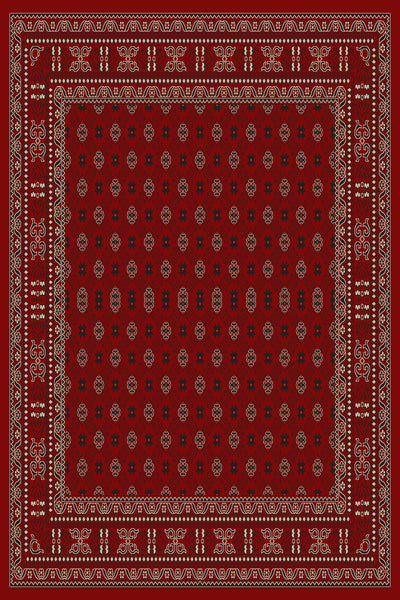
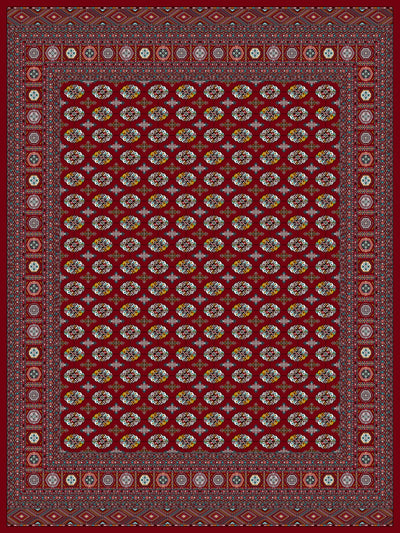
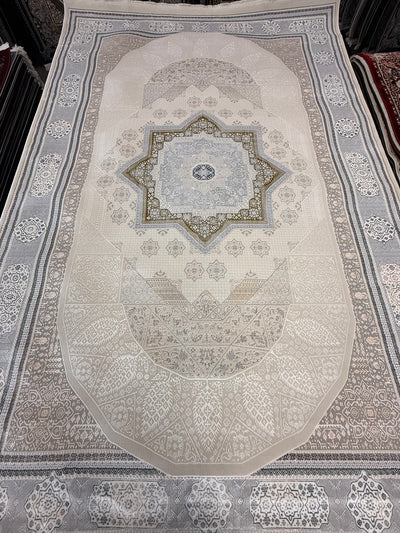
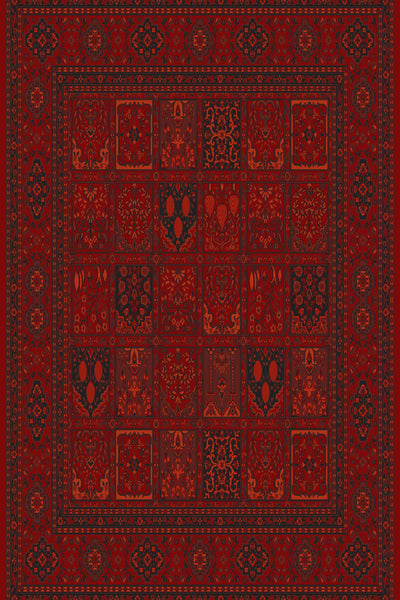
Open concept changed how rooms are built but didn't change the eye's need for zones. Without walls, the room reads as a single undifferentiated space; the floor is what tells the eye where one function ends and another begins. A rug per zone is not decorative — it is the architecture the missing walls used to provide. The discipline is making two or three rugs read as one coordinated composition rather than three competing rugs.
TL;DR
- Open-concept layouts almost always want multiple coordinated rugs, not one large rug spanning all zones
- Anchor the palette with the living zone rug first; the dining and kitchen zones coordinate to it
- Coordinate via shared palette family; differentiate via pattern, scale, or texture — never match exactly
- Leave 2-4 feet of bare floor between rugs to give each zone its own visual frame
- Dining zone usually wants flat-weave or low-pile for chair geometry and spill management; living zone can carry deeper pile
Why one giant rug usually fails open-concept
The instinct in a large open-concept space is to choose one enormous rug — a 12×15 or 14×18 — and use it to cover the entire living/dining/kitchen footprint. This rarely works for two reasons. First, the rug has to compromise across three functional zones with three different sets of requirements: thick pile is wrong under a dining table where chairs catch on the pile; flat-weave is wrong in a living zone where bare-foot comfort matters; pattern that anchors a dining table looks wrong as the background under a sofa. Second, one rug treats the open-concept as one room, which defeats the visual zoning the layout actually needs. The rooms are visually open; the floor needs to do the dividing work the walls don't.
The anchor-and-coordinate framework
The standard approach: choose the living zone rug first, because it carries the largest footprint and the most visible palette. The living rug establishes the palette family for the open-concept space — the dominant ground color (cream, sand, taupe, grey, charcoal), the accent palette (rust, sage, indigo, terracotta), and the overall warmth/coolness. Every other rug in the open-concept coordinates back to this palette. Coordination means shared colors and shared mood; it does not mean matching patterns or matching scales. Two rugs that match exactly look like one rug interrupted by furniture; two rugs that coordinate look like two rugs in conversation.
Differentiation strategies
How to make coordinated rugs look intentional rather than accidental. Different patterns, same palette — a medallion in the living zone, a tribal geometric in the dining zone, both in cream-and-rust palette. Different scales, same family — a large-scale floral in the living zone, a small-scale repeat in the dining zone, both in the same color family. Pattern + solid — patterned living rug, solid or tonal dining rug in a color drawn from the living rug's accents. Different textures, same color — a hand-knotted wool in the living zone, a flat-weave kilim in the dining zone, both in muted sage. The principle: vary one or two axes, hold the rest constant.
The 2-4 foot gap rule
Between zones, leave 2 to 4 feet of bare floor. This gap is the visible boundary between zones — it tells the eye that the dining area ends here and the living area begins there. Less than 2 feet, the rugs read as one interrupted surface; more than 4 feet, the zones feel disconnected. The gap should be consistent (don't have 2 feet on one side of the dining rug and 5 on the other) and ideally bare floor (not bridged by furniture). Coffee tables, ottomans, and consoles can sit within the gap if their footprint is small relative to the gap.
Material logic per zone
The same palette can express through different materials per zone. Living zone: hand-knotted wool, medium-to-deep pile, generous size, the rug you sink your feet into when you sit down. Dining zone: flat-weave (kilim, dhurrie), low-pile wool, or hand-loomed cotton — anything that lets chairs glide without catching and is easier to clean of food crumbs. Kitchen prep zone: indoor-outdoor synthetic, washable cotton, or a low-pile runner — high traffic, regular spills, fast cleanup priority. Entry/circulation: low-pile or flat-weave, often a runner aligned with the corridor. The material logic varies by zone; the palette unifies them.
Sizing per zone
Each zone follows its own standard sizing rules from the rug size guide. Living zone: front-legs-on minimum, typically 8×10 or 9×12. Dining zone: 24-30 inches past table edge on all sides, typically 8×10 or 9×12 depending on table size. Kitchen prep: runner or small accent (2'6×6', 3×5). Entry: runner aligned with corridor, 2'6×8' or similar. Add up the individual zone sizes (with the 2-4 foot gaps) to verify the open-concept space can support all three rugs visually without crowding.
Coordinating with the floor
Open-concept layouts usually have continuous flooring — engineered hardwood, large-format tile, or polished concrete — running unbroken through all zones. The continuous floor color affects every rug choice. On warm oak or walnut, the rugs need cool accents to avoid full-warm monotony; on grey-toned engineered floors, the rugs can be warm or cool but should anchor the room intentionally. See rugs on oak floors and rugs on grey floors for the floor-color framework.
Common open-concept mistakes
Four patterns we see and correct most often. One giant rug for the whole footprint — compromises every zone; the fix is splitting into two or three. Two identical rugs — reads as one rug interrupted, not two zones; the fix is coordinate-but-don't-match. No gap between zones — rugs touch or nearly touch and lose individual definition; the fix is the 2-4 foot bare-floor gap. Wrong material per zone — thick pile in the dining zone where chairs catch, or thin flat-weave in the living zone where comfort matters; the fix is matching material to function.
Open-concept and the kitchen island
Many open-concept layouts include a kitchen island that creates a third functional zone (kitchen prep with seating at the island). The island side facing the kitchen wants a low-pile runner or washable cotton runner aligned with the island length. The island side facing the living room is the visible side from the seating zone; choose a runner that coordinates with both the kitchen and living palettes. For the full kitchen runner sizing protocol see rug runner sizes — kitchen, hallway, entryway.
From our Sacramento showroom
Open-concept consultations are common from customers in newer Sacramento neighborhoods — Granite Bay, Folsom Ranch, Roseville's West Park and Fiddyment Farm, El Dorado Hills' new construction — where open-concept floor plans dominate, and from custom-renovated mid-century properties in East Sacramento, Sierra Oaks, Curtis Park, and Land Park where walls have been opened up. The standard protocol: bring a floor plan with furniture positions and zone dimensions; we identify two-to-three coordinated rugs that share palette but differentiate by pattern or texture. Visit our showroom with floor plans.
Related guides
- Rug size guide (Cluster 9 pillar)
- Rug for great rooms and open-concept
- Rug for the living room
- Rug for the dining room
- Layering rugs — when to do it
- Rug runner sizes
Frequently asked questions
Should I use one big rug or multiple rugs in an open-concept room?
Almost always multiple coordinated rugs, not one large rug. One rug across living, dining, and kitchen has to compromise across three sets of requirements and defeats the zoning the layout actually needs. Two or three coordinated rugs (shared palette, different patterns or scales) anchor each functional zone separately.
How do I coordinate multiple rugs without matching them?
Share the palette family and differentiate one or two axes. Different patterns in the same color family, different pattern scales, pattern-with-solid pairings, or different textures (hand-knotted wool with flat-weave kilim) in the same color all work. Avoid identical matching rugs — they read as one interrupted surface.
How much space should be between rugs in an open layout?
2 to 4 feet of bare floor between rugs. This gap is the visible boundary between zones — too small and the rugs read as one continuous surface; too large and the zones feel disconnected. Keep the gap consistent on all sides.
Can a dining rug and living rug be the same material?
They can, but often shouldn't. The dining zone benefits from flat-weave or low-pile (chairs glide cleanly, spills are easier to manage); the living zone benefits from deeper hand-knotted pile (more comfort underfoot). Same palette with different materials per zone reads more designed than matching material across zones.
What size rugs for an open-concept great room?
Each zone follows its own sizing rule. Living zone: 8×10 or 9×12 with front-legs-on. Dining zone: 24-30 inches past table on all sides, typically 8×10 or 9×12. Kitchen prep: runner or small accent. Add the zone sizes plus 2-4 foot gaps to verify the overall space supports the rugs visually.