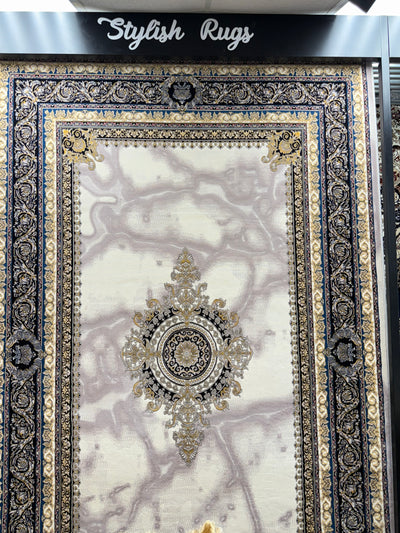
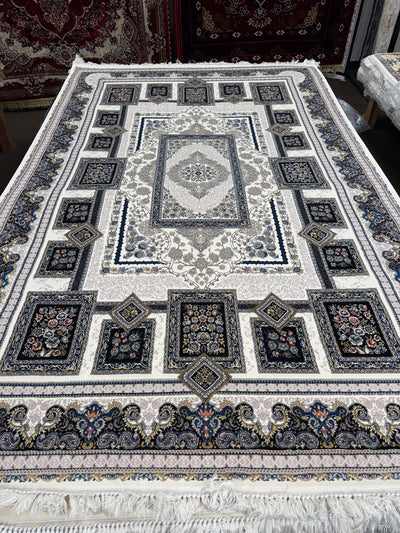
TL;DR.
- 'Antique' has a real definition: 100+ years old (80+ in some traditions). 'Vintage' typically means 20–50 years old. 'Semi-antique' covers the 50–100 year gap. 'New' or 'contemporary' hand-knotted means modern workshop production, usually under 20 years.
- The differences that actually matter: dyes (natural vs synthetic), wool source (hand-spun heritage vs commercial), design provenance (regional/tribal vs contemporary studio), and condition (decades of use vs new). Age alone is not value.
- Antique and semi-antique pieces carry patina — the soft color shift, surface luster, and design imperfection that comes from a century of light and use. Patina can't be manufactured. It's the single non-substitutable advantage of older pieces.
- New hand-knotted rugs offer design control, condition certainty, and access to colors and sizes that older pieces rarely match. Production-quality Persian (Tabriz, Kashan, 1200-reed lines) and new tribal weaving are honest pieces — not lesser than antique, just different.
- The honest decision rule: choose antique when you want unrepeatable beauty and have flexibility on size and palette; choose new when you need a specific size, color, or condition and want it to start aging from year one in your house.
What 'antique' actually means in the rug trade
The U.S. Customs Service defines antique as 100+ years old for tariff purposes, and most reputable dealers follow that line. Some European and Persian traditions use 80 years, which is a softer cutoff that's still legitimate. A rug woven in 1924 is unambiguously antique. A rug woven in 1955 is not, regardless of how worn it looks or what the seller calls it.
The reason the age line matters is what it correlates with: dye chemistry, weaving practice, and design lineage. Synthetic dyes for rugs became widespread in the early 20th century and dominant by the 1920s in commercial production, though many village and tribal weavers used natural dyes much later. A rug woven in 1900 is almost certainly natural-dyed. A rug woven in 1960 is mostly synthetic-dyed unless deliberately produced otherwise. The dye chemistry changes how the rug ages — natural dyes mellow and harmonize over decades; some early synthetic dyes can fade unevenly or shift hue.
Vintage and semi-antique — the in-between
The mid-20th century produced enormous quantities of hand-knotted Persian, Turkish, Caucasian, and Central Asian rugs. Many were exported, many remain in circulation, and they're the bulk of what most American homes own without realizing it. 'Vintage' typically means 20–50 years old in the trade — a 1980s Kerman or a 1990s Tabriz, woven by skilled hands in a region where weaving was still central, but with mostly synthetic dyes and design conventions adapted for export.
'Semi-antique' bridges the gap: 50–100 years old, often mixed natural and synthetic dye lots, village-scale production, and beginning to show meaningful patina. A 1940s village Heriz or a 1930s Hamadan piece is semi-antique territory — not yet centenarian, but visibly older than a modern production rug and starting to carry the soft glow that distinguishes older wool.
The vocabulary matters because pricing follows it. A vintage Persian sold honestly is a meaningful piece at meaningful pricing. A vintage Persian sold as antique is overpriced. Ask the date. A reputable dealer will tell you.
New hand-knotted — the case for production-quality wool
'New' hand-knotted rugs are the modern descendants of the same craft tradition. They are not machine-made. They are not synthetic. They are woven knot-by-knot, often in the same regions and sometimes by descendants of the same families that produced 19th-century antiques. The differences are real but they are not always disadvantages.
Design control. New production allows specific sizes, specific colors, and specific design conventions you can choose. A 9×12 in a particular palette is a few weeks of weaving; finding an antique 9×12 in that exact palette can take years.
Condition certainty. A new rug is in new condition. No foundation weakness, no thin spots, no historic repairs. It starts its life with you.
Dye stability. Modern dye chemistry, in workshops that take it seriously, produces colors that are reliably colorfast — they age, but they don't bleed or fail unpredictably. Some new lines use modern natural dyes; many use carefully controlled synthetic dyes that perform well.
Pricing. A new production-quality Persian in a midline construction (1200-reed Tabriz, modern Kashan, low-pile Heriz) is meaningfully less expensive per square foot than a comparable antique. The patina premium on antiques is real, but for many rooms it's not the deciding factor.
The case against new pieces, honestly stated: they have not aged. The soft color and surface luster that distinguishes a 100-year-old piece is genuinely not present at year one. The rug will get there — wool ages well, and a properly cared-for new rug at year 30 has its own patina — but you're buying it knowing the rug will improve under your ownership rather than arriving improved.
What changes with age — the patina story
Three things change visibly in a hand-knotted wool rug over decades, and these are what people are paying for when they buy antique:
- Color softens and harmonizes. Vegetable dyes — madder, indigo, walnut hull, pomegranate — mellow into each other under decades of light. The reds become rusts, the blues become slate, the ivories become honey. Adjacent colors that began as discrete dye lots become a single tonal field. This is the visual signal of a well-aged Persian: nothing is too saturated, everything reads as belonging to the same conversation.
- The wool develops surface luster. Decades of vacuuming, walking, and the natural redistribution of lanolin from the fiber base to the fiber tip produces a soft sheen on the pile surface. New wool is matte. Antique wool catches light like waxed leather.
- The design relaxes. Minor weaving irregularities — a slightly compressed border, an asymmetric medallion, a color shift mid-row — read as character in old pieces and as defects in new ones. The same human imperfection ages into authenticity. This is why machine-made copies of antique designs never feel right; they reproduce the design but not the time.
None of this can be faked. There are 'distressed' new rugs in the market that try to mimic patina through chemical washing, sun exposure, and selective shearing. Some are reasonable design objects at honest pricing. None of them are antique. The patina of time is the one thing the rug trade cannot fast-forward.
Honest decision tree
Buy antique or semi-antique when: you have flexibility on size and palette (antique rugs come in the sizes they come in), you want unrepeatable design and natural-dye patina, you're decorating a primary room where the rug is the foundation of the visual register, and you accept that older pieces sometimes have historic repairs or thin areas (which honest dealers disclose).
Buy new hand-knotted when: you need a specific size (large primary rooms, runners of particular length, custom dimensions), you want a specific color story to coordinate with existing furniture, you want certainty of condition, or you're building toward a decade-horizon piece that will become an antique in your family rather than starting that way.
Buy vintage (20–50 years) when: the look is right, the price is honest for the age, and you want something with some patina without paying full antique premium. Vintage Persian and Caucasian pieces are often the best value in the trade — underrated by collectors who chase pure antique status, but materially closer to antique than to new.
What to ask any dealer about age
An honest dealer will give you a specific decade or year range, the region of origin, and the basis for those claims (knot count, design conventions, dye analysis, wool source). 'Old' or 'vintage' without a date estimate is a red flag. 'Antique' without a decade is a red flag. Reputable pieces come with provenance — sometimes documented, often inferred from technical analysis — and reputable dealers explain how they arrived at the dating.
The corollary: don't trust round-number ages. 'About 100 years old' is sometimes accurate and is sometimes the boundary the seller picked to justify antique pricing. Ask for the specific decade. If the answer is vague, the age estimate may be vague.
Condition and repairs — honest framing
Most antique rugs have been used. Some have been repaired. This is not a defect — a well-executed historic repair is part of the piece's story and often invisible. The questions to ask are: where are the repairs, what kind (re-piling, re-fringing, foundation work), and how stable is the rug now. A 100-year-old rug with one corner repaired by a skilled hand 40 years ago is in honest condition. A rug with current weak spots that need work to be usable is a project, and the price should reflect that.
Production new rugs don't have this complexity — they're new. If they show wear in five years, the wear is a recent story that's easier to interpret. Both categories are legitimate. The buyer just needs different questions for each.
Sacramento showroom
Our showroom in Sacramento — serving East Sac, Land Park, Sierra Oaks, Granite Bay, El Dorado Hills, Folsom, and Roseville — carries both antique and new hand-knotted pieces, including semi-antique village weaving (Heriz, Hamadan, Kerman), antique tribal pieces (Caucasian, Turkmen, Baluch), and a curated selection of new production Persian (Tabriz 1200-reed, modern Kashan, low-pile Heriz). We talk honestly about age, condition, repairs, and which category is right for your room.
Shop the rugs in this guide
Related guides
- How to authenticate a hand-knotted Persian rug — knots, dyes, provenance
- Investment-grade rugs and resale value
- Reading a Persian rug by origin — Tabriz, Kashan, Isfahan, Heriz, Bidjar
- Rug care & maintenance — the longevity protocol
- Rug size guide
Frequently Asked Questions
How old does a rug have to be to be antique?
100 years in the U.S. trade (the Customs Service definition), 80 years in some European and Persian traditions. Anything younger is vintage (20–50 years), semi-antique (50–100 years), or new (under 20 years). A rug woven before approximately 1925 is unambiguously antique in 2026.
Are antique rugs better than new hand-knotted rugs?
Not necessarily — they're different. Antique pieces carry patina (soft color, surface luster, design relaxation) that can't be manufactured. New hand-knotted offers design control, condition certainty, and specific sizes/colors. Both are legitimate. The right choice depends on what you value most: unrepeatable beauty (antique) or specific requirements (new).
What's the difference between vintage and antique?
Vintage typically means 20–50 years old (a 1980s Kerman or 1990s Tabriz). Antique means 100+ years old. Semi-antique fills the 50–100 year gap. Many vintage rugs are honest, beautiful pieces at meaningful pricing; the term becomes a problem only when vintage is sold as antique.
Why are some antique rugs so expensive?
Three factors compound: rarity (a specific origin/size/design that can't be reproduced), patina (decades of natural dye mellowing and surface luster), and condition (uncommonly preserved pieces command premiums). Provenance matters too — documented attribution to a particular workshop or weaver adds value. Not all antique rugs are expensive; some are modestly priced. The premium is paid for specific combinations, not age alone.
Do hand-knotted Persian rugs hold their value?
Quality hand-knotted Persian rugs hold value well over decades — better than most furniture and most decor categories. Investment-grade pieces (fine antique, documented provenance, exceptional condition) can appreciate. Standard production new rugs typically don't appreciate but hold steady or decline modestly while serving the household for 30+ years. The full discussion is in our investment-value guide linked above.