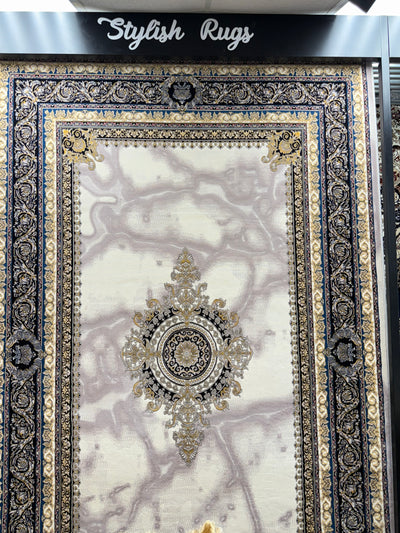
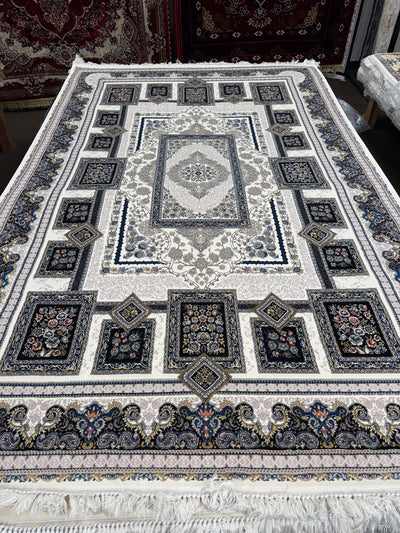
TL;DR.
- Persian rugs are not one tradition but a network of regional traditions — city workshops producing fine curvilinear floral design, village weaving producing balanced medium-fine pieces, and tribal weaving producing bold geometric work tied to specific peoples and places.
- Each region has identifiable signatures: knot type (Persian or Turkish), knot density (KPSI), design vocabulary (medallion, all-over, prayer, garden), palette range, foundation material (cotton or wool), and pile fiber characteristics. Trained eyes recognize origin in seconds; new eyes can learn the major regions in a few hours of structured looking.
- City workshops (Tabriz, Kashan, Isfahan, Qum, Nain) produced finest formal pieces — curvilinear floral medallions, palmette borders, silk highlights or silk foundations, 250–800+ KPSI in their finest grades.
- Village weaving regions (Heriz, Bidjar, Hamadan, Kerman, Sarouk, Tabriz village) produced the bulk of household-grade Persian export over the 19th–20th centuries — medium-fine, balanced design, durable, and the foundation of most American Persian-rug collections.
- Tribal weaving (Qashqai, Bakhtiari, Baluch, Turkmen) is geometric, regionally specific, and design-vocabulary-tied to specific peoples — a Baluch prayer rug is identifiable on sight; a Qashqai medallion has signature motifs distinct from a Bakhtiari panel design.
Why regional reading matters
'Persian rug' covers an enormous range — from a 60-KPSI village Heriz to a 1,000-KPSI silk Qum, from a tribal Baluch prayer to a formal Kashan medallion. Treating them as one category is like treating all French wine as one category. The structural differences (knot, foundation, fiber, palette, design) tell you what the piece is for, where it came from, and what it should look like to be honest.
Regional literacy also protects against misattribution. Reproductions of Persian designs woven in India, Pakistan, China, or Egypt are common and often honest pieces at honest prices when sold as what they are. They become problems only when sold as Persian. Reading the signatures lets you ask the right questions.
City workshops — the formal tradition
Tabriz (northwest Persia, near the Caucasus border). Long workshop tradition; the historic capital of the Persian rug export trade. Tabriz pieces range across an enormous quality spectrum. Fine Tabriz uses Turkish knot, cotton foundation, hand-spun wool pile, curvilinear medallion-and-corner designs with palmette borders, 200–400 KPSI. Master pieces from the late 19th century (Haji Jalili workshop attributions) approach 600+ KPSI. Modern Tabriz production includes excellent 1200-reed lines (the reed count refers to weaving density) widely available at honest pricing.
Kashan (central Persia). Historic weaving capital; one of the oldest workshop traditions in Persia. Persian knot, cotton foundation, very fine wool, often with silk highlights. Design vocabulary is formal floral — central medallion with delicate corner spandrels, dense floral fields, palmette borders. Antique Mohtashem Kashan pieces (named for the workshop) are among the most collected fine Persian rugs in existence. Modern Kashan continues the tradition at more accessible KPSI.
Isfahan (central Persia). Court-style tradition; some of the finest Persian rugs ever made come from Isfahan workshops. Persian knot, silk foundation in master pieces (cotton in standard production), very fine wool or silk pile, 400–1,000+ KPSI. Design vocabulary draws on Safavid-era court patterns — vase carpets, hunting designs, garden plans, formal medallions. Antique Isfahan pieces from named workshops command the highest prices in the Persian rug market.
Qum (Qom) (central Persia). Established in the 20th century specifically for fine workshop weaving — a relatively young tradition by Persian standards but producing exceptional pieces. Persian knot, often silk on silk foundation, 400–1,200+ KPSI. Design vocabulary borrows from historic Persian motifs (vase, medallion, garden) but with workshop creativity and signature designs.
Nain (central Persia). 20th-century workshop tradition known for fine wool-and-silk pieces in distinctive ivory-and-pale-blue palettes. Persian knot, cotton foundation, characteristic curvilinear floral designs with silk pile highlights against wool background. KPSI typically 200–500; finest pieces ("Nain 9-La") indicate yarn structure that allows higher density.
Village weaving — the household tradition
Heriz (northwest Persia, near Tabriz). The most family-correct hand-knotted Persian rug ever made. Turkish knot, cotton foundation, coarse to medium-fine wool, 60–150 KPSI. Iconic large-medallion-with-corner-spandrels design in rust, ivory, and indigo palettes. Heriz wool is exceptionally durable; well-made Heriz pieces from the 1880s–1930s are everywhere in American homes and still serving daily use. The closely related Karaja, Mehraban, and Goravan villages produce variations.
Bidjar (Kurdish region of western Persia). 'The iron rug of Persia.' Wool foundation in classic period, exceptionally densely packed wool pile, Turkish knot, 100–200 KPSI. Almost unbreakable underfoot — the densest weaving in any Persian village tradition. Design vocabulary draws on garden, herati (the all-over fish-in-pond motif), and medallion patterns. Antique Bidjar pieces are highly sought.
Hamadan (western Persia). The largest historic export volume in Persian weaving — hundreds of villages around the Hamadan trading center. Turkish knot, cotton foundation, single-weft technique, 60–150 KPSI. Design vocabulary varies by village but draws on medallion, herati, mina khani (small repeating floral), and pictorial motifs. Honest, durable, household-grade weaving — the workhorse of Persian export.
Kerman (southeast Persia). Long history of workshop and village weaving. Persian knot, cotton foundation, fine wool, often with elaborate floral or pictorial designs. Pale palettes are characteristic — cream, soft rose, ivory, with green and rust accents. American-market Kerman pieces of the 1920s–40s ('Kerman American' or 'Cyrus Kerman') were specifically designed for export to U.S. living rooms and remain widely collected.
Sarouk (central Persia). Closely related to Kashan tradition but with distinctive characteristics. Persian knot, cotton foundation, fine wool, 200–300 KPSI. Sarouk became famous in the 1920s for the 'American Sarouk' — a deep-red ground with all-over floral motifs woven specifically for the American export market and then artificially over-dyed in port to deepen the red further. Original undyed Sarouk pieces are increasingly rare.
Tribal weaving — the regional traditions
Qashqai (Fars province, southern Persia). Nomadic Turkic confederation; bold geometric design with strong palette — deep red, indigo, ivory, with characteristic medallion and animal motifs (birds, gazelles, sometimes humans). Turkish or Persian knot depending on subgroup, wool foundation, medium-fine. Distinctive 'Qashqai medallion' with hooked outline is signature.
Bakhtiari (central Zagros region). Tribal-village hybrid; iconic panel-or-garden design with rectangular field divisions filled with weeping willow, cypress, and floral motifs. Turkish knot, often wool foundation, 80–180 KPSI. Bakhtiari palette is rich — deep red, navy, mustard, ivory, sometimes a striking pale-blue ground. Highly collectible.
Baluch (eastern Persia, western Afghanistan). Nomadic and semi-nomadic tribal weaving. Persian or Turkish knot depending on group, all-wool foundation, smaller formats. Characteristic prayer rugs (mihrab pointing toward Mecca), dark palette — deep madder red, indigo, brown, ivory — with abrash from natural-dye batch variation. Baluch pieces are dense and dark; identifiable on sight once seen.
Turkmen (Central Asian tribal). The 'red rug' tradition — deep madder ground, ivory, dark brown, with all-over gul (medallion) repeats organized into rows. Each tribe has signature gul patterns: Tekke, Salor, Yomut, Saryk, Ersari. Turkmen pieces are dense, formal in their geometry, and structurally beautiful. The Tekke gul (small octagons with quartered interior) is the most widely recognized.
Kurdish (Kurdish regions, western Persia and northern Iraq). Strong geometric design, Turkish knot, often wool foundation, medium-fine. Kurdish pieces include some of the most striking abstract geometric designs in the Persian repertoire — hexagonal medallions, hooked motifs, bold color blocks. The Bidjar village tradition (above) is technically Kurdish; broader Kurdish village and tribal weaving extends throughout the region.
How to use this when looking at a rug
Examine in sequence:
- Knot type. Persian or Turkish. This rules out half of the possibilities.
- Foundation material. Cotton (most city and village production after 1800) or wool (most tribal, some early village, some specific city traditions like classic Bidjar).
- KPSI range. Coarse tribal (30–80), village (80–150), fine village or moderate city (150–250), fine city (250–500), masterpiece (500+).
- Design vocabulary. Curvilinear floral (city) vs. balanced geometric-floral (village) vs. bold geometric tribal. Specific motifs (herati, boteh, gul, mihrab) point toward specific regions.
- Palette. Rust-ivory-indigo points to Heriz; deep red on cream points to Kerman or American Sarouk; ivory with pale blue accents points to Nain; deep red ground with gul rows points to Turkmen; dark abrash with prayer arch points to Baluch.
With these five inputs, most Persian rugs can be regionally attributed within a few candidate origins. Specific dating and workshop attribution then require deeper expertise.
Common misattributions to watch for
- Indian or Pakistani reproduction sold as Persian. Hand-knotted, often well-made, but design-borrowed and woven outside Persia. Persian knot, cotton foundation, often slightly different wool character. The price is usually a tell — a 'Tabriz' priced at one-third of market is almost certainly not Tabriz.
- Chinese hand-knotted in Persian designs. Common from the late 20th century. Persian knot, often a distinctive thicker wool, color palette adjusted for export markets. Honest pieces; not Persian.
- Modern production sold with antique pricing. A new 1200-reed Tabriz is an honest piece at honest pricing; it is not an antique Tabriz, and shouldn't be priced as one.
- 'Persian' as a catch-all. Some sellers use 'Persian' to mean any oriental rug, including Turkish, Caucasian, Central Asian, or East Asian pieces. Persia is a specific weaving tradition with specific regional styles; other regions are equally honest but should be called what they are.
Sacramento showroom
Our showroom in Sacramento — serving East Sac, Land Park, Sierra Oaks, Granite Bay, El Dorado Hills, Folsom, and Roseville — carries pieces across the regional spectrum: city-workshop Tabriz and Kashan production, village Heriz and Hamadan in semi-antique and antique grades, tribal pieces (Qashqai, Bakhtiari, Baluch, Turkmen) when we can find them, and a curated selection of fine new production from established Persian workshops. We talk through regional attribution honestly on every piece, explain what the technical evidence supports, and never call something 'Persian' when it isn't. Bring questions; the showroom is a good place to develop regional eye in person.
Related guides
- Antique vs vintage vs new hand-knotted — honest definitions
- How to authenticate a hand-knotted Persian rug
- Investment-grade rugs and resale value
- Rug care & maintenance — the longevity protocol
FAQ
- What are the main types of Persian rugs?
- Three main categories: city workshop weaving (Tabriz, Kashan, Isfahan, Qum, Nain) producing fine curvilinear floral pieces; village weaving (Heriz, Bidjar, Hamadan, Kerman, Sarouk) producing balanced medium-fine household-grade pieces; and tribal weaving (Qashqai, Bakhtiari, Baluch, Turkmen, Kurdish) producing bold geometric work tied to specific peoples and regions. Each has identifiable signatures in knot type, density, design, and palette.
- What is the most valuable type of Persian rug?
- Workshop-attributed antique pieces from the city traditions — Mohtashem Kashan, Haji Jalili Tabriz, fine antique Isfahan court pieces, master Qum silks — command the highest prices, with masterpiece examples reaching six and occasionally seven figures at auction. The 'most valuable' is always a specific piece with specific provenance, not a category.
- What is a Heriz rug?
- A coarse-to-medium-fine hand-knotted village rug from the Heriz region of northwest Persia, near Tabriz. Turkish knot, cotton foundation, durable wool pile, 60–150 KPSI. Iconic large-medallion-with-corner-spandrels design in rust, ivory, and indigo palettes. One of the most family-correct Persian rugs ever made — widely used in American homes since the late 19th century and still serving today.
- How do I identify a Kashan rug?
- Kashan rugs use Persian knot on cotton foundation with fine wool pile (200–350 KPSI typical, finer in workshop pieces). The design vocabulary is formal floral — central medallion with delicate corner spandrels, dense floral or palmette fields, formal palmette borders. Palette tends toward rich red, ivory, and indigo. Antique Mohtashem Kashan pieces are workshop-attributed and command the highest prices in the tradition.
- Are Tabriz rugs better than Kashan?
- Neither is better; they're different traditions. Tabriz uses Turkish knot and tends toward slightly more geometric medallions and a wider design range. Kashan uses Persian knot with finer wool and tends toward formal curvilinear floral. The choice depends on what design language fits the room. Both traditions produce pieces across the full quality spectrum.