The most common dining-room rug failure in California homes isn’t the wrong color or the wrong style. It’s a rug that’s six inches too small in every direction, and the household has been catching chair legs on the edge for three years.
TL;DR
- The rug must extend 24 to 30 inches past every edge of the table — 30 inches is safer for taller diners and deeper chair seats
- Most rectangular tables that seat 6 to 8 need 9×12 minimum; our 10×13 is the ceiling and covers deeper chair-backs
- Round tables work best with square rugs (9×9 or 10×10); round-on-round is a design choice, not a sizing rule
- Flat-woven, low-pile hand-knotted, or 1200 Reeds machine-woven are the only practical dining materials — chairs need to slide and crumbs need to vacuum out
- Dining rooms tolerate stronger pattern than living rooms because the room is used briefly and the table covers most of the rug
The 24- to 30-inch rule (and why 30 is safer)
The single rule that governs every other dining-rug decision: the rug must extend far enough past each edge of the table that when a chair is fully pulled back for someone to sit down, all four legs of that chair remain on the rug. Twenty-four inches is the minimum that holds for shorter diners with standard chair-seat depth. Thirty inches is safer for taller diners, deeper-seated chairs, and homes that host frequently. Measure your chair-back at maximum pull-back distance from the table edge — that number plus a small safety margin is the rug overhang you need on each side.
Rectangular tables
A 60″ rectangular table seating 6 fits cleanly on a 9×12 rug with standard 24″ chair clearance on each side. A 72″ table seating 8 also fits 9×12 in most cases and is safer on our largest 10×13 if your chairs are deeper than standard. A 96″ table seating 10 needs more than 10×13 — that is beyond our range, and we will say so rather than sell you a rug the chairs will fall off. The check isn’t the table length — it’s the chair clearance at the head and side positions. If a chair pulled out at the head of the table would leave the rug, the rug is too short.
Round tables
Round tables present two design options: a square rug or a round rug. The square option works in more rooms because it provides more chair-clearance margin in the corners (where chairs at the four cardinal positions sit). A 48″ round table seating 4 works cleanly on a 9×9 square rug; a 54″ round seating 6 wants 9×9 or 10×10. The round-on-round option is a stronger aesthetic choice but provides less chair clearance — the rug must be at least three feet wider than the table’s diameter. Round rugs over hardwood are also more visually demanding; the rug shape must integrate with the room’s architectural geometry.
Oval tables
Oval tables follow rectangular-rug math with rectangular rugs (most common) or oval-rug math (rarer, harder to source, more design-led). A 72″ oval table seating 6 to 8 fits 9×12 cleanly. Oval rugs under oval tables read very polished but require a precise size match; for most rooms, a rectangular rug under an oval table is the more flexible choice.
Square tables
Square tables (most often seating 4) want square rugs — an 8×8 or 9×9 square works for a 48″ or 60″ square table. Rectangular rugs under square tables can work but visually pull the room asymmetric; the asymmetry can be a feature in long narrow dining rooms.
Material logic
Two practical constraints drive material choice in dining rooms: chairs need to slide easily when guests sit and stand, and crumbs need to vacuum out without trapping in deep pile. That points to flat-woven (kilim-style), low-pile hand-knotted, or 1200 Reeds machine-woven. Avoid high-pile shag, viscose, and silk in dining rooms — chair drag damages pile, food drops permanently into shag, and viscose stains on the first wine spill. Low-pile hand-knotted wool is the most durable design choice; 1200 Reeds machine-woven is the most accessible price point that holds up to ten years of dining use, and it is water-safe so a spill washes out rather than setting. The 1200 Reeds and other machine-woven Persian-design rugs throughout our catalog work cleanly here — and because they have a woven cotton backing, from about 3 m² up they stay put without a pad. We do not sell pads.
Pattern density in dining rooms
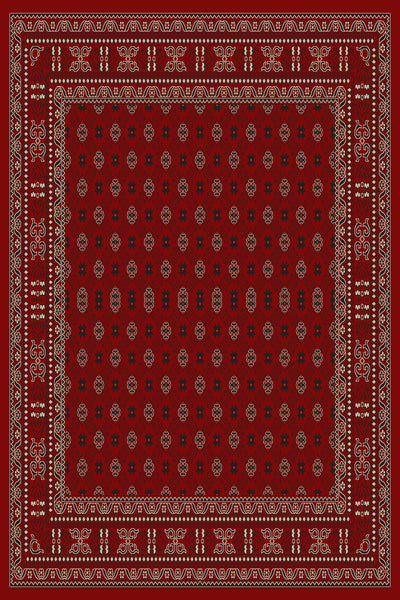
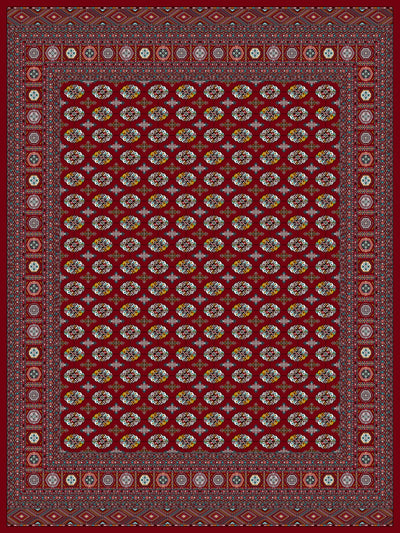
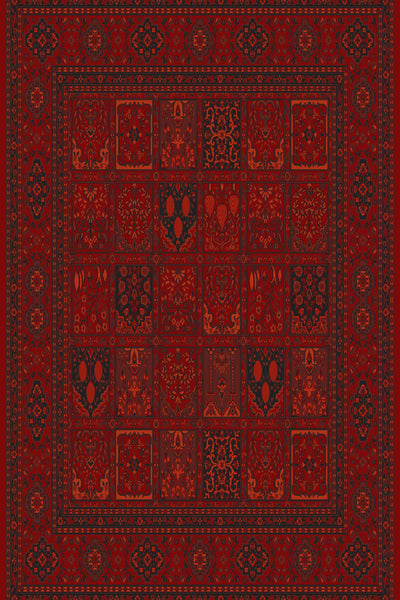
The dining-room rug spends most of its time covered by the table. That changes the pattern math — only the perimeter of the rug is visible during use, so a strong pattern around the borders is more impactful than a strong central medallion. Dining rooms also tolerate more dramatic palettes than living rooms because the room is used in shorter sessions and the table breaks up the rug’s visual weight. Saturated Persians in our burgundy oriental collection or deep navy palettes in the Blue Persian collection work cleanly in dining rooms where the same intensity would be heavy in a living room.
Palette in dining rooms
Dining-room palette logic follows two practical realities: the room is usually used in the evening under warm lighting, and a large wood table dominates the visual field. That means warm Persian palettes (rust, burgundy, ivory, gold) read at their best in dining rooms. Cool palettes (deep teal, navy, sage) also work in California homes with lighter wood tables and natural-light dining areas. The rare rule for dining rugs: a fully neutral cream-on-cream rug under a heavily-grained wood table can read flat — some pattern or palette presence holds the room better.
Floor + ceiling + lighting
Dining rooms with statement light fixtures benefit from rugs with central medallions that visually anchor underneath the chandelier; rooms without overhead lighting work better with allover patterns that distribute visual weight. Dark hardwood under dining tables wants a brighter-ground rug for value contrast; light oak or LVP wants a slightly darker rug to ground the room. See our light direction guide for the full daylight + artificial light interaction.
The mistakes we correct most often
Under-sized dining rugs (the chair-tip mistake) account for nearly every dining-rug consultation in our showroom. The fix is to upsize to the next standard dimension — almost never the recommendation a homeowner is hoping to hear, but the only fix that resolves the daily catching-of-chair-legs that prompted the consultation. The second most common mistake is a high-pile or viscose rug under a dining table; we recommend replacement with flat-woven or 1200 Reeds for any household that actually uses the dining room.
From our Sacramento showroom
The dining-rug conversation in our Sacramento showroom is unusually technical — we measure tables, photograph chair-back arcs, and confirm the household’s typical seating count. Clients from Folsom, El Dorado Hills, Granite Bay, Roseville, Lincoln, Land Park, Sierra Oaks, and Davis routinely come in with a rug that’s six inches too small in every direction and leave with the next size up — and if the table genuinely needs more than our 10×13 ceiling, we tell them that too. Visit our showroom with the table dimensions and a photo — we can size the rug correctly in a five-minute conversation.
Related guides
- Rug by room (Cluster 7 pillar)
- Great room and open-concept rugs
- Oversized rugs guide
- Rug fiber and construction guide
Frequently asked questions
What size rug for a dining table that seats 6?
A 9×12 rug is the standard for a rectangular table seating 6, assuming 24″ chair clearance on each side. If your chair-back depth is more than 22 inches or you prefer 30″ clearance for taller diners, upsize to our largest 10×13.
What size rug for a dining table that seats 8?
Our largest 10×13 for a rectangular 72″ table seating 8. A 9×12 can work if chairs are shallow-seated and diners are average height. For a 96″ table seating 10, the geometry wants more than we stock — we will tell you so.
Should I put a round rug under a round dining table?
It’s a design choice rather than a sizing rule. Square rugs under round tables provide more chair-clearance margin and are the more flexible choice. Round rugs under round tables read very polished but require a precise size match and integrate best with rooms that have other round or oval architectural elements.
What is the best material for a dining-room rug?
Flat-woven (kilim), low-pile hand-knotted wool, or 1200 Reeds machine-woven Persian. All three handle chair drag, vacuum out crumbs cleanly, and resist spills better than high-pile alternatives. Avoid viscose, silk, and shag in dining rooms.
Can I use a rectangular rug under an oval dining table?
Yes — rectangular rugs under oval tables are the most common pairing because they provide the most flexible chair clearance and integrate easily with rectangular dining rooms. Oval rugs under oval tables are a stronger design statement but require a precise size match.