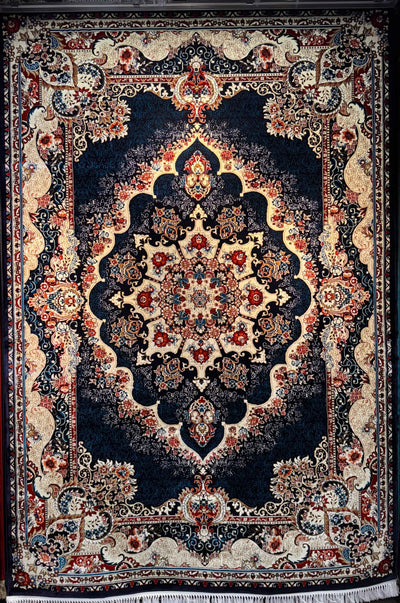
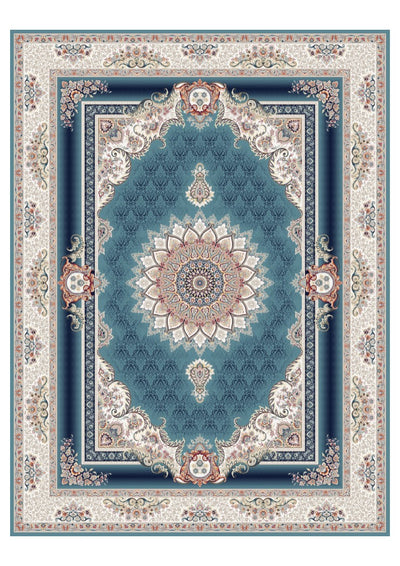
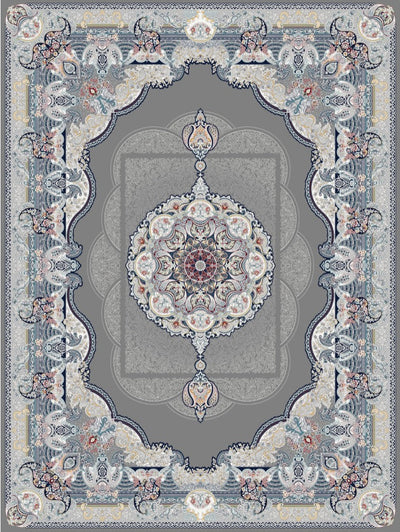
A rug is not a fixed color. It is a color plus the light hitting it — and that light changes every hour, every season, and every time you flip a switch. The same Persian-inspired pattern that read deep navy at noon can shift to bruised charcoal by dusk and back to soft slate under your living-room lamps. This is not a flaw in the rug. It is how human vision works, and once you understand it, you stop blaming the carpet for "not looking the way it did online."
Why the same rug looks like four different rugs
Color is light. Remove the light, the color disappears. Change the temperature of the light — measured in Kelvin — and the color shifts with it. A wool rug woven in deep burgundy will read true red under midday sun (~5500K), warm and amber under a 2700K incandescent bulb, and almost brown under a yellowed 2200K filament. That is not three different rugs. That is one rug, three light environments.
Two factors govern what you actually see: the direction the light enters the room (which windows, which time of day) and the color temperature of the light (cool daylight vs. warm artificial). Get both wrong and a $2,000 hand-knotted piece can look like a mistake. Get both right and the rug seems to glow.
North-facing rooms — cool, even, and quietly flattening
North-facing windows (in the northern hemisphere) never receive direct sun. The light they do receive is sky-scattered, blue-shifted, and unusually consistent from morning to evening. Designers love north light for studios because it doesn't change — but it also drains warmth out of every surface it touches.
In a north-facing room, cool palettes go colder. A gray rug can look almost lavender. A pale ivory can read greenish. A navy reads heavier and more inky than it actually is. The room needs warming from the rug, not cooling. Choose burgundies, rusts, terracotta, ochre golds, warm camels, and red-leaning beiges. Avoid pure white, ice blue, and silver-gray rugs unless you're deliberately leaning into the "cool gallery" effect.
South-facing rooms — warm, golden, and forgiving
South-facing rooms receive direct sun for most of the day. The light is warmer, more golden, and shifts dramatically from morning angle to high-noon flood to late-afternoon honey. South light saturates every color it touches. Reds become richer. Blues become deeper. Even neutrals look more dimensional.
This is the most forgiving orientation for color choice. Cool palettes that would die in a north room — silvery grays, ice blues, soft sage — come alive here because the warm light balances them. South-facing rooms can handle dramatic dark rugs (charcoal, midnight, oxblood) without feeling closed in, because the daylight keeps the room buoyant. The only caution: avoid placing high-pile or silk-blend rugs in direct south-window paths long-term — UV exposure will fade the dye over years.
East-facing rooms — bright morning, soft afternoon
East-facing rooms get warm, low-angle sun for two to four hours in the morning, then drop into ambient indirect light for the rest of the day. The rug will look gloriously warm at breakfast and noticeably cooler by 2 p.m. Plan for the afternoon condition, not the morning one — you spend more hours in the muted light than the golden hour.
East rooms favor mid-tone palettes: dusty rose, soft terracotta, warm taupe, antiqued gold, faded indigo. Anything too pale will look washed-out by afternoon. Anything too dark will lose dimension once direct light leaves the room.
West-facing rooms — long, intense, dramatic
West-facing rooms get the most punishing light in the house — late-afternoon sun, low-angled, raking across every surface for hours. It is warm to the point of orange and intensifies every color it crosses. West light is theatrical. It can make a rug look stunning at 5 p.m. and almost garish at 6:30 p.m.
For west rooms, choose palettes that can absorb that intensity: deep navy, oxblood, forest green, charcoal, espresso-grounded patterns. Avoid bright corals, hot pinks, and saturated oranges — west light will push them past elegant into loud. Wool absorbs west light beautifully; silk reflects it and can create harsh hotspots.
Warm-LED vs. cool-LED — the after-dark variable nobody plans for
A rug chosen perfectly for daylight can look entirely wrong at night because most homes are lit with the wrong color temperature. 2700K bulbs (warm white) push reds, ambers, and golds forward and mute blues and grays. 4000K bulbs (neutral / "cool white") hold color closer to daylight but make warm rooms feel clinical. 5000K+ (daylight bulbs) make a wool rug look photographically accurate but the room itself feels like a dentist's office.
For living rooms, bedrooms, and dining rooms with traditional or warm rugs, stay at 2700K–3000K. For modern, minimalist, or gray-palette rooms with cooler rugs, 3000K–3500K reads better. Mixing color temperatures in one room is the most common lighting mistake — and it will make your rug look two different colors at the same time.
Dark floors vs. light floors — the rug reads against the floor first
Your eye doesn't see the rug in isolation. It sees the rug against the floor. A medium-tone rug looks deeper on light oak and lighter on espresso walnut — same rug, opposite reading. This is why showroom rugs photographed against pale plywood can look dramatically darker once installed in a home with dark hardwood.
On dark floors (espresso, walnut, smoked oak), favor rugs with at least one pale or mid-tone element — ivory, sand, cream, dusty blue — to keep the floor from swallowing the rug. On pale floors (white oak, ash, limed pine), the rug can carry far more dark mass without the room feeling heavy — deep navy, charcoal, oxblood all work. For more on this interaction, our grey wood floor pairing guide and oak floor pairing guide walk through specific tone-on-tone vs. contrast strategies.
Ceiling height — why low ceilings need lighter rugs
A dark rug pulls the eye down. In a room with 8-foot ceilings, that downward pull can compress the space and make the room feel shorter than it is. In a room with 10- to 12-foot ceilings, that same dark rug grounds the space and gives it gravity. Same rug, opposite effect.
If your ceilings are 8 feet or lower: favor lighter rugs, busier patterns (which the eye reads as visually lighter than solid dark), and avoid heavy borders. If your ceilings are 9 feet or higher, you can handle dark, dense, deeply colored rugs without the room feeling closed in. For double-height great rooms, see our great-room layering guide.
Small rooms vs. large rooms — the perception game
In a small room (under 150 sq ft), a single large rug that nearly fills the floor will make the room feel larger, not smaller. Counterintuitive but consistent. The unbroken floor plane reads as more spacious than a small rug surrounded by exposed flooring, which visually chops the room into fragments.
In a large room (300+ sq ft), the rug needs to define a zone, not fill the floor. Leave 12–18 inches of exposed flooring on each side to give the rug a frame. A rug that runs wall-to-wall in a large room reads as carpet, not as a rug, and loses its presence entirely.
The 24-hour test before you buy
If you are deciding between two rugs, do not choose under a single light condition. Lay each option (or a fabric swatch in the same palette) on the actual floor at three points in the day: morning, midday, and evening with the lamps on. The right rug is the one that holds its character across all three. The wrong rug is the one that only looks good in one window of light — because you will see it in every other window for the next decade.
Where this fits in the broader system
- Start with the room-by-room pillar guide — choose the room, then return here for lighting.
- How to choose a rug color from your palette — the parent palette framework.
- Patterned vs. solid rugs — pattern interacts with light differently than solid color.
- Best rug colors for light wood floors — the floor-tone half of the equation.
Talk to a designer who's seen your light
Our Sacramento showroom faces a mix of north and west exposures, which means we've watched every rug in our collection behave under both cool morning light and intense afternoon sun.
FAQ
Why does my rug look different at home than it did in the store?
Almost certainly a light-direction or color-temperature mismatch. Showrooms use 3500K–4000K lighting designed to render color neutrally. Most homes use 2700K bulbs, which warm everything. The rug hasn't changed — the light has.
Will a dark rug make my small room feel smaller?
Not necessarily. A large dark rug that fills the floor will actually make the room feel more spacious than a small dark rug that leaves visible borders. The fragmentation is what shrinks rooms, not the color.
What's the best rug color for a north-facing living room?
Warm-leaning palettes: burgundy, terracotta, warm camel, ochre, antiqued gold, red-grounded Persian designs. Avoid pure grays, ice blues, and stark whites in north-facing spaces unless balanced by warm textiles elsewhere.
Does the floor color change which rug I should pick?
Significantly. Same rug reads as much as two tones darker on a pale oak floor and two tones lighter on espresso walnut. Always consider the rug-plus-floor combination, not the rug alone.
Should I match my bulb temperature to my rug?
Match it to the room's mood and to the dominant rug undertone. Warm rugs in traditional rooms: 2700K. Cool rugs in modern rooms: 3000K–3500K. Avoid mixing temperatures in a single room — it splits the rug into two readings simultaneously.