Oak is by far the most common hardwood floor we see in Sacramento homes — 1920s Land Park craftsmans, 1970s Carmichael ranches, 1990s Folsom builds, and brand-new El Dorado Hills and Roseville construction. The species and finish vary, but oak in three rough categories — red oak, white oak, walnut — covers most of what walks through the showroom door. Each one wants a different rug palette, and the mistake we see most is shoppers treating “oak” as one floor when it’s really three.
TL;DR
- Red oak (warm, mid-tone) → ivory grounds with rust, navy, or aubergine accents. Avoid warm-brown rugs.
- White oak (pale, cool-neutral) → almost any rug color works. Pattern weight becomes the dominant decision.
- Walnut (dark, saturated) → lean lighter (cream, soft sage, dusty rose) or pick a rug with strong field color and clear medallion structure.
- The most common mistake: a warm-brown or muddy rug on warm oak. Both colors are “right” in isolation; together they melt into a brown puddle and the rug disappears.
Why floor color drives the decision more than people realize
The floor is the largest single block of color in any room — usually bigger than the sofa, often bigger than every wall combined — and it is visible around the entire perimeter of the rug. Whatever undertone the floor carries, the rug sits inside that undertone. A rug that shares the floor’s undertone without contrasting against it will look correct in a photograph and wrong in the room. The eye reads the rug + floor as a single field, and the room loses the spatial definition the rug was supposed to deliver.
This is the principle that drives every recommendation below, and it is the first chapter of our working guide to rug color, palette, and light. The oak-specific rules in this article are the on-the-ground application of that one principle.
Red oak: warm, mid-tone, the trickiest oak to rug
Red oak is the warm, slightly pinkish hardwood you’ll find in most Sacramento homes built before about 2005, and in many remodels since. Under indoor light it reads orange-warm; under daylight it reads honey-warm. It is the trickiest oak to rug correctly because most “safe” rug colors share that same warm undertone, and the result is a brown-on-brown room.
What works:
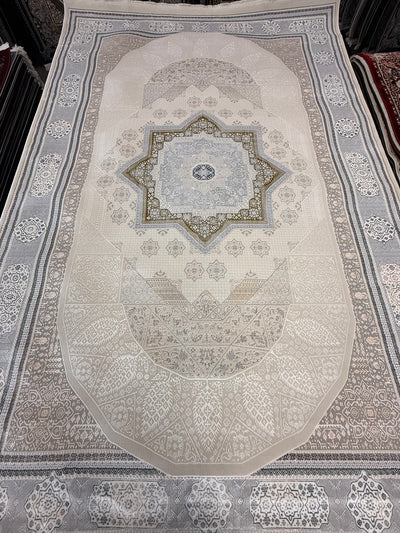
- Ivory or cream grounds with rust, navy, or aubergine medallions — the workhorse Persian triad. Lifts the room and provides contrast.
- Cool-leaning rugs — slate-and-ivory, navy-and-cream, muted teal-and-ochre — let the warm floor warm the rug for you.
- Significantly darker rugs — deep aubergine, charcoal-and-rust — that the floor cannot blend into.
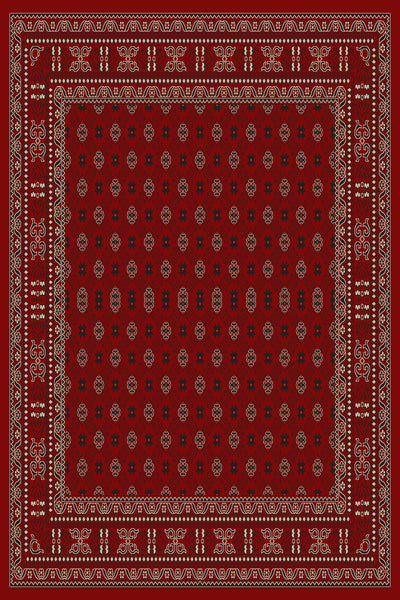
What fails: Warm-brown rugs (any tan/camel/walnut field), muddy multicolor rugs without a clear ground tone, and dark-but-warm rugs that share red oak’s exact undertone.
Most of our Sacramento clients with red oak end up in the Cream + Ivory Edit or the Kashan medallion family for this exact reason — cream ground with rust and navy accents resolves the oak undertone instead of fighting it.
White oak: pale, cool-neutral, the most forgiving oak
White oak became the default hardwood in California new construction sometime around 2015 and has stayed there. It reads pale, slightly cool, and visually quiet. It is by far the most forgiving floor to rug because almost any rug palette has enough contrast against it.
On white oak, color is almost never the decision — pattern weight is. A busy patterned rug and a busy room together will exhaust the eye; a quiet rug in a quiet room will read as flat. (See the second half of our patterned-vs-solid decision guide for the room-weight rule.)
Specific palettes that consistently work on white oak:
- Ivory + rust + navy Persian triad — the safest first rug, full stop.
- Navy + ivory + soft teal — coastal-modern, library-feeling. See the Blue Persian collection.
- Cream + soft rose + sage — for low-light rooms with cream-and-walnut interiors. Rare in the machine-woven range.
- Aubergine + cream + ochre — for darker, more dramatic rooms.
Walnut: dark, saturated, where light rugs almost always win
True walnut floors are rare in residential new construction but common in mid-century Sacramento homes, 1990s-2000s high-end builds, and walnut-stained engineered floors throughout. The floor is dark and visually heavy, and the rug needs to either lighten the room or commit to a strong field color that competes intentionally.
What works:
- Lighter rug grounds — cream, soft sage, dusty rose, pale grey-blue — that lift the floor instead of doubling its weight.
- Rugs with strong field color and a clear medallion — a deep teal-and-cream Kashan, a navy-ground Tabriz with ivory medallion. The medallion gives the eye an anchor against the dark floor.
- Antique and semi-antique pieces with abrash variation — walnut’s saturation handles complex color better than white oak does.
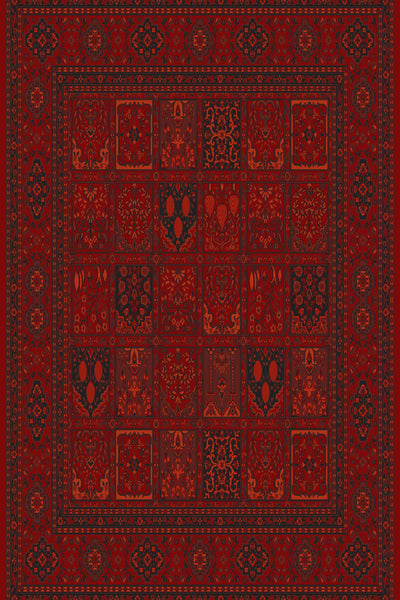
What fails: Muddy dark rugs (the rug and floor merge), under-pigmented or washed-out rugs (the floor visually swallows them), and oversaturated reds without a clear field structure.
Engineered oak, LVP-over-oak, and the in-between cases
Most California new construction since 2018 is engineered white oak in 7″ or wider planks, often with a UV-cured matte finish that reads slightly more cool than real white oak. Treat it as white oak for rug-color purposes; if anything it is even more forgiving.
Grey-stained oak (popular 2014–2019) reads as a grey floor more than as an oak floor — the rug should lean warm. See our companion piece, what rug color goes with grey floors.
LVP that mimics oak follows the same rules as the oak it imitates — warm-oak-LVP wants ivory and cool accents; pale-oak-LVP is forgiving.
From our Sacramento showroom
If you would like to test palettes against your actual oak in your actual light, our Watt Avenue showroom carries the full ivory-rust-navy range across machine-woven Persian-design 1.5M and 2M construction, plus a working selection of hand-knotted pieces and a thinner antique/vintage layer. See visit the showroom.
Frequently asked questions
What rug color goes with red oak floors?
Ivory or cream grounds with rust, navy, or aubergine accents work best on red oak. The warm Persian triad (ivory + rust + navy) is the most forgiving choice because it provides contrast against red oak’s warm undertone without fighting it. Avoid warm-brown, tan, or camel rugs — they share red oak’s undertone and visually merge into the floor.
What rug color goes with white oak floors?
Almost any rug color works on white oak because the floor is pale and cool-neutral enough to contrast with most palettes. On white oak, the more important decision is pattern weight — busy rugs in already-busy rooms exhaust the eye, and quiet rugs in already-quiet rooms can read as flat.
What rug color goes with walnut floors?
Lighter rug grounds — cream, soft sage, dusty rose, pale grey-blue — consistently lift walnut floors. Rugs with strong field color and a clear medallion (teal-and-cream Kashan, navy-ground Tabriz with ivory medallion) also work because the medallion anchors the eye against the dark floor. Avoid muddy dark rugs and washed-out neutrals on walnut.
Can I put a brown rug on oak floors?
Almost never on red oak (the rug disappears into the floor), rarely on warm engineered oak, occasionally on white oak if the rug brown is distinctly cooler or warmer than the floor brown. The contrast-with-floor rule is what governs — if you cannot tell the rug from the floor in a quick glance from across the room, the rug is too brown for the floor.
What is the safest rug color for any oak floor?
An ivory or cream ground with quiet pattern — the cream-ivory Persian field. It provides contrast against warm oak, looks correct on white oak, and lifts walnut. It is the closest thing to a one-rug-fits-all-oak answer that exists.