One of the most useful decisions a rug shopper can make is whether they need a patterned rug or a quiet one — and most shoppers make it backwards. They fall in love with a strongly patterned Kashan or Tabriz in the showroom (where the rug is one of the few decorated objects) and bring it home to a room that’s already carrying significant visual weight. The result is a room that feels busy and exhausting rather than composed. The fix is simple once you know the rule.
TL;DR
- Match the rug to the visual weight of the room, not the other way around.
- Busy room → quieter rug. A quiet rug holds a busy room together; a busy rug fights it.
- Quiet room → patterned rug. A patterned rug gives a quiet room a focal anchor; a solid rug leaves it flat.
- The mid-ground (low-contrast medallion, near-solid abrash) is where most shoppers actually want to live — it carries enough pattern to be interesting and enough quiet to be flexible.
- Sanity check: look at the wall directly across from where you sit. If it has more than three visual elements (art, sconce, shelf, window, drape), the room is busy — pick a quieter rug.
The room-weight rule, plainly stated
A room can hold a finite amount of visual weight before the eye gets tired. Walls, drapery, upholstery, art, shelving, mixed wood tones, exposed hardware, statement lighting — everything contributes. The rug is one of the largest single elements in the room, and it can either share that weight or relieve it. A strongly patterned rug in a strongly decorated room doubles the visual load. A quieter rug in the same room becomes the surface that holds everything else together.
The reverse is also true: a minimal room with clean upholstery and quiet walls needs something for the eye to land on, and the rug is the natural focal point. A flat-color rug or near-solid in a minimal room reads as a void. A patterned rug — a Kashan medallion, a Tabriz with strong herati field, an oval medallion piece — gives the room its anchor.
This is the principle behind the pattern-weight step in our working guide to rug color, palette, and light. Pattern and color are tangled; this article is the deep-dive on the pattern half.
When a patterned rug wins
Pattern wins in rooms where it is the visual main event. Concretely, this means:
- Quiet upholstery. Cream linen sofas, slate-grey wool sectionals, single-color leather chairs — furniture that brings color and shape but not pattern.
- Neutral walls without major art. Off-white or warm-white walls with one or two large-scale pieces (or no art at all) leave room for the rug to lead.
- Single-direction wood tones. A room with one consistent wood (all walnut, all oak) handles a patterned rug better than a room with three or four mixed woods.
- Formal living rooms, dining rooms, and entries. Spaces with defined edges and limited furniture density welcome a patterned focal piece.
- Vaulted ceilings and double-height rooms. The volume gives the eye somewhere to rest above the rug, so the rug can carry more pattern below.
The strongest patterned rugs — central Kashan medallions, Tabriz herati, oval medallion pieces — live their best lives in these rooms. See the Oval Medallion Edit for what a strong patterned anchor looks like across a curated set.
When a quieter rug wins
Quiet wins in rooms that already carry significant visual weight from other elements:
- Gallery walls, open shelving, or display cabinets. If the eye is already busy with objects, the rug should be the surface that calms.
- Patterned drapery, wallpaper, or major patterned upholstery. Two strong patterns in one room compete; the rug should defer.
- Mid-century rooms with multiple wood tones. Mixed warm walnut + light oak + teak rooms already carry tonal complexity; the rug should be tonally simple.
- Family rooms, playrooms, and great rooms with high object density. Toys, books, throws, sectionals — rooms where life happens visibly want a forgiving, quiet rug.
- Open-plan rooms where the rug is one of several zones visible at once. The rug needs to define the seating zone without competing with the kitchen, dining, or entry within sightline.
“Quiet” doesn’t mean solid — it usually means a single dominant ground color with a low-contrast medallion, a near-solid flat-weave with subtle abrash, or a pattern at very small scale (small Kheshti, small geometric). A truly solid rug in any of these rooms still risks reading as flat; what these rooms want is quiet pattern, not no pattern.
The middle ground (where most shoppers actually land)
The honest truth from years on the showroom floor is that most California rooms aren’t fully busy or fully minimal — they sit in the middle, and they want a rug in the middle. Specifically:
- Near-solid grounds with low-contrast medallion (cream-on-cream Kashan, ivory-on-ivory Tabriz).
- Quiet allover patterns (small herati, small boteh, small Heriz field) that read as texture from across the room and as pattern up close.
- Cream + ivory pieces with subtle abrash — quiet from a distance, alive on inspection.
- Single-color flat-weaves or kilims with quiet geometry.
This is where the Cream + Ivory Edit lives, and it is why we recommend it disproportionately to first-time rug buyers. It is the rug that is easiest to live with for ten years, easiest to redecorate around, and hardest to get wrong.
The sanity check that decides for you
If you cannot decide whether your room is busy or quiet, look at the wall directly across from where you usually sit. Count the visual elements: art, sconce, shelf, mirror, window with view, statement drape, exposed brick, ceiling beam, statement light. If you count more than three, the room is busy — pick a quieter rug. If you count one or two, the room is quiet — pick a patterned rug. If you count zero, the room is genuinely minimal and wants a strong patterned anchor.
The same test works for any seat in the room. If the answer changes depending on where you sit (busy from the couch, quiet from the entry), default to the seat where you spend the most time.
The fiber-and-construction layer
Pattern legibility is also a function of fiber and construction. A 1200-reed machine-woven rug shows pattern more crisply than a coarser 500-reed; hand-knotted wool with natural abrash shows pattern with more softness than crisp machine-woven; hand-tufted rugs sit in between. (See our fiber and construction guide for the full picture.) If you want a strongly patterned rug but you also want it to read “quiet” from a distance, choosing a hand-knotted piece with abrash will do more for you than choosing a less-patterned machine-woven.
From our Sacramento showroom
The Watt Avenue showroom carries both ends of the spectrum — from strongly patterned Kashan and Tabriz medallions through near-solid cream-and-ivory pieces and quiet allover Heriz fields. In the showroom we will stand a piece against upholstery and lay it out in an open bay rather than leave it flat on a stack, so you can judge it against real visual weight instead of in isolation — and because every unused rug can be returned within 30 days in its original condition, the final read happens in your own room. See visit the showroom. Related: rug color for oak floors and rug color for grey floors.
Patterned pieces from our collection
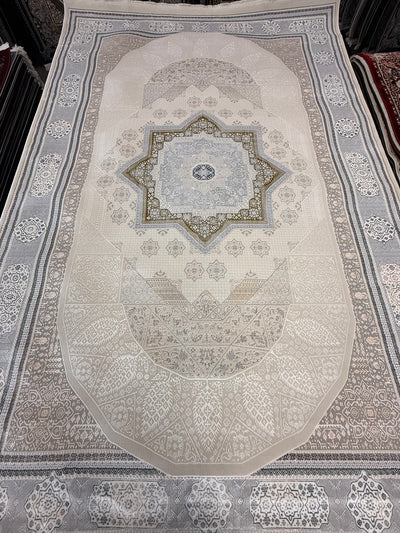
If your room is quiet enough to carry a patterned anchor, three medallion pieces from our 1200-reed line: the Steel Gray Medallion Persian Rug · 1200 Reeds, the Light Gray Floral Persian Rug · 1200 Reeds, and the Silver Panel Persian Rug · 1200 Reeds.
Frequently asked questions
Should I get a patterned rug or a solid rug?
Match the rug to the visual weight of the room. Busy rooms (gallery walls, open shelving, patterned drapery, mixed wood tones) want a quieter rug. Quiet rooms (minimal walls, clean upholstery, single wood tone) want a patterned rug as the focal anchor. When in doubt, lean quieter — quieter rugs are easier to live with for ten years.
Are patterned rugs out of style?
No. Strongly patterned Persian rugs — Kashan, Tabriz, oval medallion — remain the most enduring rug category in interior design and consistently outlast trend-driven solid rugs. The question is not whether patterned rugs are stylish; the question is whether your specific room has the visual quiet to carry one.
Will a solid rug make a room look bigger?
Marginally, but the more common effect of a fully solid rug is that the room loses a focal anchor and reads as undecorated. A quiet near-solid with subtle pattern (cream-on-cream medallion, abrash flat-weave) gives the same visual openness while still grounding the room.
Can I put a patterned rug in a small room?
Yes — pattern weight is independent of room size. A small minimal room can carry a strong patterned rug if it lacks other visual elements. A small busy room (gallery wall, open shelving) should still get a quieter rug, regardless of square footage.
What is the safest rug pattern for any room?
A near-solid cream or ivory ground with low-contrast medallion or quiet allover pattern. It reads as quiet from a distance, interesting up close, and pairs with virtually any sofa, floor, or wall color. It is the closest thing to a one-rug-fits-all-rooms answer that exists.