Of every room in a home, the bedroom is the room where the rug is touched the most and seen the least. That asymmetry — tactile primary, visual secondary — flips every rug rule we use elsewhere in the house. The right bedroom rug isn’t the one that photographs best; it’s the one that feels right under the first step of the day.
TL;DR
- One large rug (9×12, or our largest 10×13) under the lower two-thirds of the bed is the design-led default for primary bedrooms
- Pile depth and fiber matter more in bedrooms than anywhere else — this is the room where paying up for pile pays off most directly
- Soft Persian palettes (cream + dusty blue + soft rust, or ivory + pale teal + sage) read settled in private rooms
- Two runners on either side of the bed is the practical compromise for smaller bedrooms or homes with existing wall-to-wall carpet
- Avoid placing the rug fully under the bed — the rug shouldn’t disappear under the headboard, only ground the lower portion
Why bedroom rug priorities are inverted
Almost every public-room rug rule is about how the rug looks. The bedroom rug is different. The bedroom rug is rarely seen from the angle the showroom photograph captures — it’s mostly covered by the bed, partially obscured by the bed skirt or the bed frame, and viewed from one or two angles in the early morning. What the rug is asked to do, instead, is provide a specific tactile experience at one specific moment of the day. That changes the priority order. Pile depth and fiber move to the top of the list. Color decisions can lean softer and more emotional because the room is private. Geometry — the dominant variable in dining rooms — recedes to secondary.
Placement option 1: one large rug under the lower bed
The design-led default is one large rug placed perpendicular to the bed, extending under the lower two-thirds of the mattress and out past the foot of the bed by 24 to 36 inches, with 18 to 24 inches showing on each side of the bed. The rug doesn’t need to reach the headboard or under the nightstands — in fact, leaving the upper third uncovered is more elegant because the rug becomes a defined zone rather than wallpaper-under-everything. King beds want 9×12 minimum, our largest 10×13 if the room is generous. Queen beds work with 8×10 or 9×12 in the same configuration.
Placement option 2: two runners flanking the bed
Two matching runners on either side of the bed is the practical compromise when the room is too narrow for a large rug or when wall-to-wall carpet is already in place. Runners should be 2×6 or 2×8, placed parallel to the bed and starting at the nightstand foot. This option provides the tactile-feel-of-rug-on-bare-feet first sensation without committing to a full area rug. It reads more practical than the large-rug option and is most common in older Sacramento homes with smaller primary bedrooms.
Placement option 3: one runner at the foot of the bed
A single runner at the foot of the bed, perpendicular to the bed’s length, is the most minimal option. It works in modern bedrooms with strong architectural geometry where adding a large area rug would compete with the room’s clean lines. The runner provides a defined visual termination at the foot of the bed and a textile anchor for the bench-or-trunk that often sits there.
Fiber and pile matter more here than anywhere
For most bedrooms, the practical answer is one of our deeper-pile machine-woven Persian-design pieces — the 1200-reed and 2 Million Points constructions carry a dense, resilient pile, they are water-safe if a glass goes over, and they cost a fraction of the hand-knotted market. If what you want is the single best thing underfoot and the budget allows it, hand-knotted wool is the genuine tactile upgrade: the knot density produces a resilience no power loom reproduces. Those pieces live in our Sacramento showroom by appointment rather than online. Whichever you choose, the one thing to avoid in a bedroom is a thin, low-pile rug — the room’s whole job is the first step of the day.
Palette in bedrooms
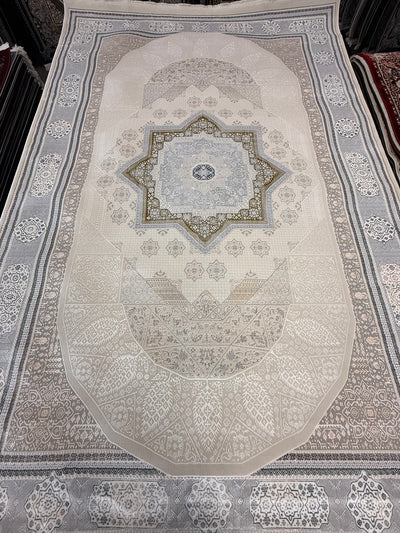
Bedrooms tolerate, and often benefit from, softer and more emotional palettes than public rooms. The combination of controlled lighting (you choose what bulbs go in the lamps), private use, and limited contrast against other furniture frees the rug to lean toward palettes that would feel either too quiet or too intimate in a living room. Cream + dusty blue + soft rust is one settled palette. Ivory + pale teal + sage is another. Soft burgundy + cream + gold reads classical-bedroom in master suites with traditional bones. The Cream + Ivory Edit opens this palette family; warmer Persians and saturated ground rugs can also work in larger primary bedrooms with strong architectural presence.
Pattern logic in private rooms
Pattern density should follow the rest of the bedroom’s visual complexity. Heavily upholstered headboards, complex bedding, layered curtains, and gallery walls argue for a quieter rug. Simple bedding and unornamented walls argue for more rug pattern. The default range is softer-medallion to near-solid abrash — busy allover patterns rarely read settled in bedrooms.
Bedroom rug + flooring
Most California bedrooms have hardwood, LVP, or wall-to-wall carpet. Each behaves differently. Hardwood and LVP bedrooms benefit most from a large area rug because the rug provides the only soft surface — and because ours have a woven cotton backing, from about 3 m² up they stay put without a pad (we do not sell pads). Wall-to-wall carpet bedrooms can use a smaller rug as a layered design element, where the rug becomes texture rather than tactile-essential; a rug-on-carpet grip pad helps there. See our grey floor pairing guide for new-construction bedrooms with LVP, and our oak floor pairing guide for hardwood bedrooms.
The mistakes we correct most often
The dominant bedroom-rug mistake is a too-small rug fully under the bed — the rug becomes wall-to-wall-under-furniture rather than a defined element of the room. The visible rug edge ends up showing only a small fringe around the bed, which reads as decorative wallpaper rather than as a rug. The fix is either to upsize so the rug clearly extends past the foot and sides, or to relocate the rug so it sits in the lower two-thirds position. The second-most-common mistake is choosing a thin, low-pile rug for a room whose entire purpose is how it feels underfoot.
From our Sacramento showroom
Bedroom rug conversations in our Sacramento showroom often start with the client asking about size and quickly turn to pile. The most useful demonstration we can give in person is to walk barefoot across three rugs of comparable size in different constructions and let the client’s feet make the decision. The hand-knotted wool usually wins on pure tactile preference; the question is whether the price-to-comfort ratio works for the household, and for plenty of people a deep-pile 2 Million Points piece is the honest answer. Visit the showroom and walk on the rugs yourself — it’s the only test that matters for a bedroom rug.
Related guides
Frequently asked questions
What size rug for a king bed?
9×12 minimum, and our largest 10×13 for generous primary bedrooms. The rug should sit under the lower two-thirds of the bed, with 18 to 24 inches of rug visible on each side and 24 to 36 inches past the foot of the bed.
What size rug for a queen bed?
8×10 works in most queen-bed rooms; 9×12 is the upsize for more generous floor coverage. The placement logic (lower two-thirds of the bed, with margin past the foot and sides) is the same as for a king.
Should the rug go fully under the bed or only partially?
Partially. The design-led default is to place the rug under the lower two-thirds of the bed, leaving the area under the headboard and nightstands uncovered. Fully covering creates a wallpaper-under-furniture effect; partial coverage defines the rug as a deliberate room element.
What rug should I choose for a bedroom?
Prioritise pile depth. A deeper-pile 1200-reed or 2 Million Points machine-woven Persian-design rug is the practical choice and is water-safe if something spills. Hand-knotted wool is the genuine tactile upgrade and lives in our Sacramento showroom by appointment. Avoid thin, low-pile rugs in a room whose purpose is how it feels underfoot.
Can I use two runners instead of one large bedroom rug?
Yes. Two matching runners on either side of the bed (2×6 or 2×8) is the practical compromise for narrow bedrooms or homes with wall-to-wall carpet. The tactile-feel-first-thing-in-the-morning experience is preserved without committing to a full area rug.