Office rug logic is shaped by a simple observation: every time the eye drops to the floor during a working day, it’s a small interruption. A quiet rug invites the eye to glance and move on. A loud rug invites the eye to stay. Choose the one that knows its place.
TL;DR
- Pattern density should be quieter than living-room rugs — the rug should read as texture, not as a focal element
- Low-pile hand-knotted, flat-woven, or 1200 Reeds machine-woven are the only chair-compatible constructions
- Size: the rug should clear the desk chair’s fully-reclined backward arc by at least 12 inches
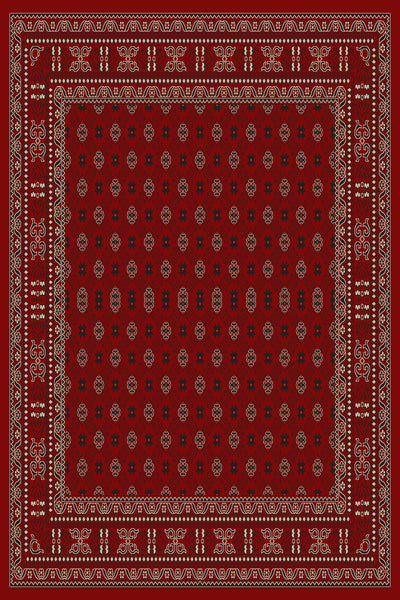
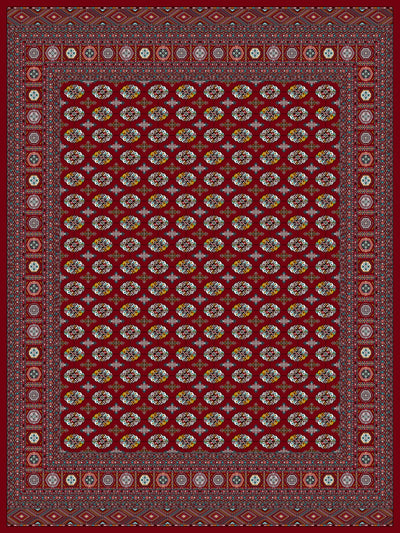
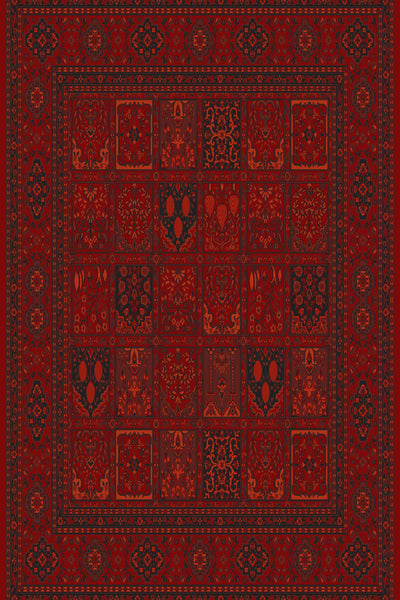
- Palette: restrained cream, ivory, soft navy, muted Persian palettes; avoid saturated reds and visually busy fields
- Avoid high-pile, viscose, and silk in offices — chair drag damages all three quickly
Why office rugs need to recede
The rest of the house asks rugs to anchor furniture, host conversation, define dining geometry, soften wake-ups. The office asks the rug to disappear. The reasoning is functional — the room exists for sustained concentration, and the human visual system pulls attention toward whichever surface in a room is highest-contrast or most patterned. If that surface is the rug, the rug becomes a low-grade visual distraction every working day. A quiet rug provides the floor warmth and acoustic damping that any room benefits from while staying below the threshold of active attention. That’s the design goal, and it’s opposite to the goal in every other room.
Sizing for desk chair geometry
The single sizing rule for office rugs is the chair-recline arc. Sit at your desk and recline as far as the chair allows. Measure from the desk to the chair’s farthest back point. Add at least 12 inches of margin. That distance is the minimum rug depth behind the desk. For most office layouts with a standard desk and chair, an 8×10 or 9×12 rug works — the desk sits along the front edge, the chair clears the back edge, and the rug provides the visual frame for the work zone. Smaller offices can use 5×8 or 6×9 with the chair fully on the rug at all positions. Avoid configurations where the chair leaves the rug edge during recline — the wheel catches the binding and the rug warps within months.
Material logic for chair compatibility
A desk chair with caster wheels needs a hard surface to glide. High-pile wool resists wheel rotation, builds up a circular wear pattern over time, and makes daily seat adjustments physically tiring. Low-pile hand-knotted wool, flat-woven kilim, or 1200 Reeds machine-woven Persian (low surface profile) are the three constructions that handle caster-wheel rotation cleanly. Viscose disintegrates under chair wheels within a year. Silk is too delicate. Shag is structurally incompatible with desk work. Hand-knotted wool with a deliberately low pile is the design-led choice; 1200 Reeds is the accessible price-point option with the same wheel compatibility.
Pattern density for focus rooms
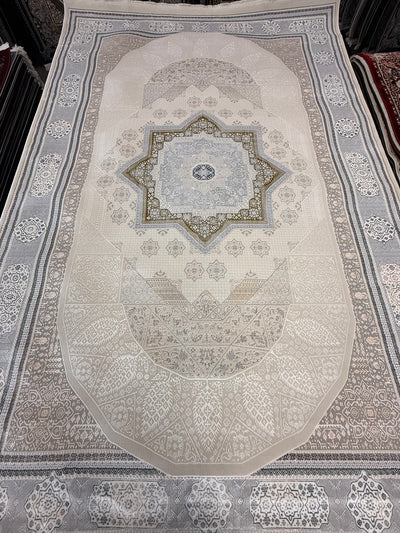
Office rugs sit in the ‘quiet’ end of the pattern-density spectrum. The reliable range is allover patterns with low internal contrast (the pattern reads as texture at a glance), near-solid abrash hand-knotted, or restrained traditional borders with quiet field. Strong central medallions, saturated reds, and high-contrast patterns are visually demanding and slowly fatigue the eye over a working day. The Cream + Ivory Edit opens the right register; the Blue Persian collection’s quieter palettes also work cleanly in studies and home offices.
Palette in offices and studies
Restraint is the rule. Cream and ivory grounds with soft navy or muted rust accents are reliable across most architectural styles. Deep navy ground with cream medallion reads classical-study and works well in panelled or library-coded rooms. Avoid red-dominant palettes (visually arousing, harder to concentrate near), high-saturation jewel tones, and busy multi-color allover fields. Greys read clean and modern but can drift toward clinical — if your office is grey-floored or grey-walled, push the rug toward warmer cream rather than another grey to avoid hospital-corridor associations.
Home office versus panelled study
The two office contexts differ in register. Home office — usually transitional or modern, light wood or LVP floors, mid-century or contemporary furniture; the rug should be quiet allover or near-solid abrash, cream or soft navy. Panelled study — usually traditional or English-country, dark wood floors, leather chair and wood desk; the rug can carry a more present traditional medallion (Kashan, Persian classical) in restrained palettes. The two contexts share the recede principle but execute it through different rug styles.
Floor + lighting interaction
Most home offices in California are either light oak/LVP (modern register) or darker wood (panelled-study register). Light floors take warm cream and ivory rugs cleanly — the rug provides slight warmth against the cool floor. Dark wood floors want lighter rugs to lift the seating zone, especially under task lighting that already creates strong contrast against the dark floor. Natural light direction matters less in offices than in other rooms because the desk is the focus and rug visibility is already secondary — see our light direction guide for the full daylight framework.
The mistakes we correct most often
Two common office-rug mistakes account for most of our consultation traffic. First: a high-pile or shag rug under a caster-wheel desk chair; the rug is already in irreversible wear within a year and the household replaces it. The fix is low-pile or flat-woven, ideally as the original choice. Second: a strong patterned rug (saturated medallion, vibrant Persian) under a desk in a home office that becomes a low-grade visual distraction during work hours; the fix is a quieter rug, often in the same palette family but with less internal pattern contrast.
From our Sacramento showroom
Office rug consultations have increased steadily as work-from-home patterns have settled into Sacramento, Folsom, El Dorado Hills, Roseville, and Davis homes. The conversation we have most often is about the trade-off between aesthetic ambition and daily focus: clients arrive wanting a strong patterned Persian under the desk and leave with a near-solid abrash hand-knotted that does the work without competing with it. Visit our showroom with the desk dimensions, chair specifications, and a photograph of the room — we can match a chair-compatible rug to the office’s palette in a focused consultation.
Related guides
Frequently asked questions
What rug works best under a desk chair?
Low-pile hand-knotted wool, flat-woven kilim, or 1200 Reeds machine-woven Persian. All three handle caster-wheel rotation cleanly. Avoid high-pile, viscose, silk, and shag rugs under desk chairs — chair drag damages all of them quickly.
What size rug for a home office?
8×10 or 9×12 for most standard home offices, with the desk along the front edge and the chair clearing the back edge with at least 12 inches of margin during recline. Smaller offices can use 5×8 or 6×9 with the chair fully on the rug at all positions.
Should an office rug have a strong pattern?
No. Office rugs should recede — quiet allover patterns, near-solid abrash, or restrained traditional borders work best. Strong central medallions and saturated patterns become low-grade visual distractions during work hours.
What palette is best for a home office rug?
Cream and ivory grounds with soft navy or muted rust accents are reliable across most architectural styles. Deep navy ground with cream medallion reads classical-study. Avoid red-dominant palettes (visually arousing) and high-contrast multi-color fields.
Can I use a rug under a chair mat?
Yes — layering a clear chair mat over a low-pile rug is the safest approach when you want both the rug’s warmth and the chair’s glide. The chair mat protects the rug from caster wear; the rug provides visual texture around the mat’s edges. The rug should still be low-pile so the mat sits flat.