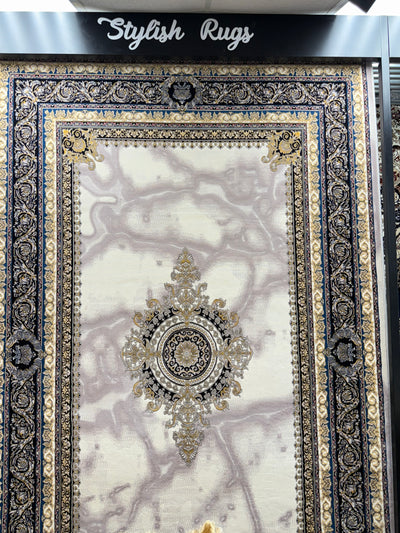
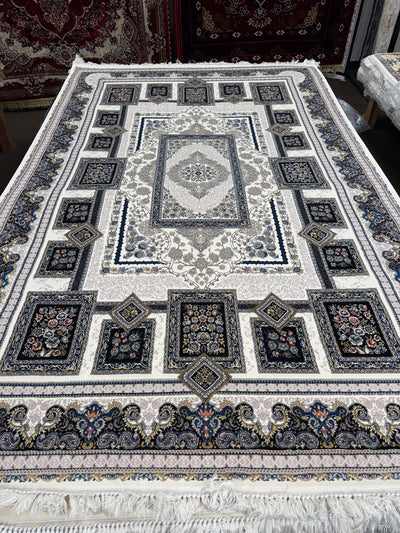
The entryway is the rug position where every romantic instinct about rugs goes wrong. Pale ground, soft pattern, hand-knotted heirloom — all of it gets ruined inside a year of suburban California life. The honest entryway rug looks slightly less photographable and lives ten times longer.
TL;DR
- Choose medium-to-dark grounds — visible dirt disappears into tonally varied Persian fields
- Material must be wool hand-knotted or 1200 Reeds machine-woven; both handle daily traffic and clean easily
- Runners must stop 6 to 12 inches before any door they cross — the door swing is non-negotiable
- Avoid high-pile, pale-ground, single-color, and viscose rugs in entryways without exception
- Two layers of defense: outdoor mat at the front door for grit, indoor entryway rug for finishing
Why entryway rugs need honest design
The entryway absorbs the daily traffic of an entire household plus visitors, deliveries, and occasional pets — concentrated into a few square feet of floor. The rug there isn’t a piece of decor; it’s a piece of equipment. Treating it like a piece of decor — pale, delicate, romantic, photogenic — means replacing it within a year. The successful entryway rug is one that hides the daily reality of a working entrance while still looking composed: medium tones, multi-color Persian field, durable wool. The discipline is honesty about what the rug is being asked to do.
Palette logic for high-traffic rooms
Dirt is the variable. Light dust deposits on light grounds and disappears on darker grounds. Mud, salt residue, food spills, and dropped objects all show worst on pale single-color rugs and best on multi-color Persian fields where the pattern itself does visual camouflage work. The optimal entryway palette is medium-tone (mid-navy, mid-rust, multi-color cream-and-rust-and-navy Persian) with active enough pattern that the eye reads the field, not the individual marks of daily wear. Saturated jewel-tone Persians in the Blue Persian collection work cleanly; warm-multi-tone Persians from the burgundy oriental collection work equally well in homes with darker wood floors.
Material logic for the highest-traffic position
Wool hand-knotted is the durability gold standard for entryways — a decade of foot traffic produces patina rather than visible wear. The trade-off is initial price. For an accessible price point at comparable traffic tolerance, 1200 Reeds machine-woven Persian is the only machine-made construction that genuinely handles entryway duty. Cotton 3M and 2M tier rugs can work in covered entries with light traffic; they shouldn’t be the primary mat at the front door. Viscose, silk, and high-pile shag should never be used in entryways — viscose stains permanently with any moisture, silk frays under shoe traction, and shag traps the dirt the rug is supposed to disguise.
Runner sizing for hallways
A hallway runner’s length depends on the corridor it sits in, but every runner follows three rules: it should stop 6 to 12 inches before any door it crosses (door swings catch and bunch the runner if they overlap); it should leave 4 to 8 inches of bare floor on each side of the runner (the runner shouldn’t wall-to-wall the corridor); and it should be straight, not centered between asymmetric walls (geometry should follow the corridor’s practical line). Standard runner widths are 2′3″ to 2′8″; standard lengths run 6′, 8′, 10′, 12′, 14′. For corridors longer than 14′, two runners with a small bare-floor gap between them often work better than one custom-length runner.
Entryway rug sizing
Entryway rugs come in three rough categories. Small foyer — 2′6″ to 4′ runner or 3×5 area rug, used as a focal mat between the front door and the next surface. Medium entryway — 5×7 or 6×9 area rug, sized to host shoes-off transitions or a small console table. Large entry hall — 8×10 or larger for traditional foyer geometries where the rug becomes an architectural element. Match the rug size to the entryway’s actual footprint; an oversized rug in a small foyer reads cramped, and an undersized rug in a large foyer disappears.
Two-layer defense (the practical approach)
The honest entryway system in most California homes is two layers. An outdoor mat at the front door — coir, rubber, or similar — catches the worst of the grit and moisture. An indoor entryway rug just inside the door does the finishing work and provides the visual welcome. Trying to do both jobs with one indoor rug is what kills good rugs — the rug absorbs grit it was never designed to handle. With an outdoor mat outside the threshold, the indoor rug becomes a design element with practical light-traffic duty rather than a piece of equipment fighting daily abuse.
Door swing and corridor geometry
Every door that opens into or across a hallway constrains the runner. Measure the door swing — the arc the door makes when opening fully — and the runner must not enter that arc. A door that swings inward into a corridor effectively shortens the usable runner length by the door’s width plus a safety margin. Closet doors, bathroom doors, bedroom doors all need the same clearance. Most California hallways have at least two and often four or five doors interrupting the runner geometry; the runner length math is rarely the simple corridor length minus a margin.
The mistakes we correct most often
Three mistakes account for nearly every entryway rug consultation. First: pale single-color rug at the front door, ruined within six months. The fix is multi-tone Persian medium-to-dark ground. Second: a high-pile rug at the door that traps everything that’s tracked in; the fix is low-pile or flat-woven wool. Third: a hallway runner that overlaps door swings; the fix is to upsize the bare-floor margin before any crossing door.
From our Sacramento showroom
Entryway and runner consultations are a steady share of our showroom traffic, especially from California homeowners with hardwood entry halls or LVP corridors in Folsom, El Dorado Hills, Roseville, Granite Bay, Lincoln, Rocklin, Land Park, Sierra Oaks, and East Sacramento. The most useful diagnostic is a photograph of the entry plus the corridor dimensions including all door positions. With those, we can size the runner and select the right palette for the household’s traffic level in a focused conversation. Visit our showroom with measurements and we can size correctly the first time.
Related guides
Frequently asked questions
What rug color is best for an entryway?
Medium-to-dark multi-tone Persian palettes. Dirt and daily wear disappear into tonally varied fields. Avoid pale single-color rugs in entryways — light dust and salt residue show first and disguise least.
What rug material handles entryway traffic best?
Wool hand-knotted is the durability gold standard. For an accessible price point with comparable traffic tolerance, 1200 Reeds machine-woven Persian is the only machine-made construction that handles entryway duty. Avoid viscose, silk, and high-pile shag.
How long should a hallway runner be?
It depends on the corridor length and door positions. The runner must stop 6 to 12 inches before any door it crosses, leave 4 to 8 inches of bare floor on each side, and follow the corridor’s practical line. For corridors over 14 feet, two runners with a small bare-floor gap often work better than one custom-length runner.
Should I use an outdoor mat in addition to an entryway rug?
Yes. The two-layer system is the honest approach — an outdoor mat catches grit and moisture before they enter the house; the indoor entryway rug does the finishing work and visual welcome. Trying to do both jobs with one indoor rug shortens that rug’s life dramatically.
Can a hallway runner cross multiple doors?
Yes, with planning. The runner must stop and resume around each door, with clear bare-floor margin at every door swing. In corridors with multiple doors, two or three shorter runners separated by bare-floor sections often work better than one long runner that fights every door.