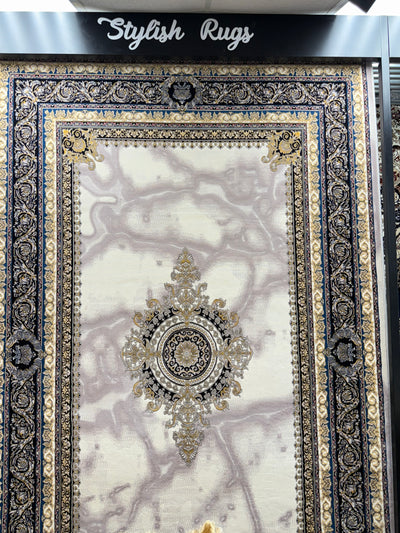
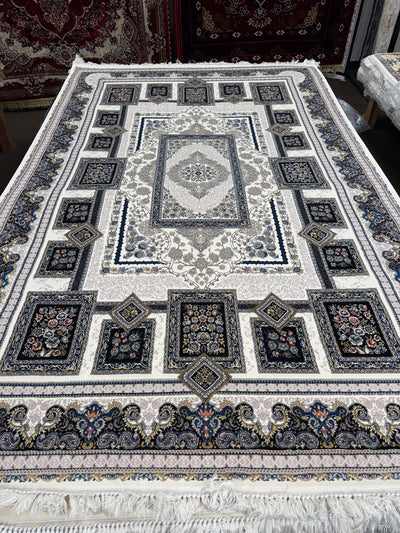
Mid-century modern as it's marketed today has narrowed the rug vocabulary. Scroll any MCM design board and the rugs are nearly all the same — Scandinavian flat-weaves with bold geometric abstracts, often in burnt orange and mustard. That's part of the picture, but it's not the whole picture. The actual mid-century homes that defined the era — Eichlers, Cliff May ranches, Joseph Eichler's tract developments, Sea Ranch — frequently had hand-knotted Persian rugs anchoring their conversation pits and walnut-paneled rooms. The MCM aesthetic absorbed Persian rugs comfortably. The honest guide includes both halves.
TL;DR
- MCM rugs work in two distinct vocabularies: era-correct flat-weave geometric AND warm-toned hand-knotted Persians
- The reliable MCM palettes: warm earth (rust, mustard, walnut, terracotta) or restrained jewel (teal, persimmon, gold)
- Pattern options: bold geometric abstracts (the "MCM look"), classic Persian medallions in warm palettes, or restrained allover designs
- Pile leans low-to-medium; high pile reads as too traditional or boho for MCM rooms
- Avoid synthetic "MCM" reproductions — the era valued material honesty; rug material honesty is part of the aesthetic
What mid-century modern actually means in rugs
The MCM design era spans roughly 1945-1970 in American architecture and interiors — characterized by clean architectural lines, walnut and teak furniture, integration of indoor and outdoor space, restrained ornament, and a deliberate move away from Victorian and Edwardian fussiness. Rugs in this era did one of two things. Rugs as architecture — bold geometric abstracts, often in saturated palettes, designed to be part of the visual composition; this is the look most associated with MCM today. Rugs as warmth — Persian and Oriental hand-knotted rugs in warm palettes (Heriz, Bidjar, Hamadan), used to soften the architectural rigor of the rooms; this was equally common in the era but is underrepresented in current MCM design references. Both are MCM-correct.
The two reliable palettes
MCM rugs work in two distinct palette families. Warm earth — rust, burnt orange, mustard yellow, walnut brown, terracotta, ochre; the warm side of MCM, paired with walnut and teak furniture. This palette suits Persian Heriz, Hamadan, and Bidjar designs as well as purpose-made MCM geometric rugs in warm tones. Restrained jewel — teal, persimmon, deep gold, charcoal, soft burgundy; the more saturated MCM palette, paired with darker walnut, leather, and brass furniture. This palette suits abstract geometric flat-weaves and certain Persian designs (deeper-toned Tabriz, some Kashan variants). Both palettes share the warmth — MCM didn't typically use cool pastels or icy minimalism; that's more Scandinavian/Japandi territory.
Persian rugs in MCM rooms
The case for Persian hand-knotted rugs in mid-century modern interiors is historical, aesthetic, and practical. Historically, Persian rugs were in the original MCM rooms — read any architecture book on Eichler homes, look at period photos of Cliff May ranches, examine documented Eames-era interiors and you'll find Heriz and Bidjar designs. Aesthetically, the warm-toned geometric Persian rugs (particularly Heriz with its bold medallion in rust-and-cream) share the visual grammar MCM rooms want: bold scale, warm palette, structural pattern. Practically, hand-knotted Persians outlast the era-correct flat-weave abstracts by decades and develop patina that suits the lived-in MCM ideal. A Heriz in a walnut-furnished living room with mid-century lighting is one of the most coherent rug-and-room combinations possible.
The flat-weave geometric option
The other half of the MCM rug vocabulary is the era-correct geometric flat-weave — abstract patterns, bold geometric blocks, often inspired by Bauhaus or Scandinavian textile design. These rugs read instantly as MCM and are the iconic look. The honest version: choose hand-loomed wool flat-weaves with real material quality, not mass-produced polypropylene reproductions. The Bauhaus and Scandinavian textile tradition that influenced MCM rugs valued material honesty above all; cheap synthetic reproductions of those designs miss the whole point. Hand-loomed wool flat-weaves in warm earth or restrained jewel palettes are the durable choice.
Pile height in MCM
MCM rooms want low-to-medium pile. Flat-weaves are the lowest-profile option and read most architectural. Low-pile hand-knotted Persian rugs (1/4 to 1/2 inch) work well — the rug provides comfort and warmth without competing visually with the room's architectural lines. High-pile rugs (over 1 inch) tend to read more traditional, more boho, or more contemporary luxe than authentic MCM. Shag rugs occupy a complicated MCM space — they were used in the era but read as kitsch-MCM rather than serious-MCM today; if you want shag, commit to it intentionally rather than accidentally. See high pile vs. low pile by room.
Pattern scale and density
MCM rugs use medium-to-large scale patterns. Small busy repeats read more traditional or coastal; large bold motifs read MCM. For Persian rugs in MCM rooms, designs with one strong central medallion or a clear allover geometric (rather than dense small repeats) work best — Heriz's bold central medallion is the canonical example. For abstract flat-weaves, the era's actual designs (Bauhaus-inspired, Scandinavian, early modernist) favored medium-large geometric blocks over small dense pattern. The general rule: the pattern should read as bold from across the room, not as texture.
What pairs with MCM rugs
MCM rugs work specifically well with the era's signature furniture vocabulary. Walnut and teak — the wood tones that defined the era; warm-toned rugs (rust, mustard, walnut) sit beautifully on warm wood floors and beneath warm wood furniture. Tan and cognac leather — Eames lounges, Wegner chairs, vintage leather sofas; warm-leather pairings call for warm-palette rugs (Persian Heriz is canonical here). Brass and bronze — period-correct metals; warm rugs amplify the warmth, cool rugs (the rare MCM cool palette) sit deliberately against. For specific sofa pairings see leather sofa rugs and tan and camel sofa rugs.
What to avoid
Three categories of "MCM rug" we recommend against. Synthetic mass-produced reproductions — polypropylene rugs printed with abstract MCM-style patterns; the look is approximated but the material honesty the era valued is gone. Hyper-trendy "atomic" patterns — boomerangs, starbursts, kitsch-1950s motifs; these read costume-MCM rather than design-MCM and date quickly. Cool minimalist Scandinavian rugs misidentified as MCM — pale grey, white, and icy tonal rugs are Scandinavian/Japandi, not MCM; the styles overlap historically but diverge in palette warmth. Use the right vocabulary for the actual style.
Persian rug names worth knowing for MCM
Five Persian designs pair particularly well with MCM rooms. Heriz — bold central medallion, geometric border, classic rust-and-cream palette; the most iconic Persian-in-MCM combination. Bidjar — denser construction than Heriz, similar warm-palette geometric vocabulary, exceptionally durable. Hamadan — village-weave Persian rugs with bold geometric motifs in warm earth palettes; less famous than Heriz but equally MCM-compatible. Tabriz (geometric variants) — the Tabriz tradition includes both ornate floral and geometric subvariants; the geometric Tabriz reads MCM cleanly. Karaja — small-format Persian geometric rugs that work as MCM accent pieces. See Persian rug types by region for the broader Persian framework.
From our Sacramento showroom
Mid-century modern is a defining aesthetic for several Sacramento neighborhoods. East Sacramento, Curtis Park, Land Park, Sierra Oaks, and Carmichael have substantial MCM home stock — original Eichlers in some pockets, mid-century ranches in many others. Our standard MCM consultation: identify whether the customer wants the era-correct flat-weave geometric look or the warm Persian-in-MCM look (or a combination), then propose specific Heriz, Bidjar, or hand-loomed flat-weave options that pair with the room's wood tones and furniture vocabulary. Visit our showroom with room photos.
Warm-palette pieces from our collection
For the warm-earth and jewel side of the MCM vocabulary, see the geometric Red Tribal Persian Rug · 1200 Reeds, the jewel-toned Teal Blue Medallion Persian Rug · 1200 Reeds, and the warm Navy & Gold Medallion Persian Rug · 1200 Reeds.
Related guides
- Designer rug styles (Cluster 10 pillar)
- Color and palette (Cluster 5 pillar)
- Sofa pairing (Cluster 6 pillar)
- Leather sofa rugs
- Rugs on oak floors
- High pile vs. low pile by room
Frequently asked questions
What rugs work in mid-century modern rooms?
Two distinct vocabularies. The era-correct geometric flat-weave (bold abstract patterns in warm earth or restrained jewel palettes) and the warm-toned hand-knotted Persian (Heriz, Bidjar, Hamadan). Both are historically accurate to the era and both work in modern MCM rooms.
Are Persian rugs OK for mid-century modern style?
Yes — Persian hand-knotted rugs were widely used in original MCM-era homes and pair beautifully with walnut, teak, leather, and brass furniture. The warm-palette geometric Persians (especially Heriz) are the most natural fit. The narrow "MCM means Scandinavian abstract" framing common online is incomplete; Persian rugs are equally MCM-correct.
What colors are best for MCM rugs?
Warm earth (rust, burnt orange, mustard yellow, walnut, terracotta, ochre) or restrained jewel (teal, persimmon, deep gold, charcoal). Both are warm-side palettes. Cool minimalist Scandinavian rug palettes (pale grey, white, icy tones) are more Scandi/Japandi than authentic MCM.
Should MCM rugs be flat-weave or hand-knotted?
Either works. Flat-weave geometric reads more iconic-MCM and architectural; hand-knotted Persian reads more warm-and-lived-in MCM. Many serious MCM rooms use one of each in different functional zones. The decision is aesthetic preference, not historical correctness — both were in original MCM homes.
What is the most iconic MCM rug pattern?
Bold geometric abstract — typically large-scale blocks, abstract shapes, or restrained Bauhaus-inspired patterns in warm or jewel palettes. The Persian Heriz medallion is the second-most-iconic, with its bold central medallion and geometric border in rust-and-cream. Both belong in the MCM canon.