Modern farmhouse has been one of the dominant American interior styles for over a decade. The trend version — shiplap accent walls, sliding barn doors, "live laugh love" signage — has peaked and is fading. The aesthetic version — soft palettes, comfortable materials, lived-in patina, mixed old-and-new furnishings — is much older and won't fade. The right modern farmhouse rug belongs to the aesthetic, not the trend. It looks like it could have been in a working farmhouse a century ago, or in a thoughtful modern home today, and neither would be wrong.
TL;DR
- Choose vintage-distressed Persians, hand-loomed wool, or low-pile hand-knotted rugs in muted neutral palettes
- The reliable palette: cream + ivory + charcoal, with optional muted accents (dusty sage, soft blue, warm grey)
- Avoid synthetic mass-produced "farmhouse" rugs marketed at the trend — they age poorly and read trendy within a few years
- Jute or natural-fiber rugs layered underneath a smaller patterned wool rug is a signature modern farmhouse texture move
- The aesthetic is muted, soft, slightly aged — not sharply contrasting or aggressively patterned
What modern farmhouse actually means in rugs
Modern farmhouse is a blended aesthetic — traditional farmhouse comfort (soft, lived-in, practical) combined with contemporary minimalism (less clutter, cleaner lines, restrained palette). Rugs in this style do two things at once: they add the warmth and texture that prevents minimalism from reading as cold, and they don't introduce visual noise that would compete with the room's deliberate quiet. The result is rugs that are present but not loud, patterned but not busy, neutral but not bland. Materials matter more than ornament here — a soft hand-knotted wool in cream-and-charcoal does more work than an aggressively-styled "farmhouse" rug.
The reliable palette
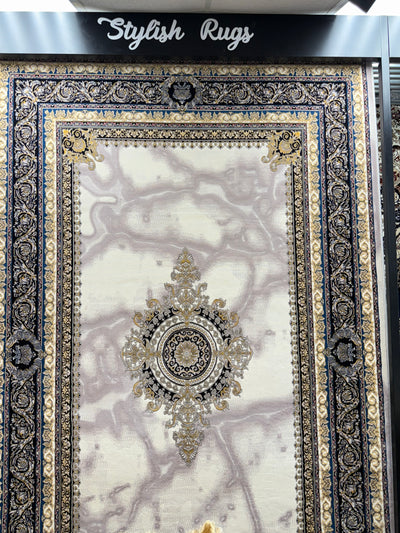
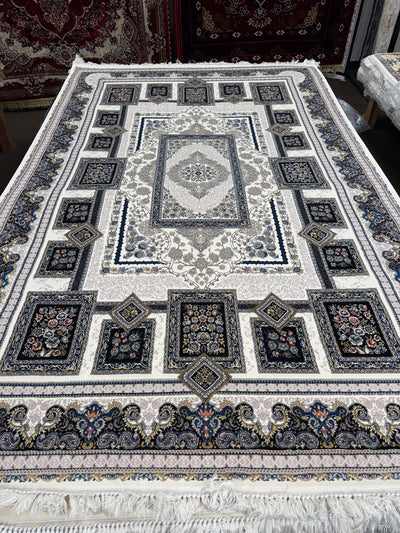
Modern farmhouse palettes center on three colors with optional accents. Cream and ivory as the dominant ground — never bright white (too cold and modern), never warm beige (too traditional); somewhere between, with a touch of warmth. Charcoal and soft black as the structural accent — used sparingly in pattern outlines, medallion centers, or border details. Dusty grey or warm putty as the secondary background — the neutral between cream and charcoal. Optional accents: muted sage green, dusty blue, soft terracotta, warm grey — never saturated, always muted by 30-50% from a "pure" version of the color. The palette should read as cream-and-charcoal with quiet accents, not as colorful.
Vintage and distressed Persians
The most authentic modern farmhouse rugs are usually genuine vintage Persians and Oriental rugs that have aged into faded, soft palettes through decades of light exposure and gentle wear. A vintage Tabriz from the 1960s with its dyes softened by sixty years of sunlight reads exactly modern farmhouse — warm-but-faded, patterned-but-quiet, classic-but-comfortable. The look is reproduced in newer distressed-finish Persians at lower price points, but the genuine vintage piece carries texture and tonal depth the reproductions can't quite match. See antique and vintage rug care for how to care for vintage pieces.
Hand-loomed and hand-tufted alternatives
For budgets that don't accommodate vintage hand-knotted, the next-best modern farmhouse options are hand-loomed and hand-tufted pieces. Hand-loomed wool dhurries and flat-weaves in muted palettes read as the casual lived-in farmhouse vocabulary without the cost. Hand-tufted wool pieces (machine-base, hand-finished) in faded medallion patterns read close to the vintage Persian look at meaningful price savings. The trade-off: these constructions don't carry the longevity of true hand-knotted Persians and tend to need replacement after 10-15 years rather than lasting a lifetime. The decision depends on budget priorities.
Jute and natural-fiber layering
One of the signature modern farmhouse moves is layering a smaller patterned wool rug on top of a larger natural-fiber base (jute, sisal, or wool sisal). The jute provides texture, warmth, and a neutral ground; the smaller patterned wool rug anchors the seating group and brings the focal palette. This layering specifically works in modern farmhouse because both elements share the muted-natural vocabulary and neither competes for attention. For the full layering protocol see layering rugs — when to do it.
What pattern works
Three pattern categories fit modern farmhouse cleanly. Faded medallion — classic central-medallion Persian designs in muted cream-and-charcoal, where the medallion is visible but soft rather than crisp. Allover muted — small-scale repeated motifs in single-family palette (cream-on-cream, dusty-grey-on-cream); reads as texture rather than pattern from a distance. Distressed abstract — gentle abstract or watercolor-style designs that read painterly rather than graphic. What doesn't work: high-contrast geometric, sharp medallion in saturated colors, aggressive florals, or anything aggressively "designed-looking."
Pile height and texture
Modern farmhouse rugs lean medium-to-high pile (1/2 inch to 1 inch) — the comfortable, lived-in tactile quality is part of the aesthetic. Very low pile or flat-weave reads more contemporary or coastal; very high pile (shag or thick Berber) reads more traditional or boho. The sweet spot is medium-thick hand-knotted or hand-tufted wool that has visible texture and pile but isn't shaggy. For the room-by-room pile framework see high pile vs. low pile by room.
What to avoid
Three categories of "modern farmhouse" rug we recommend against. Aggressively-branded trend rugs — large central typography ("home sweet home"), oversized geometric "farmhouse" patterns, or designs explicitly riding the trend cycle; these read dated within 3-5 years. Cheap synthetic reproductions — polypropylene rugs printed to look like distressed Persians; the look is approximated but the materials don't last and won't develop the patina the look requires. Over-styled vintage — rugs sold as "vintage" that have been chemically stripped, over-bleached, or aggressively distressed to manufacture a look they didn't earn; these tend to age unevenly and disappointingly.
Pairing with sofa and furniture
Modern farmhouse rugs work with most farmhouse-style furniture without specific calibration. The most common sofa colors in modern farmhouse rooms are cream, dove grey, soft charcoal, and warm beige — all of which sit comfortably on the muted neutral palette these rugs offer. For specific sofa pairings see grey sofa rugs and cream and beige sofa rugs within the Cluster 6 sofa pairing pillar.
From our Sacramento showroom
Modern farmhouse is one of the most-requested aesthetics from customers in Folsom Ranch, El Dorado Hills, Roseville's newer subdivisions, Granite Bay, and Rocklin. The standard consultation starts with photos of the room — particularly the existing palette of walls, sofa, and large textiles. We then propose two or three vintage-Persian or distressed-finish options that share the room's palette. Visit our showroom with room photos.
Related guides
- Designer rug styles (Cluster 10 pillar)
- Color and palette (Cluster 5 pillar)
- Sofa pairing (Cluster 6 pillar)
- Layering rugs — when to do it
- Antique and vintage rug care
- High pile vs. low pile by room
Frequently asked questions
What is a modern farmhouse rug?
A rug with muted neutral palette (cream, ivory, charcoal, dusty grey), soft pattern (faded medallion, muted allover, gentle abstract), and comfortable medium-pile texture. The honest version uses real materials — vintage Persians, hand-knotted wool, hand-loomed flat-weaves — not synthetic reproductions marketed at the trend.
Should modern farmhouse rugs be vintage or new?
Vintage is most authentic if budget allows — genuine vintage Persians have decades of natural softening that reproductions can't match. New hand-knotted wool in faded palettes is the next-best option. Avoid synthetic reproductions or aggressively-styled "farmhouse" branded rugs.
What colors should I look for in a modern farmhouse rug?
Cream and ivory as the dominant ground, charcoal or soft black as the structural accent, dusty grey or warm putty as the secondary background. Optional accents: muted sage, dusty blue, soft terracotta — all heavily muted, never saturated. The palette should read cream-and-charcoal with quiet accents.
Can I use a Persian rug in a modern farmhouse?
Yes — vintage Persians in muted palettes are among the most authentic modern farmhouse rug choices. The patina of natural aging, the comfortable medallion or allover patterns, and the soft palette of decades-aged dyes are exactly the modern farmhouse vocabulary. Hand-knotted Persian rugs work better than purpose-made "farmhouse" reproductions in most cases.
Is modern farmhouse style still trendy?
The trend version (shiplap, barn doors, signage) has peaked. The aesthetic version (muted palettes, lived-in textures, mixed old-and-new) is much older than the recent trend and won't fade. Choosing the aesthetic version with durable materials avoids the trend-cycle risk.