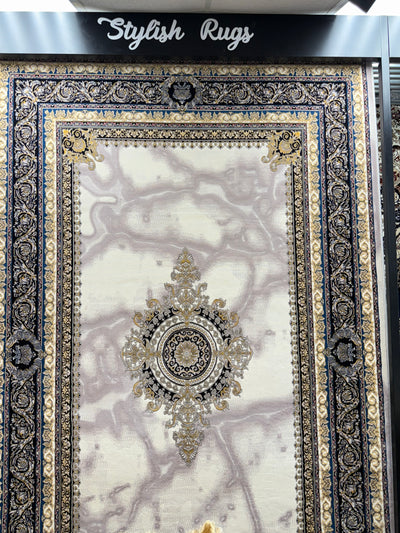
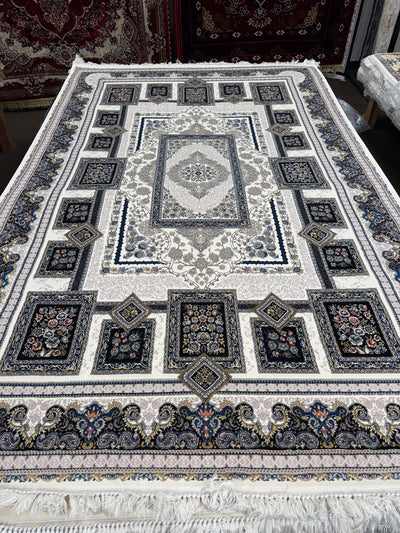
The short answer: A real Persian rug is a hand-knotted piece woven in the classical Persian weaving centres in one of the regional traditions — Tabriz, Kashan, Isfahan, Heriz, Nain, Qom. A “Persian-design” or “Persian-style” rug borrows the visual language but is machine-woven, hand-tufted, or woven outside those centres. Five honest tests separate them in seconds: knot heads visible from the back, fringe continuous with the foundation (not sewn on), abrash in the wool, vegetable-dye depth, and a recognizable regional pattern vocabulary. For more on this, see browse our curated Persian rug collection.
A field guide from our Sacramento showroom.
"Persian rug" is a country of origin, not a pattern. Persia is where the term belongs, and a real Persian rug is a hand-knotted piece woven inside that geography by weavers working in a regional tradition with deep roots. Anything else that uses the word "Persian" is borrowing the design language. Borrowing the language can be honest or dishonest depending on how the seller talks about it. The honest version is "Persian-design" or "Persian-style" — usually machine-woven, sometimes printed, sometimes hand-tufted in a country with no Persian weaving tradition. The dishonest version is the silence. The piece is sold as "Persian" with no qualifier, the buyer pays a price that implies provenance, and the rug is actually from a different country entirely. The good news: you can read the truth off the back of a rug in about five seconds, and after this article you will not need anyone to tell you what you are looking at.
The frame: what "Persian" actually means
Persia is the older name for the classical weaving lands. The Persian weaving tradition is roughly 2,500 years old and is concentrated in a set of cities and regions whose names function the way wine appellations do — Tabriz, Kashan, Isfahan, Heriz, Nain, Qom, Bijar, Kerman, Mashhad, Hamadan, Tabas, Sarouk, Mahal. Each city or district has a recognizable weaving signature: knot type, knot density range, palette tendency, foundation material, motif vocabulary. A "Tabriz" is structurally and visually different from an "Isfahan," which is different from a "Heriz." A buyer learning the Persian rug world is really learning these regional vocabularies. We talk through the broader construction landscape in our pillar fiber and construction guide; this article zooms in on the Persian-versus-Persian-design question specifically.
The reason this matters in 2026 is that the U.S. retail market has a tendency to use "Persian" loosely. A machine-woven rug with a Tabriz medallion pattern is a "Persian-design" rug, not a Persian rug. A hand-tufted piece made in a country with no Persian weaving tradition is a "Persian-style" rug, not a Persian rug. The pattern is borrowed; the provenance is not present. Either of those can be the right purchase for the right buyer at the right price — but you should know which one you are buying.
The five honest tests, in order of how fast they answer
You do not need a loupe and you do not need a certificate. You need to flip the rug. The back of a real Persian rug tells you everything in five seconds.
Test 1 — Look at the knots from the back
A hand-knotted rug shows its knots from the back. You can count the rows. You can see the knot heads as tiny lozenge or V-shaped marks, sometimes asymmetric (the Persian knot, also called the senneh), sometimes symmetric (the Turkish knot, also called the ghiordes). Persian weavers historically use the asymmetric knot, with regional exceptions; Turkish, Caucasian, and Kurdish-Persian weavers use the symmetric knot. Either is hand-knotted; only the asymmetric is canonically Persian. A machine-woven rug does not show this. It shows a uniform grid of mechanical loops, no individual knot heads, and the colors stop abruptly at color boundaries — there is no fiber-side blending because no weaver was making decisions one knot at a time. We cover construction at the category level here if you want the broader frame; for the Persian-specific question, the knot reading on the back is the first and most decisive test.
Knot density — knots per square inch, often abbreviated KPSI — varies by region. A Heriz might be in the 80-120 KPSI range with bold, geometric medallion work; a fine Kashan or Isfahan might be 300-500 KPSI; a master-grade Qom in silk can run 800-1,200 KPSI. Higher KPSI does not mean "better." It means a tighter weave, finer pattern resolution, and usually more hours of work. A coarse 100-KPSI Heriz is one of the most durable rugs in the world. A fine 600-KPSI Isfahan is a different category of object — slower to weave, finer pattern, often more delicate underfoot. The Persian weaving world spans both ends of this spectrum on purpose; the regional system exists precisely so the buyer knows which one they are looking at.
Test 2 — Check the fringe
The fringe on a real hand-knotted Persian rug is not decoration sewn onto the edge. The fringe is the foundation. The warp threads that run the length of the rug — the cotton, sometimes wool, sometimes silk — come out of the body of the rug at each end and form the fringe. Cut the fringe off a hand-knotted rug and you are cutting into the structure; the rug will start to unravel. By contrast, the fringe on a hand-tufted or machine-woven "Persian-design" rug is sewn or glued onto the edge as a finishing element. You can see the seam if you look — the body of the rug ends, and a fringe band is attached separately. This is the easiest test of all: lift the fringe, look where it meets the body, and you will see either continuous warp threads or an attached strip. Continuous warp = hand-knotted. Attached strip = not hand-knotted.
Test 3 — Read the wool
Hand-spun wool yarn has personality. The ply is slightly irregular, the thickness varies, and after the dye is applied the same color reads slightly different across the surface — sometimes a subtle horizontal band of lighter or darker tone runs across the field. This is abrash. In Persian weaving abrash is not a defect; it is a signature, the visible record of two batches of dyed yarn meeting in the middle of the rug. Many collectors prize it. Machine-spun yarn, by contrast, is perfectly uniform — same ply, same diameter, same dye saturation across every meter. A machine-woven "Persian-design" rug will look flat-uniform in color even on subtle background fields. A hand-knotted Persian wool rug will show small variation; a hand-knotted silk Persian rug will show a faint, almost luminous abrash in raking light. We keep a working selection of hand-knotted rugs in the showroom for exactly this kind of side-by-side learning.
Test 4 — Read the dye
Vegetable dyes — madder root for reds, indigo for blues, walnut hull and pomegranate skin for browns and yellows, weld and onion skin for golds — age into depth. After ten or twenty or fifty years a vegetable-dyed wool rug develops a luminous, slightly hazy palette where the colors look like they sit at slightly different depths in the pile. Aniline and synthetic chrome dyes, by contrast, look brighter when new but flatten as they age — they do not develop that depth, and after thirty years they often look slightly chalky or muted in the same way a faded color photograph looks. Persian weavers have used both, depending on region, century, and weaver — purists prefer vegetable, pragmatists used what was available. The dye reading is a probabilistic test, not a yes/no one. A vegetable-dyed appearance is a strong tell in favor of a serious hand-woven piece. A flat, uniform-modern aniline palette is a weak tell against, but not a disqualifier — many modern Persian rugs use careful chrome dyes that age well.
Test 5 — Read the regional vocabulary
This is the test that takes time to learn but pays back forever. Each Persian weaving region has a visual signature that, once you have seen ten or twenty examples, becomes instantly recognizable:
- Tabriz — the northwest highlands. Highly varied. Often a central medallion with elaborate corners and a precisely drawn floral field. Medium-to-fine knot density. Cotton foundation. Can be wool, wool-and-silk, or silk-on-silk in the finest grades. The most internationally recognized Persian city of weaving and the one whose patterns are most often copied by the machine-woven market.
- Kashan — the central plateau. Classical medallion-and-corner format with a deep ruby-red or ivory field, formal floral arabesques, and very even knotting. Medium-to-high knot density. The "diplomat's rug" — Kashans show up in formal living rooms and embassies for a reason.
- Isfahan — the central plateau. Fine knot density, silk-and-wool combination common, palettes lean toward ivory, soft blues, and gentle reds. The drawing is precise and the rugs are usually smaller-format (often 4×6 to 7×10) — these are rugs you study at close range.
- Heriz — the northwest highlands. Bold geometric medallions, terracotta-and-navy palettes, coarser 80-120 KPSI knot density, extremely durable wool. The Heriz is the working Persian rug — what people put in dining rooms, family living rooms, hallways. Decades-of-use durable.
- Nain — the central plateau. Light ivory or beige fields, soft blue and cream palette, very fine knotting often with silk highlights in floral motifs. Quiet and formal. Mid-twentieth century forward.
- Qom — the central plateau. The silk Persian specialty. Very fine knot density, often pure silk warp and weft and pile, jewel-tone palettes. These are the pieces collectors hang on walls as often as they put them on floors. The price ceiling is higher than every other Persian category.
Other named regions — Bijar (the "iron rug" — densest, heaviest, most durable Persian construction), Kerman (southeast, often with French-influenced floral fields), Mashhad (northeast, deep red palette), Hamadan (village-grade everyday weaving), Sarouk (rose-and-ivory American-market favorite) — each has its own visual fingerprint. A buyer does not need to know all of them. Knowing four or five anchors — Tabriz, Kashan, Isfahan, Heriz — covers the majority of what shows up in the U.S. market.
Where "Persian-design" honestly fits
Not every buyer wants or needs a hand-knotted Persian rug, and there is nothing wrong with that. A 9×12 hand-knotted Persian in even a working Heriz grade is a real-money decision; a fine Isfahan or Qom in the same size is a significant-money decision. The category of machine-woven "Persian-design" rugs exists for the buyer who wants the visual language of a Tabriz or Kashan medallion in a 8×10 or 9×12 size, in a polypropylene or wool-blend pile, at a price-bracket where the rug is replaceable. The most respected version of this category — the 2 Million Points construction — uses a very high stitch density on a power loom to reproduce fine-knot Persian medallions with a hand-look from a normal viewing distance. It does not pass the back-of-the-rug test, the fringe test, or the abrash test. It is not pretending to. It is sold honestly as machine-woven and priced accordingly. We carry it because it serves a category of buyer well: working family with kids and pets, first apartment, room that will be redone in five years, vacation rental.
What we do not carry, and what we would urge any buyer to avoid, is the middle category — a piece sold with the word "Persian" but no construction qualifier, at a price between the honest machine-woven bracket and the real hand-knotted bracket. That is almost always a mislabeled hand-tufted piece from a country with no Persian weaving tradition, or a machine-woven piece priced as if it were hand-knotted. The five tests above will catch all of them.
What to ask when you are buying
Five questions, asked of any seller, will quickly separate the serious dealers from the ambiguous ones:
- Is this hand-knotted, hand-tufted, or machine-woven? A serious seller answers in one word with no hedging. Ambiguity here is the warning.
- What country was it woven in? A classical Persian weaving centre is the only correct answer for a piece sold as a Persian rug. India, Pakistan, Turkey, Afghanistan, Nepal, China are all legitimate weaving countries — but a piece woven there is not a Persian rug. It may be a beautiful Indo-Persian or Pak-Persian or Sino-Persian piece, and a good seller will say so.
- What region or city? A serious Persian-rug seller can tell you Tabriz vs Kashan vs Heriz at sight and will say so. "Persian-design" or "Persian-style" with no region is a tell that the regional vocabulary is not present in the piece.
- What is the foundation and pile fiber? Cotton warp with wool pile is the most common Persian construction. Silk warp with silk pile is the Qom-tier exception. A polypropylene pile, even if perfectly nice, is a machine category.
- What is the rough age? New (under 20 years), semi-antique (20-80), antique (80+). Vintage is a marketing category, not a structural one. We cover the age question in the pillar fiber and construction guide in more detail.
The honest pricing landscape
Cross-checked across the U.S. market in mid-2026, here is the honest bracket logic for a 9×12 in good condition, no exotic provenance, no museum-grade history:
- Machine-woven Persian-design (2 Million Points, polypropylene) — $400 to $1,200. Replaces every 5-10 years depending on traffic. Honest category, honest price, no pretense.
- Hand-tufted Persian-style (cotton-backed, latex) — $800 to $2,500. We do not carry this category in any Persian framing because the lifespan is short relative to the price; if a buyer wants the look at this budget, the machine-woven version above is the more honest purchase.
- Hand-knotted Persian working-grade (Heriz, Mahal, Hamadan, village weavings) — $2,500 to $7,000. Wool pile, cotton foundation, 80-120 KPSI. 30-50 year lifespan with normal use. Repairable.
- Hand-knotted Persian fine-grade (Kashan, Isfahan, Tabriz medium-fine) — $6,000 to $20,000. 200-500 KPSI. Wool, often with silk highlights. 50-80 year lifespan. Holds value; can appreciate.
- Hand-knotted Persian silk (Qom, fine Isfahan silk, master Tabriz silk) — $15,000 to $80,000+ for new master pieces; antique examples reach six figures at auction. Appreciation curve.
The trap that catches most online buyers is the $1,500 to $4,000 zone where machine-woven, hand-tufted, and entry hand-knotted overlap visually but diverge structurally. If you are shopping that range, the five tests above are the difference between a decade of regret and a working rug that lasts.
What we do in the Sacramento showroom
Our public-facing online catalog is a curated, working slice of our inventory — the pieces priced for households actively redecorating, the working-grade hand-knotteds and the honest machine-woven Persian-design tier. The hand-knotted Afghan pieces live in the back of the showroom and travel out by appointment, because that conversation is a different conversation: provenance documentation, knot reading in raking light, a careful look at restoration history, a conversation about lifestyle fit. Come visit the showroom if you want to see four or five regions side by side and read the backs in person — it is the single fastest education in Persian rugs available.
If you are still in the sizing-and-placement stage of the buying decision and want to think through dimensions before construction, our sizing guide for living, dining, and bedroom is the right companion piece. Construction is the question of what you are buying; sizing is the question of how it sits in the room. Both matter; neither answers the other.
One last thing — provenance is a story, not a certificate
There is no certifying body that stamps "real Persian rug" on the back of a hand-knotted piece. There are export documents, weaver signatures (in fine pieces — often woven into the field as a Farsi cartouche near one end), and provenance stories carried by dealers. The five tests above are the real certification. A serious seller welcomes the questions and welcomes the back-of-the-rug inspection. A seller who deflects either is telling you something — and the five tests will fill in the rest.
— The Stylish Rugs Editorial Desk · Sacramento, CA · Last updated 2023-06-06