
The short answer: Hand-knotted, hand-tufted, and machine-woven are the three rug constructions that matter, and they are distinguishable in about five seconds: flip the rug. Hand-knotted shows individual knot heads on the back. Hand-tufted shows a fabric (canvas or scrim) backing glued onto the rug. Machine-woven shows a uniform, ruler-straight mechanical grid. Lifespan and value follow construction — hand-knotted lives 50–100 years and can appreciate; hand-tufted lives 10–15 years until its latex glue fails; machine-woven is replaced, not restored.
A field guide from our Sacramento showroom.
Worth stating before you read on: everything in our online catalog is the third category — machine-woven Persian-design, woven in Türkiye. Hand-knotted carpets are shown at the showroom by appointment and are not listed online, and we do not sell hand-tufted at all. The comparison below is here so you can judge any rug anywhere, including ours.
If you remember one distinction from any rug article you ever read, make it this one. Fiber, origin, age, dye, knot pattern — these all matter, but they matter inside the frame set by construction. A rug's construction determines what it costs to make, how long it will live in your home, whether it can be repaired, and whether the photograph you saw online is doing the work or hiding it. Three categories account for roughly everything sold under the word "rug": hand-knotted, hand-tufted, and machine-woven. Most retailers blur the line between the first two on purpose, because hand-tufted looks identical from above and costs a fraction to produce. This article exists so you can read the back of the rug in five seconds and know what you are looking at.
For the broader frame of how construction fits with fiber, origin, and age, read our fiber and construction guide. This piece zooms in on construction alone.
Hand-knotted — the original, and the only category that appreciates
A hand-knotted rug is built one knot at a time. A weaver sits at a vertical loom strung with the cotton or silk foundation threads (the warp), and ties an individual knot of pile yarn — wool, silk, or a blend — around two adjacent warp threads. After each row of knots is tied, a horizontal thread (the weft) is passed across, and the row is beaten down with a hand comb to lock the knots into the foundation. The pile is then trimmed flat with shears. A small 4×6 hand-knotted Persian rug at moderate knot density takes one weaver three to four months. A 9×12 at fine density takes a team of weavers six months to a year, sometimes longer. Counted at the knot, a 9×12 piece carries between roughly one million and four million individual knots; very fine Tabriz or Qum work pushes that into five or six million.
Craftsmanship signature: the pattern is structurally inseparable from the pile. Fold the rug in half and the design continues on the back, knot-for-knot. The knots are visible from behind as a tight grid of colored dots — you can see them with your fingertip.
Durability: a properly woven, properly maintained hand-knotted rug lives fifty to a hundred years on the floor, sometimes far more. The foundation is its bones; if the foundation holds, the rug can be reknotted in worn patches, edges re-bound, fringes re-sewn, indefinitely.
Texture and feel: dense, substantial, slightly springy. A 9×12 hand-knotted wool rug weighs between forty and seventy pounds depending on knot density and pile height. When you walk on one with bare feet you can feel the foundation underneath the pile — the rug has a structural floor of its own, not a fabric backing pressed against your hardwood.
Repairability: this is the under-discussed argument for hand-knotted. A worn corner can be rewoven by a master weaver — the new knots tied into the existing foundation, dyed to match the abrash of the surrounding field. Damaged edges can be re-overcast. Fringes can be re-sewn or replaced. Moth damage can be reknotted. A hand-knotted rug is a piece of furniture that is genuinely intended to be restored across generations, and the trade exists to do it. We do not do restoration ourselves — ask us and we will point you to a specialist.
Value trajectory: hand-knotted rugs are the only category in the market that consistently appreciates rather than depreciates, particularly for semi-antique and antique pieces from named regions (Tabriz, Kashan, Isfahan, Heriz, Bidjar, Qum). A new hand-knotted piece holds its value over decades; an antique one tends to gain.
Maintenance: vacuum weekly with a brush-off or low-suction setting, professional wash every three to five years depending on traffic, rotate one-hundred-eighty degrees yearly to even out light fade and traffic patterns, always use a pad. Spills are blotted, never rubbed; cleaning is done cold, not warm.
Where it belongs: living rooms, formal dining rooms, bedrooms — anywhere you want a piece that anchors the room for thirty years and reads as belonging to the home.
Hand-tufted — the affordable lookalike with a real ceiling
A hand-tufted rug is made with a handheld tufting gun. The weaver stands at a vertical primary backing stretched on a frame and punches the yarn through the backing fabric with the gun, following a printed pattern drawn on the backing. The result is loops of yarn standing up from one side of the backing — these loops can be left as loop pile or sheared to cut pile. The back is then sealed with a layer of latex glue, and a secondary backing fabric (canvas or scrim) is glued on to hide the glue and the raw yarn ends. A 9×12 hand-tufted rug takes one tufter roughly one to two weeks.
Craftsmanship signature: the back is fabric, not knots. The pattern is glued in place; you cannot see knots from behind, and cutting into the back reveals the latex layer. Pull a fringe and you may find it's a sewn-on strip of fabric, not an integral extension of the warp.
Durability: the limiting factor is the latex backing. Latex degrades and crumbles in roughly ten to fifteen years under household conditions — sometimes faster in dry climates or with under-floor heat. Once the latex fails, the yarn loops loose, and the rug effectively cannot be repaired. The pile may still look fine; the structural backing is gone.
Texture and feel: denser-feeling than the knot count would suggest because the pile is packed close. Weight is moderate — a 9×12 hand-tufted weighs roughly thirty to fifty pounds. The hand is slightly stiffer than a hand-knotted piece because of the latex layer underneath.
Repairability: low to none. The pile is held in by glue, not knots; a repair on a hand-tufted rug usually means patching new latex over a damaged area, which works for a season at best. Edges that fray cannot be reknotted because there is nothing to knot into. The economics of restoration don't work — the labor exceeds the rug's value.
Value trajectory: depreciating. A hand-tufted rug is consumed by its use; treat it like furniture with a known shelf life.
Maintenance: the same routine as hand-knotted (vacuum, rotate, professional wash), but the professional wash interval matters more — water exposure accelerates latex breakdown if done at home, so wet cleaning is for the professionals only, and never very often.
Where it belongs: rooms with a moderate budget and a defined design life. A guest bedroom you'll redecorate in five years. A starter home. A child's room where the rug will be replaced before college. Hand-tufted is an honest answer for these rooms; it is dishonest only when sold as the same category as hand-knotted. We do not stock it.
Machine-woven — including the 2 Million Points category
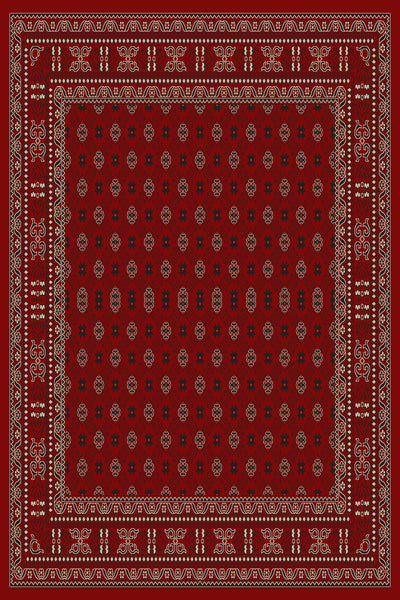
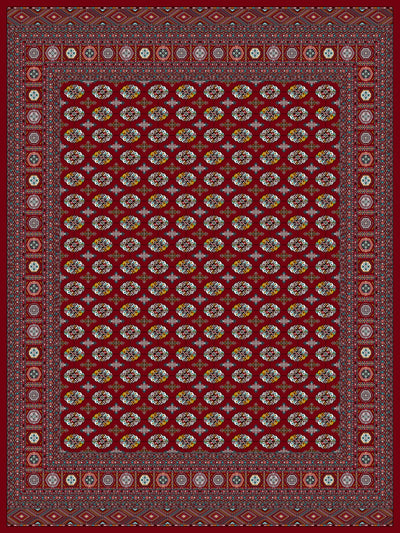
A machine-woven rug is produced on an industrial loom, typically in Türkiye, Belgium, or Egypt. There is no individual weaver — the loom executes a programmed pattern at speeds measured in square meters per hour rather than weeks per piece. The pile is woven into the structure (as in a wilton or axminster) or heatset and integrated mechanically (in the case of fine polypropylene production). The contemporary high end of this category is what gets marketed as 2 Million Points — wilton looms running at roughly two million points per square meter, producing dense Persian-design pile rugs in heatset polypropylene that mimic the saturation and detail of fine wool work. Ours are woven in Türkiye.
Craftsmanship signature: the back shows a printed-looking, regularly-spaced grid of pile bases — uniform and mechanically precise, with none of the slight irregularities of hand work. The fringe is typically machine-sewn, though ours are hand-attached and hand-finished at the edge. The pile is even in height to a tolerance no hand-finisher can match.
Durability: we do not quote a number of years, because nobody honestly can — it depends on traffic, light and care. What we can tell you is what actually retires a rug, and how this construction stands up to each of those things: see how long do machine-made rugs last? The pile holds shape well because polypropylene is more abrasion-resistant than wool by some measures; what limits the rug is not the pile but the look — over time, dirt and UV dull the fiber, and unlike wool, polypropylene cannot be deeply cleaned to restore color.
Texture and feel: firmer than wool, slightly slick to the hand. Weight is lighter than hand-knotted at the same size — a 9×12 2 Million Points rug weighs roughly twenty-five to forty pounds. Pile direction is consistent and pronounced; you can see the nap "flip" cleanly when you brush across it.
Repairability: none, practically speaking. Machine-woven rugs are not restored; they are replaced. They are designed for a defined product life, not for restoration economics.
Value trajectory: depreciating, like any household furnishing. The argument for buying one is never investment; it is design-now access to a Persian aesthetic at a price that doesn't require commitment.
Maintenance: low. Vacuum regularly, blot spills with cold water and a drop of mild soap, and for a full clean hose it down outdoors and lay it flat to dry or take it to a carpet-wash service. This is the easy-care end of the category.
Where it belongs: rentals, starter homes, children's playrooms, secondary rooms, vacation properties, and any room where the visual program calls for a Persian design but the budget or use-case does not justify hand-knotted. We carry these openly — they are not hand-knotted, they don't pretend to be, and for the right buyer in the right room they are the right answer.
The back-side test — five seconds, definitive
Flip any rug over and look at the back. This is the single most decisive identification test in the field, and it requires no training:
- Hand-knotted — you can see individual knots from behind, each one a small visible dot of pile color tied around the foundation threads. The pattern is fully readable from the back. The fringe is the extension of the actual warp threads.
- Hand-tufted — the back is fabric (canvas or scrim, glued to the rug). You cannot see knots; you see solid backing. Sometimes the backing has a printed grid or a manufacturer's stamp. The fringe is sewn on.
- Machine-woven — the back shows a uniform mechanical grid of pile bases, ruler-straight, perfectly even.
This test takes longer to describe than to perform. Bring a rug into honest light, flip it, look at the back. Five seconds.
Price brackets and what to expect at each
The categories live in different price universes for reasons that line up with the labor and material content of each:
Hand-knotted 8×10 / 9×12: roughly $2,500 to $25,000 for new and semi-antique pieces; antique-grade or rare-region pieces run higher. Per-square-foot pricing usually lands $30–$300. Variation is driven by knot count, fiber (wool vs silk vs wool-and-silk), origin, and age.
Hand-tufted 8×10 / 9×12: roughly $400 to $2,500. This is the price bracket where most "looks like Persian, on sale" online inventory lives. The price is honest if the construction is honestly labeled.
Machine-woven (including 2 Million Points). The market bracket runs roughly $200 to $1,200 for an 8×10 or 9×12. Our own range sits at the lower end of that — roughly $250 to $700 depending on size and tier, with smaller mats starting well under $100. The listing price on each product page is the price.
Be cautious of any hand-knotted piece priced inside the hand-tufted bracket, and of any hand-tufted priced inside the machine-woven bracket — either there is a real reason (heavy damage, mislabeling, deeply discounted close-out) or the labeling is incorrect.
How to think about the choice for your room
The construction decision is downstream of three things: how long you intend to live with the rug, how the room will be used, and what budget you are working with. The pairings that actually serve people best:
- A home you intend to be in for ten-plus years; a formal living, dining, or primary bedroom; a budget that allows it — hand-knotted. The thirty-year cost per year is lower than any other category once you factor in lifespan and restoration economics. This is the only category that ends up worth more than you paid.
- A nice guest room, a secondary living space, a transitional design phase, or a household with high turnover (kids, pets, frequent moves) — hand-tufted or machine-woven, depending on aesthetic preference and tolerance for the latex-failure timeline. Both are honest answers.
- A rental, a starter home, a vacation property, or a room where the rug is part of a quick-cycle design — machine-woven, including the 2 Million Points line. Persian aesthetic, modest commitment, easy maintenance.
The room itself matters too. A hand-knotted wool piece under a dining table works because the chair feet glide on the dense pile; a hand-tufted piece in the same spot will show wear in the chair traffic lanes inside a year. A machine-woven runner in a high-traffic kitchen is sensible and easy to replace; a hand-knotted silk Qum in that same spot is not a rug, it is a lawsuit waiting to happen. Construction has to match use.
For the room sizing decision that runs in parallel to this one — 8×10 vs 9×12, sofa-on vs sofa-off, dining clearance, runner placement — read our sizing companion guide.
Come compare all three side-by-side
The five-second back-side test is real, but the difference reads even faster when the three rugs are next to each other on the showroom floor. Come visit the Sacramento showroom; we will lay a hand-knotted Persian wool and a 2 Million Points piece side by side, flip each one over for you, and let your hands and eyes do the work in ten minutes. Most clients leave the showroom able to identify any rug in any room they walk into for the rest of their lives.
For the broader frame across fiber, origin, and age, return to the fiber and construction guide.
—
Sirsh, Stylish Rugs Sacramento editorial. Last updated 2026-09-15.