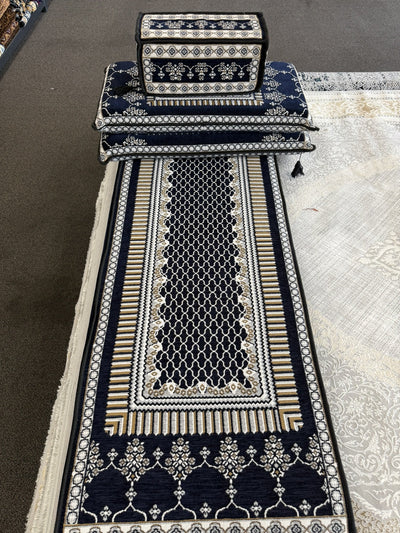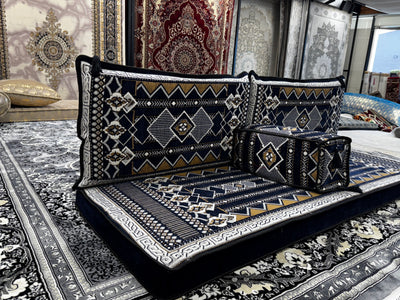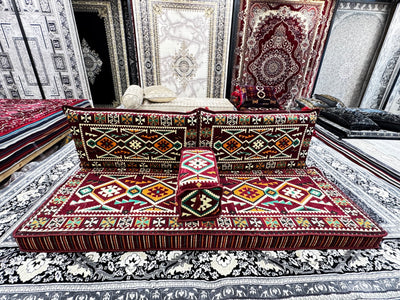


The short answer: A majlis (مجلس) is the traditional Arab seating room — floor cushions and low bolsters arranged around the perimeter of the room with an open center for tea, conversation, and hosting guests. A majlis rug is the large hand-knotted rug that anchors that arrangement: typically 10×14, 11×16, or 12×20 feet, low to mid pile, with busy traditional patterns that hide everyday wear and welcome bare feet. Persian Tabriz, Kashan, Heriz, and Bidjar are the most common majlis-format weaves; Afghan and Pakistani large-format pieces are also popular. The right majlis rug is sized to the open seating zone with a clear field in the center, which is where the coffee, qahwa, or dallah service sits.
A field guide from our Sacramento showroom. Our Northern California Arab and Persian clientele has informed how we curate large-format rugs — the majlis is a use case we know intimately.
What is a majlis?
In Arabic, majlis literally means “sitting place” — a room or section of a home dedicated to receiving guests, drinking qahwa (Arabic coffee) and tea, and hosting family gatherings. The traditional Gulf and Levantine layout places long bolster cushions and floor seating around the perimeter walls, leaving the center of the room entirely open. Food and drink come on low trays placed in the center; guests reach forward from their cushions.
This arrangement is fundamentally different from a Western living room, where furniture occupies the center of the space. In a majlis, the rug occupies the center as a visible, walkable, hospitable surface — not a backdrop for sofas. The rug is the room.
Sizing a majlis rug
The rug should:
- Extend nearly to (but not under) the perimeter cushions. A 2–3 inch gap between rug edge and cushion edge is ideal.
- Fill the center walking zone completely — guests should never step from the rug onto bare floor and back.
- Leave enough open center to accommodate trays, dallahs, and seated children.
Translation to dimensions:
- Modest majlis (12×16 ft room) — 9×12 or 10×14 rug.
- Standard majlis (16×20 ft room) — 11×16 or 12×18 rug.
- Large majlis (20×24+ ft room) — 12×20, 14×22, or two paired rugs.
- Multi-rug layouts — some larger majlises use a pair of large rugs side-by-side, framing the open center. This is common in Saudi and Emirati majlis design.
For sizing context across other room types (Western living, dining, bedroom), see our rug sizing guide.
Pattern and pile for majlis use
Pile height: low to mid
Majlis rugs see daily bare-feet traffic, food and drink service, and (in many households) children playing. A low to mid pile (under 1/2″) is essential:
- Crumbs and rice don’t embed in low pile.
- Spills can be blotted before soaking.
- Children sliding across the rug don’t catch in loops.
- Vacuuming actually reaches the foundation.
Pattern: traditional and busy
Solid or minimalist patterns are wrong for a majlis. The traditional Persian and Arab approach is busy medallion or repeating-motif weaving:
- Tabriz — fine curvilinear pattern, central medallion, rich palette. The classical majlis rug.
- Kashan — elegant central medallion with floral spandrels, deep reds and blues.
- Heriz — bold geometric medallion, terracotta and indigo. Tough enough for heavy use.
- Bidjar — “the iron rug of Persia.” Densely woven, exceptionally durable. Ideal for high-use majlises.
- Afghan / Pakistani large-format — Bokhara, Khal Mohammadi, Ziegler. Strong, traditional, less expensive per square foot than fine Persian.
The busy pattern serves a practical function: it hides everyday wear, crumbs, and faint stains the same way Persian medallion patterns were originally designed to camouflage centuries of foot traffic in homes with dirt floors.
Color palettes
Traditional majlis palettes favor warmth and richness:
- Deep red field with cream / ivory medallion — the classical Tabriz / Kashan look.
- Indigo field with terracotta accents — the Heriz / Northwest Persian look.
- Ivory and gold — modern Pakistani and Arabian Gulf palettes; lighter feel for contemporary majlises.
- Multi-tone abrash — traditional handwoven color variation reads as luxurious and hides daily use.
For broader color theory and selection, see our guide to rug color, palette and light.
Browsing options
An honest size note first: 10×13 ft (300×400 cm) is the largest rug we carry, and we sell from stock only — nothing is woven or ordered in. The true majlis formats above 10×13 are therefore sizes you would need to source elsewhere. What we can answer is the modest majlis and the paired-rug layout: our oriental rugs collection and Persian collection carry large-format Tabriz, Kashan and Heriz designs up to 10×13, which suit a 12×16 room on their own and a larger majlis in pairs framing the open center.
An honest note on inventory
Truly large-format majlis rugs (12×20 and above) are not commodity inventory, and they are not something we carry: our ceiling is 10×13. The Sacramento showroom holds genuine hand-knotted Afghan carpets — Turkmen gul, Khal Mohammadi, Baluch and Aqcha in hand-spun wool — shown by appointment, but those stop at our largest size too. If you are building a majlis that needs a single 12×20, we will say so plainly rather than take the order: we do not commission weaving and we do not special-order sizes. Come in and we will plan the paired-rug layout with you instead, which is how most large majlises are laid anyway.
When to come see us
If you’re furnishing a majlis or formal Arabic-style sitting room, bring the room dimensions and cushion fabric swatches to the showroom. We’ll lay options out at full size so you can see the proportions in person.
— The Stylish Rugs Editorial Desk · Sacramento, CA · 2023-05-18