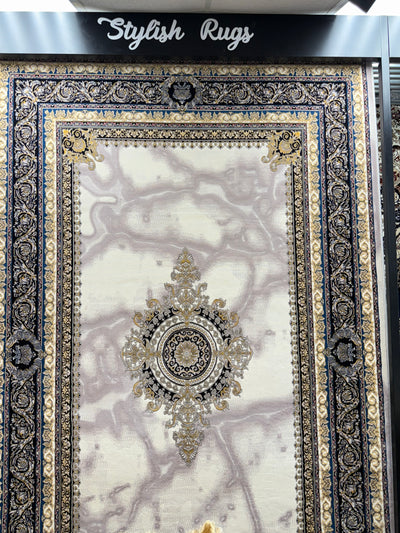
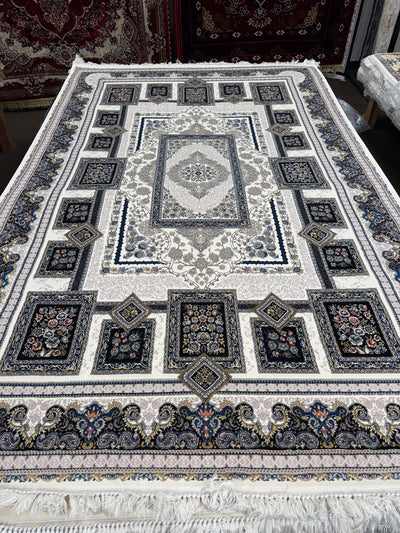
The short answer: a hallway runner should be 26–32″ wide (leaving 4–6″ bare floor on each side) and stop 6–18″ short of each doorway. Most Sacramento hallways take a 2.5×8, 2.5×10, or 3×10. Kitchen runners belong in front of the sink (2×6 to 2×8) or between the island and the range (2.5×8 to 3×8), in dark or tribal patterns that hide stains. Stair landings take a 3×4 to 4×6. The foot of a king bed wants a 3×10; the foot of a queen, a 3×8.
Four placements, four sets of rules — and why the runner is the most under-appreciated rug format in the catalog.
Most clients arrive at the showroom looking for a living-room rug. Fewer arrive looking for a runner — but more should. The runner is the format that quietly transforms a hallway, a kitchen, a landing, or the foot of a bed; the format that gets walked on most often per square foot; and the format where the wrong proportion shows up almost immediately. In an 8×10 living-room rug, half an inch of mis-sizing disappears under the sofa. In a 30-inch-wide hallway runner, half an inch shows.
This post sits underneath our broader Rug Sizing Guide and complements our living-room layouts article. Where those posts cover the room-defining anchor rugs, this one covers what the rest of the floor wants.
Hallway runners — the geometry that matters
A Sacramento hallway is typically 36 to 42 inches wide — wider in newer Folsom and El Dorado Hills construction, sometimes narrower in older Land Park and Curtis Park craftsman bungalows. The runner you choose should be 26 to 32 inches wide, leaving 4 to 6 inches of bare floor on each side between the runner edge and the wall.
The length rule is the one most often broken. Leave 6 to 18 inches of bare floor at each end of the runner — never run the rug all the way to a doorway threshold, and never stop it short of a doorway with two feet of bare floor showing. The runner should read as a deliberate path that ends slightly before each end-point, not as wall-to-wall carpet that someone gave up on.
In practice, this means most Sacramento hallways take a 2.5×8, 2.5×10, or 3×10. Long pre-war bungalow hallways with a single straight run sometimes accept a 3×13 or even a 3×15 — we keep a small inventory of these long runners specifically because they are hard to source elsewhere.
A pad matters more under a runner than under almost any other format. Hallways concentrate foot traffic into a narrow strip; without a non-slip pad, the runner walks toward one end within a month and starts to bunch.
Kitchen runners — durability over delicacy
Kitchens demand different fiber rules. A kitchen runner sees standing water, oil splatter, dropped tomato sauce, and the daily grit of a busy room. This is not the place for hand-knotted silk, antique pieces, or anything light-colored.
There are two kitchen placements that actually work. In front of the sink — a 2×6 to 2×8 runner that softens the standing zone where you do dishes and prep. Between the island and the range — a 2.5×8 or 3×8 along the working corridor. Avoid placing a runner on the perimeter side of a kitchen island that nobody walks on; it reads as decoration in a room that should read as a working space.
For fiber and design, three categories work: synthetic-wool flat-weaves (durable, washable, sheds least food residue); traditional Persian-design pieces in darker palettes — burgundy, navy, deep cream — that hide minor stains; and tribal pieces from our Afghan rugs collection or Turkish rugs collection — pieces where small irregularities and natural variation in dyes mean a stain reads as patina, not damage. Avoid bright cream silk or ivory wool in the kitchen, however beautiful. You will regret it within six months.
Stair landings and the foot of the bed
Stair landings — that small square or rectangle where a staircase turns — take a 3×4, 3×5, or 4×6, depending on the landing footprint. Leave 4 to 8 inches of bare floor between the rug and the stair edges. A landing rug is one of the few places we recommend a smaller scatter rug deliberately; it softens the architectural corner without competing with the staircase carpet or the hardwood treads.
The foot of the bed is the most overlooked runner placement in residential design. A 3×8 runner at the foot of a queen or a 3×10 at the foot of a king lands exactly where you step out of bed, lays parallel to the bed's foot edge with about 6 inches of overhang on each side, and visually anchors the bed without committing to a full 9×12 underneath.
This is also the placement where the pillar's "runner-pair" configuration applies — two matching runners flanking the bed instead of one underneath it, covered in more detail in our overall sizing guide. For mid-century and Scandinavian bedrooms especially, the runner-pair is the most architectural and most economical option.
When a runner becomes the visual centerpiece
A long hallway with a gallery wall, a stair landing under a skylight, a corridor that doubles as display space — these are the cases where the runner is no longer a quiet utility but the actual visual focus of the room. The right rug here is something with character: a tribal Afghan piece with asymmetric medallions, a Caucasian-design runner with strong geometry, or a Persian-design piece from our broader Persian collection with a clear central spine that pulls the eye down the length of the corridor.
The mistake to name openly: a cheap synthetic runner in a hallway designed as a gallery space reads as a builder-grade afterthought. If the architecture is asking for art, treat the runner as art.
Come measure with us
Most runners we sell are decided in the showroom in under fifteen minutes. Bring your hallway width and length, your kitchen floor plan or a phone photo, or the dimensions of your stair landing or bedroom. We keep a deep runner rug inventory — synthetic-wool, Persian-design, Afghan tribal, Turkish — in sizes from 2×6 to 3×15, and most clients leave with the right runner the same afternoon.
Most decisions that look uncertain in a photograph resolve themselves in five minutes on the showroom floor.
—
Sirsh, Stylish Rugs Sacramento editorial. Last updated 2023-09-27.