One rule decides whether a dining-room rug works. The same rule is broken in roughly half the dining rooms we see.
The most common dining-room rug mistake is also the most preventable. A rug that looks correct under the table — generous, centered, the right color — turns into a tripping hazard the moment someone pulls a chair out to sit down. The back legs of the chair catch the rug edge, the diner stops mid-motion, and the entire choreography of sitting down at the table becomes awkward. This is not a chair problem. It is a rug-sizing problem, and it has one rule.
This post sits underneath our broader Rug Sizing Guide and is the dining-room companion to our living-room layouts article. Where the living-room rug is a question of layout intent (all-furniture-on, front-legs-on, floating), the dining-room rug is a question of geometry. The geometry is non-negotiable; the style and material choices come second.
The 24-inch rule — geometry, not arbitrary
The rule: your dining-room rug must extend at least 24 inches past every edge of the dining table, on every side, so that when a chair is pulled out for someone to sit down, the chair's back legs remain on the rug. Not "approximately 24." Not "a few inches past the table." Twenty-four inches, measured from the table edge.
The geometry: a standard dining chair is 18 to 20 inches deep at the seat. When you pull the chair out to sit down, the back of the chair travels 22 to 24 inches from the table edge before you can clear the seat. If the rug stops short of that distance, the chair's back legs land on the bare floor mid-pull, drag the rug toward the table, and either trip the diner or scrape the floor.
The same 24 inches also gives the visual proportion that makes a dining-room rug read as deliberate — the table looks framed, not stranded. Less reveal and the table looks oversized for the rug; more reveal and the rug stops contributing to the room's geometry.
Once you internalize 24 inches, every dining-room rug decision becomes arithmetic.
Rectangular tables — the math by size
The four common rectangular dining tables in Sacramento homes, with the rug sizes the 24-inch rule produces:
- 60×40 table (seats 4-6 typically, common in craftsman bungalows and apartment dining): rug must be at least 108×88 — round up to an 8×10. The 8×10 is the standard answer for the smaller dining table.
- 72×42 table (seats 6, the most common new-furniture purchase): rug must be at least 120×90 — still an 8×10 works, though a 9×12 looks more generous. Choose 9×12 if the room is wider than 13 feet.
- 84×42 table (seats 6-8, common in East Sac formal and Folsom open-plan dining): rug must be at least 132×90 — this is firmly 9×12 territory.
- 96×44 table (seats 8-10, formal dining and great-room dining-ends): rug must be at least 144×92 — a 10×13, our largest, is the honest answer here, and it is the point at which the geometry starts asking for more rug than we stock.
The 8×10 covers the bottom of the table-size distribution; the 9×12 covers the middle and upper-middle; our 10×13 is the ceiling. For a table longer than 96 inches the arithmetic genuinely wants more than that — and we would rather tell you so than sell you a rug your chairs will fall off. Browse our 8×10 dining rugs for the smaller-table format and our 9×12 collection for the 84-inch-and-up tables.
Round and oval tables — fewer right answers
Round tables introduce an honest design question: round rug or square rug? Both work, and the answer depends on the room.
A round rug under a round table is the most graceful pairing — the geometries echo, the room reads as composed. The rug should be 48 inches wider in diameter than the table: a 48-inch round table needs a 96-inch (8-foot) round rug; a 54-inch table needs a 102-inch round rug (or round up to a 9-foot). The 24-inch margin on every side is preserved.
A square or rectangular rug under a round table also works, often better in rooms where the architecture is square — craftsman dining rooms, formal dining boxes in East Sac. The math is the same: 24 inches of rug past the widest point of the table. A 48-inch round table on an 8×10 works perfectly; a 54-inch round table on a 9×12 works perfectly.
Oval tables generally take rectangular rugs — the oval shape softens the rectangular footprint, and the math collapses to the rectangular-table case. Measure the oval at its longest and widest points, apply the 24-inch rule, choose the rectangular size.
Material and pattern for dining rooms
Three material principles, all earned through replacing rugs that didn't survive a dining room:
- Low-pile is non-negotiable. A high-pile or shaggy rug under a dining table catches every chair leg and traps every crumb. Use flat-weaves, hand-knotted Persian-design with traditional low-pile, or 2 Million Points machine-woven pieces — anything with a pile under about 8 millimeters.
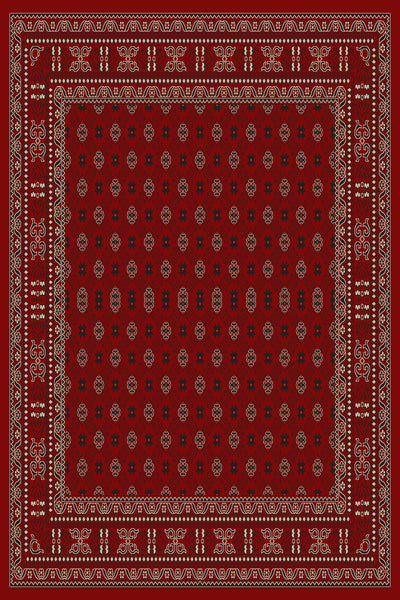
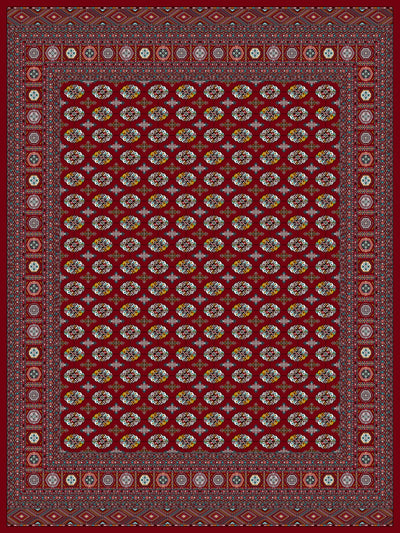
- Pattern conceals; solid reveals. A patterned rug — medallion-and-border Persian, all-over Heriz, tribal Afghan with strong color variation — makes minor stains and crumbs invisible. A solid cream or pale gray under a dining table is asking for trouble; we have replaced more solid dining rugs than any other category.
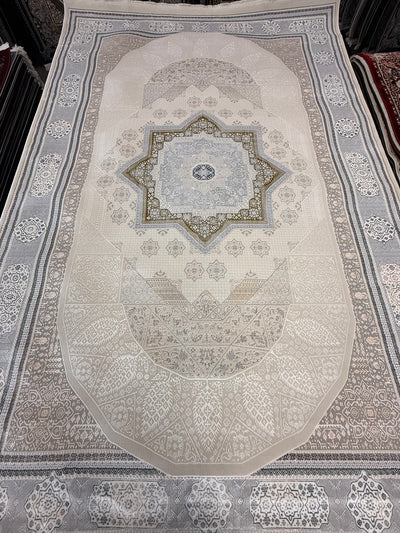
- Avoid silk and avoid ivory. Silk under chair legs delaminates over a few years; ivory shows everything. Both have legitimate roles elsewhere in the home, but the dining room is not where to use them. (We do not currently stock genuine silk.)
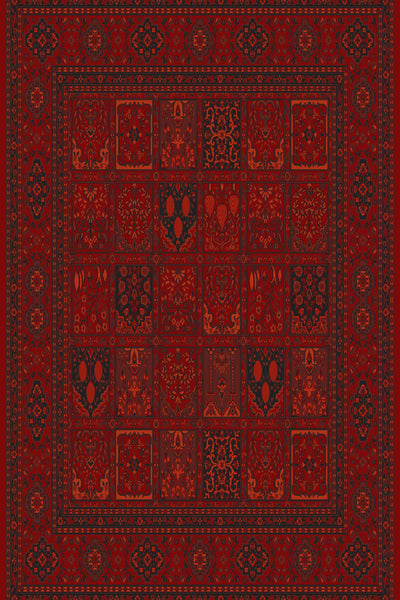
The pieces that work best in dining rooms come from the broader Persian rug collection, particularly the Tabriz, Heriz, Mahal, and Kashan-design medallions in burgundy-and-cream or navy-and-rust palettes. These were originally designed for high-traffic Persian salons; they survive American dining rooms with similar elegance. A dining rug is also the one place a pad is genuinely useful on a smaller piece — we do not sell pads, but our own rugs have a woven cotton backing and hold their place without one from about 3 m² up.
For kitchens and breakfast nooks — which follow different rules than formal dining rooms — our runner placement article covers the kitchen-specific case (durability over delicacy, anti-silk, two specific placements that work).
Common Sacramento dining setups
Four configurations we encounter weekly, with the right answer for each:
- East Sac formal dining (separate room, 13×16, 72×42 or 84×42 table): 9×12, Persian-design medallion, burgundy-cream or navy-ivory palette. The rug is the entire decorative gesture of the room.
- Folsom open-plan dining-end (great room with dining at one end, 84×42 or 96×44 table): 9×12 minimum, our 10×13 ideal. The rug defines the dining zone within the larger space; choose a palette that coordinates with the living-room rug 12 to 16 feet away.
- Craftsman built-in dining (Land Park, Curtis Park, narrower 60×40 or 72×42 tables): 8×10 fits the room; a single rich Heriz-design or Caucasian-design piece carries the period perfectly.
- El Dorado Hills great-room dining (vaulted, 96×44 table or oval 96×48): this is the configuration our 10×13 ceiling does not quite reach. We will say so, and help you plan an open-field Persian-design 10×13 with a slightly tighter chair margin, or a two-zone layout. See our pillar guide's dining-and-great-room section for the broader configuration logic.
Come measure with us
Bring your table dimensions (length and width, or diameter), the room width and length, and a phone photo of the chairs in their normal position to our Sacramento showroom on Watt Avenue. We will lay out the candidate rug sizes on the showroom floor, simulate the chair-pull-out, and have a decision in fifteen minutes.
The dining-room rug is the one decision in the home where the geometry is unambiguous — the 24-inch rule does not bend for style preference. What does bend is which rug you bring home: the size is fixed by the table, but the construction, palette, and pattern are entirely yours to choose.
Most decisions that look uncertain in a photograph resolve themselves in five minutes on the showroom floor.
—
Sirsh, Stylish Rugs Sacramento editorial. 2023-09-06.