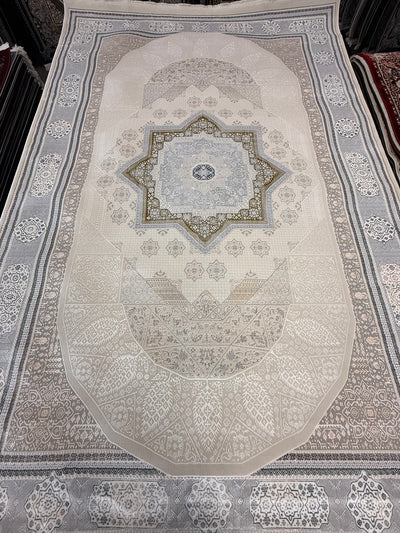

The short answer: yes — rugs reduce sound, but only certain kinds. A wool rug with a felt or felt+rubber pad cuts impact noise (footsteps, dropped objects, chair scrapes) by 25–40% and reduces room reverberation (echo, harsh speech) by roughly half in a typical apartment living room. What rugs do not meaningfully reduce: deep bass through walls or floors, voices coming through a shared wall, or sound from below traveling up. For maximum acoustic effect: thicker wool pile + dense felt pad, covering at least 60% of the floor.
A working acoustic guide from our Sacramento showroom. We get this question constantly from apartment renters and downstairs neighbors — here's what rugs actually do for sound, and what they cannot.
What kinds of sound exist in a room
To know what rugs help with, it helps to know what sounds you're trying to control. Apartment and home acoustics break into three categories:
- Impact noise — footsteps, dropped items, chair scrapes, kid running. Sound generated by something hitting the floor and traveling through both air and the building structure.
- Reverberation (echo) — sound bouncing around inside a room. Why empty rooms sound harsh and full rooms sound warm. Affects speech intelligibility, music quality, and perceived "loudness."
- Airborne transmission — voices, TV audio, music traveling through walls, ceilings, and floors to other rooms or units. Controlled by wall mass and insulation, not floor coverings.
Rugs strongly affect the first two. They have effectively no effect on the third.
What rugs reduce (and by how much)
Impact noise — 25–40% reduction
A wool rug with a quality pad sits between your footsteps and the hard floor. The pile compresses, the pad compresses, and the sharp transient (the actual "thump" frequency that travels through the structure) softens significantly. Measurements in apartment buildings show a 25–40% reduction in impact noise transmission to the unit below when a 60%+ floor coverage rug-and-pad system is installed. This is real, audible, and the single most-cited reason apartment renters add rugs.
Reverberation — roughly 50% reduction in a typical room
Hard floors reflect sound; soft pile absorbs it. Adding a wool rug to a typical 12x15 ft living room with hard floors typically reduces measurable reverberation time by 30–60%. The subjective effect is dramatic — voices sound warmer, harsh consonants soften, the room "calms down" acoustically. This is why recording studios, podcast booths, and high-end home theaters all use heavy wool rugs.
High-frequency clatter — noticeable reduction
Glasses on a glass table, keys dropping on a counter, dog claws on hardwood. The clatter component travels through the air; the rug absorbs much of the reflected portion. Conversations near a rugged area feel less harsh than the same conversation over a bare hardwood floor.
What rugs do NOT meaningfully reduce
Bass and low frequencies
Low-frequency sound (below ~200 Hz) has long wavelengths that rugs, even thick wool ones, are too thin to interact with. A neighbor's subwoofer or your own deep music reproduction will be essentially unaffected by floor coverings. Bass requires mass (denser walls, isolation pads under speakers) or active treatment (bass traps).
Voices and TV through walls
Sound transmitted through shared walls or ceilings is governed by wall construction (drywall thickness, insulation, stud spacing) not what's on the floor. Adding rugs does not reduce a neighbor's voice coming through the wall.
Sound from below traveling up
If a downstairs neighbor's TV is loud, a rug in your unit cannot reduce it. Acoustic isolation is bottom-up: the floor coverings of the unit generating the sound matter, not the ceiling-side coverings of the unit receiving.
Which rug construction is best for sound
Pile thickness matters more than fiber
For acoustic absorption, pile thickness is the dominant variable. A 1/2 to 1-1/4 inch wool pile absorbs significantly more sound than a 1/4 inch low pile. This is one of the few cases where high pile genuinely outperforms low pile — acoustic absorption increases roughly linearly with pile thickness for the first inch.
Wool outperforms synthetic for sound
Wool fibers have natural crimp and microscopic air pockets that absorb sound across a broader frequency range than smooth synthetic fibers. The difference is measurable but not dramatic — maybe 15–20% better absorption per same-pile-thickness comparison. For the construction context, see our hand-knotted vs hand-tufted vs machine-woven comparison.
Dense weave > loose weave
A tightly-knotted hand-knotted rug absorbs slightly more sound than a loose hand-tufted rug at the same pile thickness, because the foundation contributes to absorption too. The difference is small (5–10%) but consistent.
Multiple smaller rugs vs one large rug
For acoustic purposes, total covered area is what matters — not whether it's one rug or three. But edges create reflection points, so a single large rug usually outperforms three smaller rugs of equal total area. For sizing context, see our rug sizing guide.
The pad trick — doubles the acoustic effect
The single most overlooked sound-reduction step is adding a quality felt or felt+rubber pad under the rug. A thin grip-only pad does nothing acoustically. A 3/8-inch felt or felt+rubber pad effectively doubles the impact-noise reduction of the rug above it, because two compressible layers absorb more transient energy than one. For the construction comparison and which pad to choose, see our rug pad selector.
Coverage threshold — the 60% rule
Acoustic effect scales with floor coverage. Below 40% coverage, the room reverberation barely changes. At 60% coverage, the room sounds noticeably warmer. At 80% coverage, the room is acoustically "tamed" — conversations feel intimate and the harsh edge is gone. For apartment renters trying to keep downstairs neighbors happy, the practical rule is: cover everywhere people walk, and as much of the seated zone as possible.
Best room-by-room for acoustic priority
Apartment living room
Large 8×10 or 9×12 wool rug, medium-to-thick pile (1/2–3/4 inch), dense felt pad. Goal: cover everywhere chairs slide, kids run, and TV speakers reflect off the floor. Browse our 8×10 collection and 9×12 collection.
Bedrooms
Medium-pile wool, large under-bed coverage. Sound benefits compound with the comfort benefits of high pile in a low-traffic room. Bedrooms with rugs reverberate less, meaning quieter ambient sound and better sleep for noise-sensitive people.
Home office
Acoustic benefit is significant for video calls — a rug under the desk and chair reduces echo on your microphone audio (your camera mic picks up reflected sound, and that's what makes home-office audio sound "hollow"). Even a 5×7 wool rug behind/under the office chair makes a measurable difference.
Home theater
Maximum coverage of large wool rugs. Hard floors are the enemy of dialogue intelligibility in home theaters; carpeted/rugged floors restore consonants and improve perceived dynamic range.
When rugs are NOT the right acoustic solution
If your acoustic problem is one of the things rugs don't fix — bass, voices through walls, sound from neighbors — a rug will not help. Other interventions for those problems: heavier wall mass (decoupled drywall, mass-loaded vinyl), acoustic panels on walls (for reverb in non-floor-coverage situations), insulation in shared walls, decoupling speakers from the floor with isolation pads. A rug is the most cost-effective floor-related acoustic intervention but it does not substitute for wall treatment when wall transmission is the issue.
When to come see us
For Sacramento apartment renters or anyone planning a quieter home, bring the room dimensions to the showroom and we'll walk you through pile thicknesses and pad combinations side by side. You can stomp on combinations on the showroom floor to hear the difference.
— The Stylish Rugs Editorial Desk · Sacramento, CA · 2025-08-05