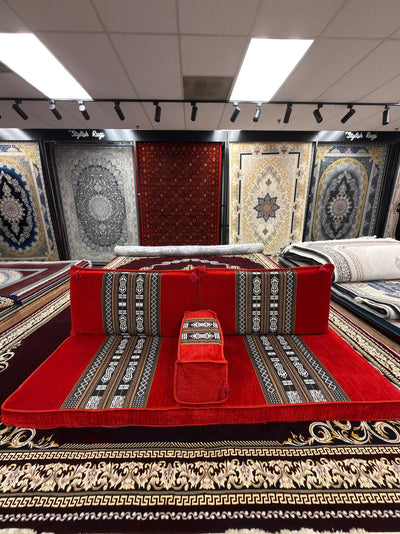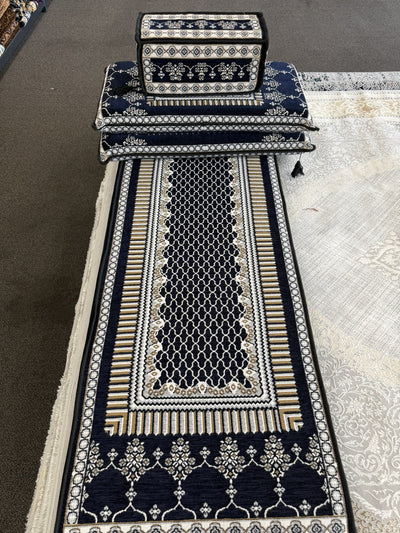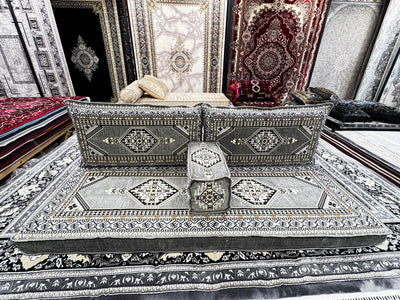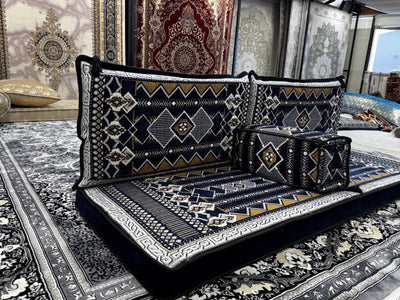

In a room furnished with floor seating, the rug isn't decoration in front of the sofa. It is the floor people sit on, put their tea glasses on and lean across to reach the dish in the middle. That changes how you size it, where you place it and what you want it to feel like. This guide works through it with real dimensions.
Know your cushion depth
Everything starts with how far the seating comes out from the wall. The pieces we sell are:
- Arabic majlis cushions: about 70 × 190 cm, 10 cm thick (roughly 27.5 in deep and 6 ft 3 in long).
- Afghan toshak: about 85 × 200 cm (roughly 33.5 in wide and 6 ft 7 in long).
Back cushions and armrests usually rest on the seat against the wall, so they add little or no floor depth. In practice a wall lined with majlis seating takes about 70 cm (2 ft 4 in) of floor; a wall lined with toshak takes about 85 cm (2 ft 9 in).
The one rule: fully on or fully off
When a cushion sits half on a rug and half on the bare floor, the rug edge makes a ridge under the seat. You feel it every time you sit down, the cushion rocks slightly, and over time the edge of the rug wears in a line. So there are two main layouts, plus a variation for long rooms.
Layout 1: the rug inside the seating
The cushions sit on the bare floor along the walls, and the rug fills the open middle of the room. This layout suits larger rooms, and it gives the room a clear center where food is served.
How to size it: subtract the cushion depth from each wall that has seating, then leave a small gap of 5–15 cm (2–6 in) between the cushions and the rug so the rug edge isn't tucked under the seat.
Example, toshak in a smaller room: an 11×14 ft room is about 335 × 427 cm. With toshak along both long walls and one short wall, the open center is about 165 cm wide (335 minus 2 × 85) and 342 cm long (427 minus 85). A 5×7.5 ft rug (150×230 cm) fits with a small gap on each side and room to walk at the open end.
Example, majlis in a larger room: a 13×17 ft room is about 396 × 518 cm. With majlis on all four walls, the open center is about 256 × 378 cm. A 6.5×10 ft rug (200×300 cm) fits with a generous gap all round; in a room a little larger, an 8.2×11.5 ft rug (250×350 cm) fills the center more fully.
Layout 2: everything on the rug
In a smaller room, the rug runs nearly wall to wall and every cushion sits on it. This makes the room feel warmer and more unified, and nobody's hands or feet touch the bare floor.
Our largest size is 10×13 ft (300×400 cm), and custom sizes are coming soon; we can cut a rug bought from us down to a smaller size, but not make one larger. So this layout works when the room is no more than a few inches larger than the rug, roughly up to about 10.5×13.5 ft. In a bigger room, a 10×13 ft rug would leave a strip of floor along the walls with the cushions half on and half off, which is exactly what to avoid. Use Layout 1 there instead.
Layout 3: two rugs
In a long room, or an open plan where the majlis takes one end, two rugs can work: one under a U of seating and another defining a dining or entry area. Keep both the same orientation and choose designs that share at least one color.
What to look for in the rug itself
Feel
People sit on this rug for hours, often cross-legged, and put their hands on it. A dense, smooth, tightly woven pile is more comfortable than a scratchy or very thick one, and it gives tea glasses and serving trays a level surface. Avoid shag: glasses tip over in it and crumbs disappear.
Easy to keep clean
Floor seating means food on the floor. A machine-woven rug with a polypropylene or polyester pile lets water-based spills sit on the surface long enough to blot. Mid-tone, patterned grounds hide crumbs and the odd tea spot far better than pale solids.
Flat-lying, no pad needed
Our rugs are machine-woven in Türkiye with a cotton backing and generally don't need a pad at 3 m² (about 32 sq ft) and up. That matters with floor seating: a soft pad under the rug makes the surface spongy, and in Layout 1 it adds height that makes the edge more noticeable.
Color: let one of them lead
Majlis and toshak covers are often richly patterned: medallions, rosettes, gold on burgundy, silver on navy. If the covers are busy, choose a calmer rug: a Persian-design rug with a quieter all-over field in a color pulled from the covers. If the covers are plain or tonal, the rug can carry the pattern, and a bold medallion in the middle of the room makes a natural centerpiece for a serving tray.
Repeating one color is enough to tie the room together: the deep red of the rug's border picked up in the cushion piping, or the gold in the covers echoed in the rug's medallion. For more on the full layout, our guide on how to set up an Arabic majlis at home covers seating and styling.
Quick checklist
- Cushion depth: majlis about 70 cm, toshak about 85 cm from the wall.
- Rug fully inside the seating or fully under it, never half under.
- For Layout 1, subtract cushion depth from each seated wall and leave 5–15 cm gap.
- Layout 2 works only in rooms close to the rug's size; our largest is 10×13 ft.
- Dense, smooth pile; no shag; mid-tone pattern for easy upkeep.
- Busy covers, calm rug; plain covers, patterned rug.
Shop Arabic majlis floor seating, Afghan toshak and covers, and the full rug collection. Shipping is free in the US and Canada on orders over $110.
Put the whole room together in Sacramento
The easiest way to match a rug to floor seating is to see them side by side. Our showroom at 3423 Watt Avenue, Sacramento, CA 95821 carries majlis and toshak seating as well as rugs, and is open daily 10 AM–7 PM. Bring your room measurements and we'll help you work out the layout.