
Many Muslim families want a dedicated place to pray at home, whether a whole spare room or a quiet corner of the bedroom. It doesn't need to be large or expensive. It needs to be clean, calm and set up so that praying there feels natural five times a day. The ideas below are practical, not religious rulings; for questions of religious practice, your local imam or mosque is always the right guide.
Choosing the spot
- Quiet and out of the traffic path. A corner where nobody needs to walk in front of you while you pray. In a shared room, a spot against a wall away from the door works best.
- Clean and dignified. Many families avoid placing the prayer area directly facing a bathroom door or in a spot used for shoes and laundry.
- Room to move. Each person needs space to stand, bow and prostrate, roughly the length of a prayer mat plus a little room behind, and about shoulder width plus a few inches. For praying together, leave room for a row side by side, with the imam's place in front.
- Light. Soft, even light is pleasant for early morning and night prayers. A small lamp is gentler than an overhead light at Fajr.
A spare bedroom, the end of a hallway, a corner of the main bedroom or a quiet part of the living room can all work. For one or two people, a corner about the size of a 5×7.5 ft rug is often enough.
Finding the qibla
The qibla is the direction of the Kaaba in Mecca. A phone qibla app or a qibla compass is the easiest way to find it, and most apps correct for the difference between magnetic north and true north automatically.
For readers in Sacramento and much of the western US, the great-circle direction (the shortest path across the globe) points roughly north-northeast, about 20 degrees east of true north. It surprises people who expect "east," but on a globe the shortest route from California to Mecca runs up over the Arctic. Many mosques in North America use this direction. Some people follow a different calculation, so if you are unsure, check with your local mosque and align with their practice.
Once you know it, mark the direction subtly: a small arrow on the shelf, the edge of the rug laid square to it, or simply the way the prayer mats are always placed.
Prayer mats
The prayer mat (sajadah, janamaz, musalla) is the heart of the space. A few things to think about:
- Padding. On a hard floor, a padded mat makes prostration much more comfortable, especially for older family members and anyone with sore knees. Our prayer mats are polyester with a foam padding inside.
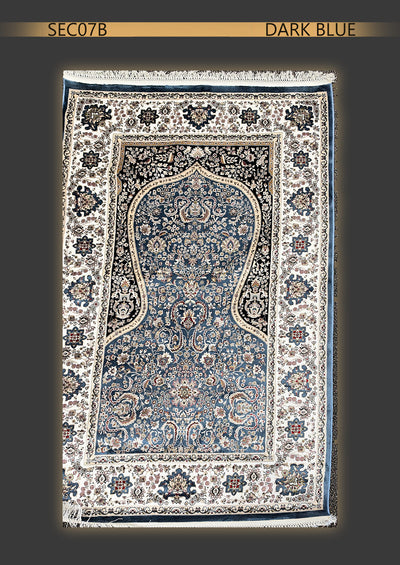
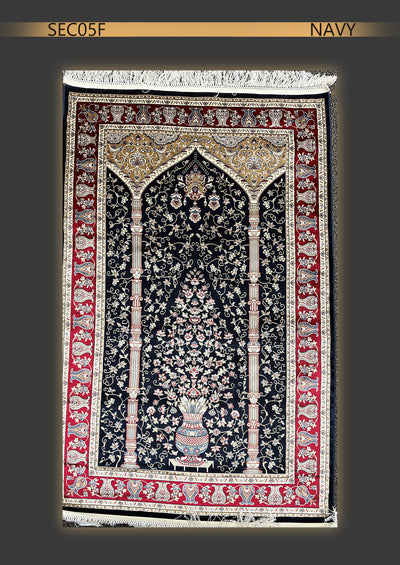
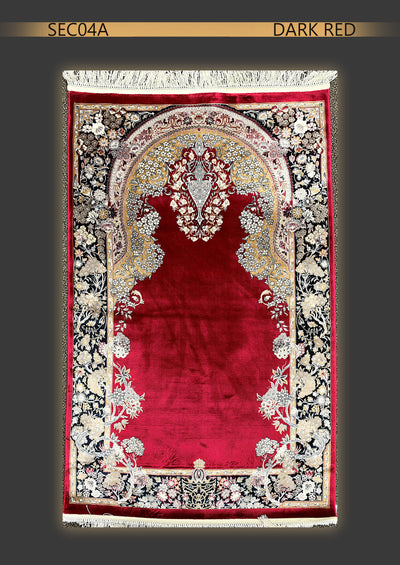
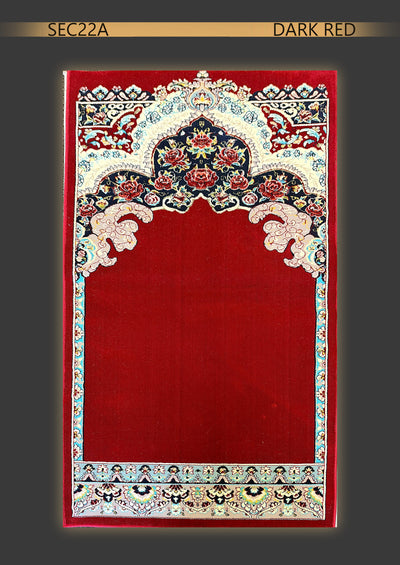
- Design. Many families prefer simple designs, often an arch (mihrab) pointing the way, and avoid images of people or animals in the prayer space. Calm, low-contrast patterns are easier on concentration.
- One per person. Having one mat for each regular user, including children, means nobody waits and children learn to look after their own mat.
Our guide to choosing a prayer mat covers sizes, padding and design in more detail, and you'll find our selection in the prayer mat collection.
A rug for the prayer room
A rug underneath the prayer mats is not required, but it makes a dedicated room warmer, quieter and more comfortable, and it defines the space in a shared room.
- Size. For a prayer corner, a 5×7.5 ft rug (150×230 cm) gives room for one or two people to pray side by side. For a family room where four or five people pray together in a row, a 6.5×10 ft rug laid with its long side across the room gives the row space.
- Orientation. Lay the rug square to the qibla, so the mats line up with its edge. It makes finding the direction automatic.
- Design. A rug with a calm, all-over field or a simple geometric pattern sits well under patterned prayer mats. A very busy rug competes with them.
- Cleanliness. A low, dense pile is easy to keep clean and lets mats lie flat. Keep the room a shoes-off space.
Our rugs are machine-woven in Türkiye in classic Persian, Afghan and Turkish designs, with a cotton backing that lies flat on the floor. You can browse the 5×7.5 ft rugs that suit most prayer corners.
Small things that make a difference
- A low shelf or wall shelf for the Qur'an, kept off the floor, along with prayer beads (tasbih) and a small book of du'a.
- A basket or hooks for prayer clothes, a scarf or prayer cap, kept clean and ready.
- A place to fold the mats. Folding mats after prayer keeps the space tidy and the mats clean. Our guide to caring for a prayer mat covers washing and storage.
- Prayer times. A small clock or a tablet with a prayer-time app helps the household keep track.
- Fresh air and a gentle scent. A window that opens, and if you like, a light, natural scent rather than heavy incense in a small room.
- Children's corner. A child-size mat beside the parents' mat helps children join in.
Prayer corner in a small apartment
No spare room? A prayer corner can be a single rug in a bedroom, a mat and a wall shelf, and a folded screen or curtain if you want a sense of separation. The key is that the corner stays clean and clear, and that the mats are folded away and ready.
Quick checklist
- Quiet, clean spot out of the walking path.
- Qibla found with an app or compass, and checked with your mosque if unsure.
- Padded prayer mat for each regular user.
- Optional rug square to the qibla: 5×7.5 ft for a corner, 6.5×10 ft for a family row.
- Calm designs; a shelf for the Qur'an off the floor.
- Shoes off; fold the mats after prayer.
Visit us in Sacramento
If you're setting up a prayer space, come and see the prayer mats and rugs together at our showroom, 3423 Watt Avenue, Sacramento, CA 95821, open daily 10 AM–7 PM. We'll help you pick a rug size for the room and mats that suit the family. Shipping is free in the US and Canada on orders over $110 if you'd rather order online.