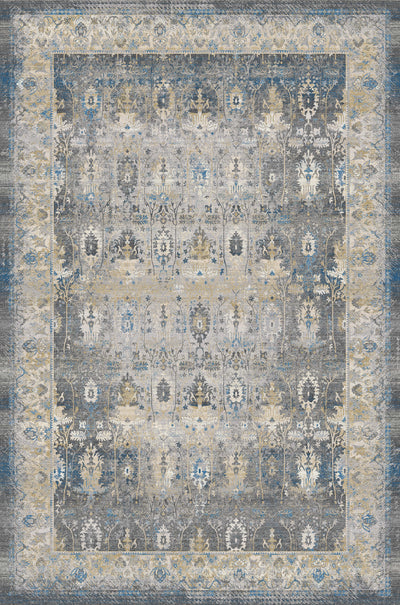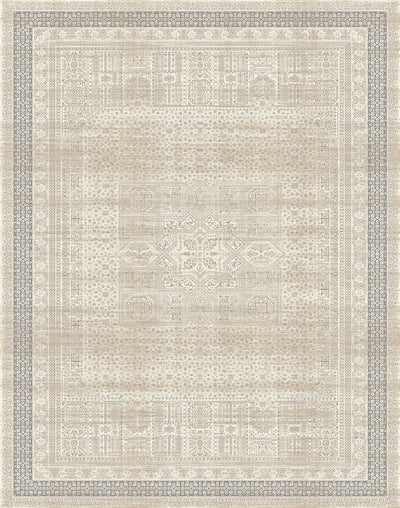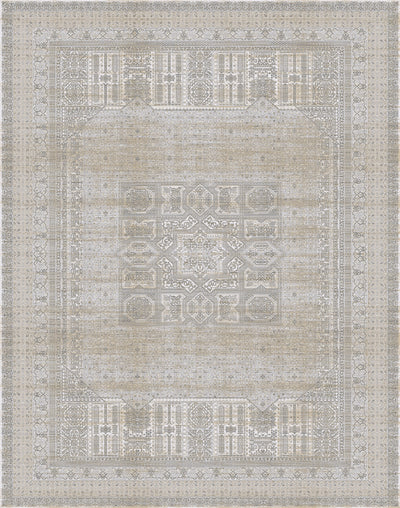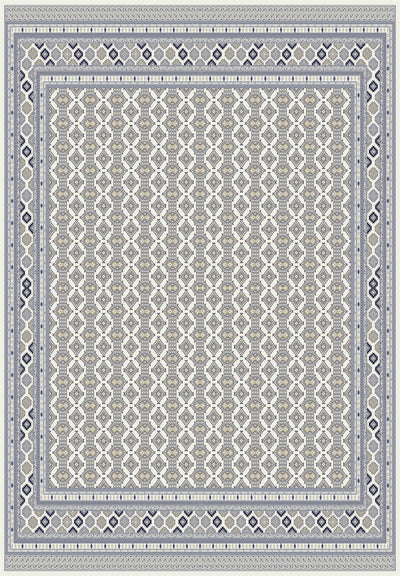

Tile is the floor people most often describe as "hard to decorate around." It's cold to the touch, it echoes, the grout lines draw a grid across the room, and large-format tile tends to come in a narrow band of grays and beiges that can make any rug look either washed out or out of place. It gets much easier once you know which contrast you're aiming for. This guide works through the four tile colors we hear about most often.
The rule that works on every tile color
A rug looks intentional when it is noticeably different from the floor it sits on. A rug that is almost the same shade as the tile reads as a stain or a mistake, especially in photos. So before you think about style, decide which way you're going:
- Darker than the tile gives the furniture a strong base and makes a pale room feel grounded. This is the more forgiving choice for daily life, because darker grounds hide crumbs and footprints.
- Lighter than the tile brightens a room with dark or busy tile, but it shows dirt sooner, so it suits bedrooms and formal rooms more than entries and kitchens.
Then repeat one color from somewhere else in the room (the sofa, the curtains, a cabinet, a painting) in the rug's pattern. That one link is what makes the rug look chosen for the room rather than dropped into it.
Gray tile
Gray porcelain is the default in a lot of newer homes and remodels around Sacramento. Gray is cool, so the main job of the rug is to bring some warmth back.
- Warm reds and rust are the most reliable pairing. A traditional design with a deep red field or a red-and-navy border looks rich against gray without clashing. Browse our red rugs to see the range.
- Navy and blue sit naturally on gray because they share a cool undertone, and a navy ground gives a pale gray floor real contrast. See blue rugs.
- Cream and ivory work when the gray is mid to dark. On a very pale gray tile, cream can look dingy by comparison, so check the two side by side in daylight.
- Gray on gray can work, but only with a clear step in value: a charcoal rug on light gray tile, or a pale silver rug on a dark slate. Our gray rugs range from silver to charcoal.
The gray floor question comes up so often that we wrote a separate guide on rug colors for gray floors, which covers gray vinyl and laminate too.
Beige, cream and travertine tile
Beige tile and travertine were everywhere in the 1990s and 2000s, and plenty of homes still have them. These floors are warm and fairly light, with a yellow or pink undertone, and the most common mistake is to put a beige rug on them. The result is a room with no edges.
- Go deeper. Navy, burgundy, deep green and charcoal all contrast clearly with beige tile and make the floor look more deliberate.
- Multicolor traditional designs with red, blue and ivory are a good fit for travertine, which has its own natural variation. A busy floor and a busy rug can coexist when the rug's ground color is darker than the stone.
- Avoid yellow-cream. A cream rug with a yellow cast next to yellow-beige tile makes both look tired. If you want a light rug, choose a cooler ivory or a soft gray.
White tile
White and very pale tile is the easiest color to design around and the hardest to live with, because it shows everything. The rug gives you a chance to fix that.
- Any strong color works, from red to navy to a deep teal. White tile acts like a gallery wall: whatever you put on it becomes the focus.
- Mid-tones are the practical choice. A mid-gray, a dusty blue or a muted multicolor hides foot traffic and pet hair far better than a cream rug, which will look gray against bright white tile within weeks.
- Watch the glare. White tile bounces a lot of light, which can make pale rug colors look washed out. Our guide to how light direction changes rug color explains why a rug can look different at noon than in the evening.
Terracotta and Saltillo tile
Terracotta and Saltillo are warm, orange-red clay tiles that already carry a lot of color. Treat the floor as one of the room's colors, not a neutral.
- Navy and indigo are the classic partners. Blue sits opposite orange on the color wheel, so a blue ground makes terracotta look richer rather than louder.
- Ivory and cream calm a terracotta room down and suit a Spanish or Mediterranean style home.
- Olive and sage greens are a softer pairing that works well in sunrooms and kitchens.
- Red, but deeper than the tile. A burgundy or deep crimson rug can look good on terracotta. A rust or orange rug that is close to the tile color will disappear into it.
Practical things that matter more on tile
Size the rug to cover the grid
Grout lines create a strong grid, and a rug that is too small sits in the middle of it like a postage stamp. In a living room, the front legs of the sofa and chairs should be on the rug, which in most homes means 6.5×10 ft (200×300 cm) or larger. Our larger sizes go up to 10×13 ft (300×400 cm). The rug size guide has layouts for each size.
Tile is cold and loud; pile helps with both
A rug on tile is doing more work than a rug on carpet. It warms bare feet in winter and cuts the echo of voices and footsteps. Our main rugs have a dense pile of roughly 10 mm, which makes a clear difference on a hard floor.
Slipping
Tile is slick. Large rugs (around 3 m², or 32 sq ft, and up) with a cotton backing like ours lie flat and generally stay put without a pad, especially with furniture on them. Small rugs and runners on tile are a different story: a 3×10 ft runner in a tiled hallway can slide, and a thin non-slip underlay rated for hard floors is worth adding there.
Kitchens, entries and patios
Tile tends to be in the wet rooms. Our machine-woven rugs have a polypropylene and polyester pile that is water-safe and solution-dyed, so the color is part of the fiber and resists fading near a sunny patio door. That makes them a reasonable fit for a tiled kitchen or entry where a delicate wool rug would be a worry.
Questions we get
Does a patterned rug work on patterned or wood-look tile?
Yes, if the scales are different. A wood-look plank tile has a fine linear pattern, so a rug with larger motifs or a medallion reads as separate from it. Two fine patterns side by side tend to blur together.
Will a rug discolor my tile?
Glazed porcelain and ceramic are very resistant. Unsealed natural stone and unsealed Saltillo can absorb moisture, so keep the floor sealed and don't put a rug down on a freshly mopped, still-damp floor.
What color rug hides dirt best on tile?
Mid-tone grounds with an all-over pattern: soft red, blue-gray, or a muted multicolor. Very pale and very dark solids show the most.
Quick checklist
- Pick clearly lighter or clearly darker than the tile, never the same.
- Gray tile: red, rust, navy or cream. Beige tile: navy, burgundy, charcoal.
- White tile: anything, but mid-tones hide daily dirt. Terracotta: navy, ivory, olive, deep red.
- Repeat one color from the room in the rug.
- Size up so the rug holds the furniture and breaks the grout grid.
- Add a non-slip underlay only for small rugs and runners.
Browse by color in our gray, blue, red, cream and ivory and beige and brown collections, or see the full rug collection. Shipping is free in the US and Canada on orders over $110, with 30-day returns.
Bring a tile photo to the showroom
Tile color is hard to judge on a screen. If you're near Sacramento, bring a photo of your floor (or a spare tile) to our showroom at 3423 Watt Avenue, Sacramento, CA 95821, open daily 10 AM–7 PM, and we'll lay a few rugs next to it. You can also call us at (916) 890-4077.