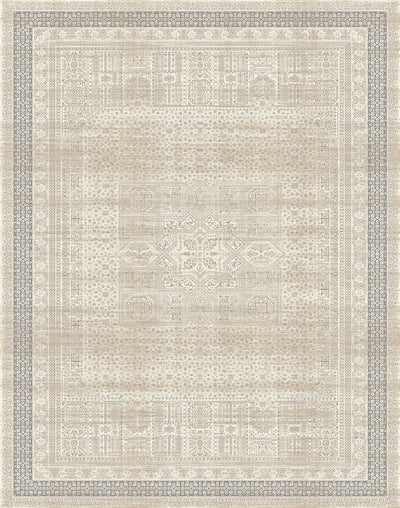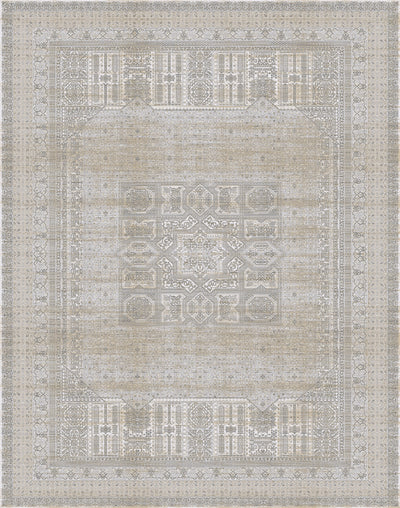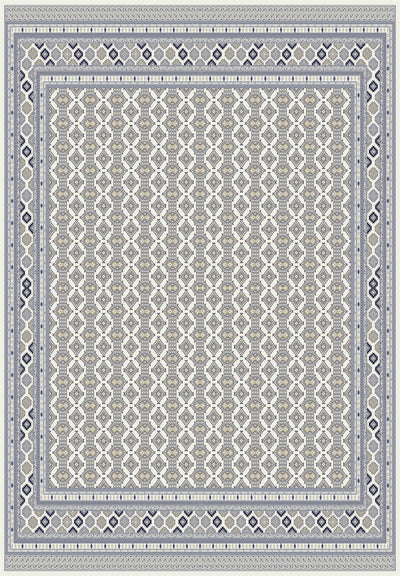

A robot vacuum and a good area rug can live together happily, but the first week is often a little rocky: the robot gets stuck on a corner, chews a fringe, or refuses to cross a dark border. Almost every problem comes down to four things: pile height, edges, fringes and color. Here's what to look for and how to fix what you already have.
Pile height: low and dense wins
Robots clean rugs with a spinning brush roll and suction. A low, dense pile gives the brush a firm, even surface to work on and lets the robot drive across without bogging down. High pile and shag let the wheels sink in, slow the robot, and sometimes trap it entirely.
Most manufacturers list a maximum height the robot can climb, often somewhere around three-quarters of an inch (about 2 cm). Check your model's specification and compare it to the rug's total thickness, not just its pile. Dense, tightly woven machine-made rugs like ours generally suit current robots well. Long shag rugs are the ones that usually defeat them.
Edges and corners
The robot has to climb onto the rug every time it enters. A thin, straight edge is easy. A curled corner, a rolled edge or a rug that has crept into a ripple is where robots get stuck, push the rug around, or climb halfway and stall.
- Flatten curled corners before you start scheduled runs. Reverse-rolling the corner for a few hours usually fixes it; our guide to getting a rug to lay flat covers the method.
- Anchor the rug with furniture. A rug with the front legs of a sofa or a bed on it doesn't slide when the robot bumps it.
- Small rugs and runners move more. A heavy rug of roughly 3 m² (about 32 sq ft) and up, like a 5×7.5 ft or larger, usually stays put. Lightweight mats and runners are the ones a robot shoves into a heap. If a runner slides, a thin gripper rated for your floor helps.
Fringes: the main problem
Fringes are a very common robot complaint. The brush roll catches the fringe, winds it up and stops, and if it happens often enough the fringe frays. Traditional-style rugs, including ours, have fringes on the short ends. Cutting a fringe off isn't a simple trim, and we don't recommend it. Instead:
- Set a no-go zone or virtual wall along each fringed end in the robot's app. Most current robots with mapping support this. The robot cleans the rug but stops a few inches short of the fringe.
- Orient the rug so the fringed ends are under furniture or against a wall where possible. A rug laid with its short ends under a bed or a sofa hides the fringe from the robot completely.
- Tuck the fringe under temporarily during a run, if the robot doesn't support zones. This is a stopgap, not a permanent fix; a fringe left folded under for months can kink.
- Vacuum the fringe by hand once a week with a handheld or a hose attachment, going from the rug outward along the fringe, never across it.
Dark rugs and cliff sensors
Robots use downward-facing "cliff sensors" to avoid falling down stairs. On some models, especially older ones, those sensors read a very dark or black surface as a drop, so the robot refuses to drive onto a black rug or treats a dark border as a ledge and backs away. If your robot avoids part of a rug for no obvious reason, this is the likely cause.
What helps:
- Check the app for a setting that adjusts or disables cliff detection on a specific area, which some models offer. Only do this where there are no stairs nearby.
- Prefer mid-tone grounds or patterns where dark colors are mixed with lighter ones, rather than solid black borders.
- Newer robots that use cameras or lidar for navigation tend to handle dark rugs better, though the cliff sensor still plays a role.
Setting up the robot for rugs
- Turn on carpet boost or the rug setting, if your model has one. It raises suction on rugs, where dust settles deeper than on hard floors.
- Map the rugs as carpet zones in the app so the robot knows what to expect.
- Mopping robots: make sure the mop lifts or the robot avoids rugs while mopping. A wet pad dragged across a rug leaves damp patches that can turn musty.
- Empty and clean the brush regularly. Rug fibers and hair wrapped around the brush reduce its pickup and can pull at the pile.
A robot doesn't replace a real vacuum
Robots are excellent at daily surface dust and pet hair. They're weaker at deep grit, which is what actually wears a rug's pile over time. A full vacuum with an upright or canister once a week, in the direction of the pile, keeps a rug in much better shape than a robot alone.
Quick checklist
- Low, dense pile; total thickness under your robot's climb limit.
- Flat edges and corners; furniture anchoring the rug.
- No-go zones along fringed ends, or fringes under furniture.
- Watch for dark-rug cliff-sensor problems; mid-tones are safest.
- Carpet boost on, mop off over rugs.
- A proper vacuum once a week as well.
Our machine-woven rugs have a dense, even pile and a cotton backing that lies flat on the floor. Browse the full rug collection, or look at the 8.2×11.5 ft rugs, a size that usually sits under enough furniture to stay perfectly still when the robot comes through. Shipping is free in the US and Canada on orders over $110.
Bring your questions to the showroom
Want to check how a rug's pile feels before your robot meets it? Visit us at 3423 Watt Avenue, Sacramento, CA 95821, open daily 10 AM–7 PM. Bring your robot's climb height from the manual and we'll help you compare.