
The short answer: Floor-level living developed separately in East Asia, Central Asia and the Arab world, and the four best-known traditions differ in ways that still matter when you furnish a room. Japan built around a floor surface (tatami) and minimal seating; Korea built around a heated floor; Afghanistan built around a portable pad; the Gulf built around a room-shaped set. The Afghan and Gulf answers travel best into an American house, because both are furniture rather than architecture.
Four solutions to the same problem
Sitting on the floor is not one tradition. It is several, developed independently, each shaped by climate, by building methods and by how people host. The differences are more interesting than the similarity — and two of the four produce furniture you can actually buy and put in a Sacramento living room, while two of them produce architecture you cannot.
Japan: the floor is the furniture
Japanese floor-level living is built on tatami — firm rice-straw mat panels in a fixed module, laid wall to wall. The mat is the surface you sit on, sleep on and lay a table on. The cushion placed on top, the zabuton, is deliberately thin, because the tatami beneath is already resilient.
That is the part that does not transfer. Put a thin zabuton on American hardwood or tile and you are sitting on hardwood with a decorative layer, which is exactly the complaint people have about floor cushions bought online. The Japanese cushion works because of what is under it.
What does transfer: the discipline of an empty centre, and the idea that a room's function changes through the day because nothing is fixed to the floor.
Korea: the floor is the heating
Korean ondol ran flues, and later hot water pipes, beneath the floor, making the floor the warmest surface in the house. When the floor is the warmest place, you live on it. Low tables, thin mattresses laid out at night, seating at floor level — all of it follows from the heating system.
This is the least portable of the four, for the obvious reason. Unless you have radiant underfloor heating, the premise is missing. If you do have radiant heating, it is worth reading our note on rugs and underfloor heating before you cover it with a thick pile rug.
Afghanistan: the portable pad
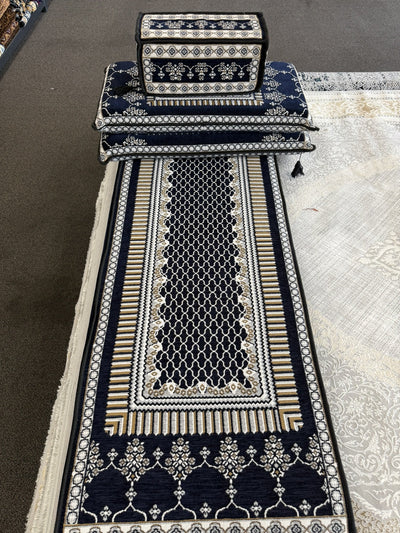
The Afghan toshak solves the problem differently again. It is a single long pad, roughly 85 × 200 cm, filled firmly and covered in a washable cover. It is not attached to the room, not sized to a module, not dependent on a heating system. It is bought one at a time, stacked when not in use, and taken out when guests arrive.
That modularity is the whole design. A household with two pads adds a third when a child grows up, a fourth when a cousin visits regularly. The same pad serves as seating during the day and as a sleeping mattress at night, which is why it is built at mattress firmness rather than cushion softness.
Of the four traditions, this is the one that moves into an existing house with the least friction — nothing about it assumes anything about the building.
The Gulf: the room-shaped set
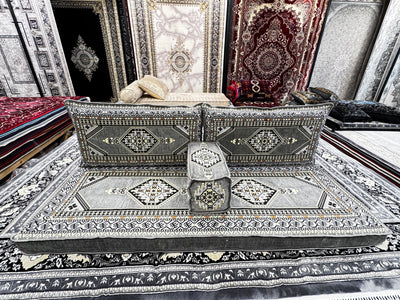
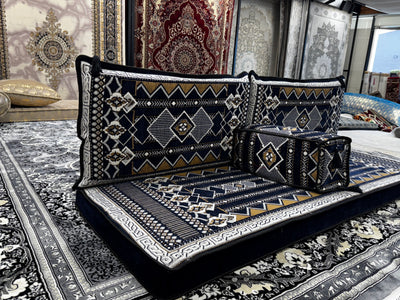
The Arabic majlis is the most architectural of the portable traditions. Where the toshak is a pad, the majlis is a set — typically four pieces at 70 × 10 × 190 cm with matching back and side pillows, laid around the perimeter of a room with the centre kept open.
The word itself means a sitting place, and the layout encodes how hosting works: seating around the edges so everyone can see everyone, the centre free for food and for people to move, one side left open as the serving and entrance side. It is designed for a gathering, not for an evening of television.
The practical consequence is that a majlis set wants a room with three usable walls. A half-arranged majlis looks unresolved in a way a single toshak never does.
What the four have in common — and it is not what you would guess
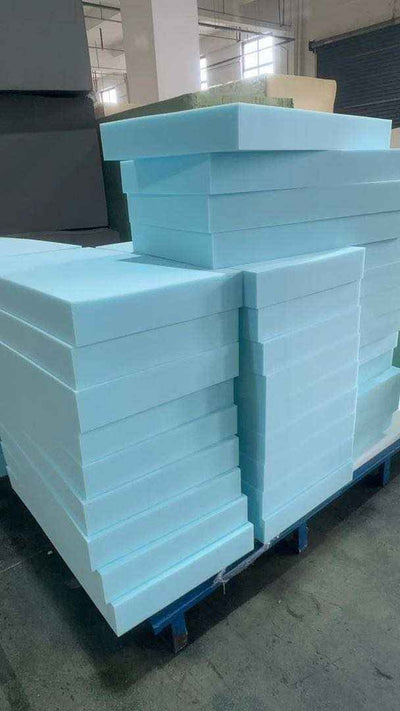
Every one of these traditions is firm. Not one of them uses soft seating. Tatami is rigid, the toshak is mattress-firm, majlis pads are dense, and a heated Korean floor is a floor.
That is the detail most Western floor-cushion products get wrong, and it is worth sitting with for a moment before buying anything. Soft is what sells in a photograph; firm is what four separate cultures independently converged on after a long time of actually doing this. The reasoning is in our foam density guide.
Borrowing well
If you are bringing floor seating into a house that was not built for it, the two things worth taking from these traditions are the firmness and the empty centre. The thing to leave behind is the thin cushion, because you do not have the tatami under it.
And the thing nobody mentions: all four assume a substantial floor covering or a floor that is itself warm. In an American house, that job falls to the rug.
For a practical comparison of the two formats we stock, see toshak vs majlis vs floor sofa.
Seeing it in Sacramento
Foam firmness is the one thing a photograph cannot tell you. Our showroom at 3423 Watt Avenue, Sacramento, CA 95821 has the covers and the foam sets out on the floor, open daily 10 AM–7:30 PM, so you can sit on a set before deciding how firm you want it. Call or text (916) 890-4077 if you want a particular colour pulled out before you arrive.
Common questions
What is the difference between a zabuton and a toshak?
A zabuton is a thin Japanese cushion designed to sit on tatami, which is already firm and resilient. A toshak is a thick, mattress-firm Afghan pad around 85 x 200 cm designed to work on a bare floor. Putting a zabuton on hardwood misses the layer it was designed for.
Which floor seating tradition works best in an American house?
The Afghan toshak and the Arabic majlis, because both are furniture rather than architecture. Japanese tatami and Korean ondol both assume something built into the room.
Why is traditional floor seating always firm?
Four separate traditions arrived at firmness independently, which is a strong signal. With only a floor underneath, soft foam compresses to the floor within half an hour of sitting.
Is a majlis the same as a Moroccan or Turkish floor seating arrangement?
They are related ideas - perimeter seating with an open centre - but a majlis set has its own dimensions and pillow structure. Ours are four pieces at 70 x 10 x 190 cm with back and side pillows.
Do I need tatami or special flooring for floor seating?
No, provided the pad itself is firm and thick enough. What you do need is a substantial rug, which in an American house does the job that tatami or a heated floor does elsewhere.