
Renting changes the rug question. A homeowner buys a rug for one room. A renter is really buying a rug for three or four rooms over the next decade, most of which they haven't seen, while also trying to get a security deposit back from a landlord who will walk the floors with a flashlight. This guide is about that second kind of buying.
Start with the lease, not the catalog
Before you measure anything, read your lease for two things.
- A floor-coverage clause. Some leases, especially for upper-floor units in apartment buildings, require tenants to cover a share of the hard floor with rugs to cut footstep noise for the neighbors below. Where it exists, a figure around 80% of the walkable floor (excluding kitchen and bathrooms) is common. If your lease has one, it decides your rug size for you, and it usually means bigger than you planned.
- Floor-damage language. Leases often list scratches, gouges and discoloration as chargeable damage. That tells you what the rug is protecting against, and it rules out anything that could leave a mark of its own.
If neither is in the lease, you still have the neighbors. A rug under the main walking path of a living room is one of the most effective things a tenant can do about downstairs noise.
Pick a size that survives a move
The rug that fits your current living room perfectly is the one most likely to be wrong in the next apartment. Renters do better with sizes that work in many rooms:
- 6.5×10 ft (200×300 cm) is the most portable living-room size. It anchors the front legs of a sofa and chairs in a typical apartment living room, and if the next place is bigger it moves to a bedroom, where it fits under the lower two-thirds of a queen bed.
- 5×7.5 ft (150×230 cm) works in a small living room, a bedroom beside the bed, a home office under a desk chair, or as a second rug in an open plan. It's the size that almost never ends up rolled in a closet.
- Runners, 3 ft wide (3×6, 3×10 ft and longer), follow you into any hallway or galley kitchen, and a 3×6 ft runner beside a bed is a reasonable plan B in a small bedroom.
Larger sizes like 8.2×11.5 ft and 10×13 ft are wonderful in the right room, but they are a commitment: if your next place has an 11-foot living room, a 10×13 ft rug has nowhere to go. Buy the big one when you know you'll stay, or when the lease clause forces your hand. Our rug size guide has room-by-room layouts if you want to test a size on paper first.
Protect the floor without creating a new problem
Rentals tend to have one of three floors, and each one has its own trap.
Vinyl plank (LVP) and laminate
This is now one of the most common rental floors, and it's the one where the wrong rug does damage. Some rubber and latex backings can react with vinyl over time and leave a yellow or brown stain that doesn't come out. That is exactly the kind of discoloration a landlord charges for. Look for a rug with a woven textile back rather than a rubbery coating, and avoid cheap rubber gripper mats underneath unless the maker states they are safe for vinyl.
Hardwood
Hardwood is mostly at risk from grit. Sand tracked in on shoes gets ground under a thin, sliding rug and slowly dulls the finish. A rug that lies flat and stays put, plus a quick vacuum of the floor before the rug goes down, does most of the protecting. Under heavy furniture, felt pads on the legs protect both the rug and the wood.
Wall-to-wall carpet
Plenty of rentals come with tired beige carpet. A rug on top is allowed and often the best decorating move available to a tenant, as long as it doesn't creep and ripple. We cover the technique in how to put a rug on carpet.
Never tape or glue
Double-sided carpet tape and adhesive grippers are the classic deposit-killers. On hardwood they can lift finish; on vinyl they can leave residue that's hard to remove. If a rug needs to be held in place, solve it with size and furniture (front legs of a sofa on the rug) rather than adhesive.
Rug pads: often less necessary than you think
Pads are sold as non-negotiable, but it depends on the rug. A heavy, flat-lying rug at roughly 3 m² (about 32 sq ft) and up, held down by furniture, often stays put by itself. Our machine-woven rugs have a cotton backing and generally don't need a pad at that size, which also means one less rubber product sitting on a vinyl floor. Small rugs and runners in walkways are the exception; if one slides, use a gripper that is rated for your floor type.
Choose a design that will work in a room you haven't seen
The next apartment might have grey vinyl, honey oak, or white tile. A few design choices travel well:
- Mid-tones beat extremes. A very pale rug shows every footprint in a shared building's hallway traffic; a very dark one shows dust and pet hair. Mid-tone grounds hide daily life and sit comfortably on most floor colors.
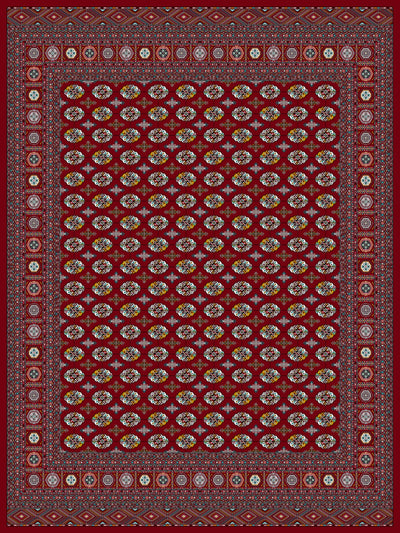
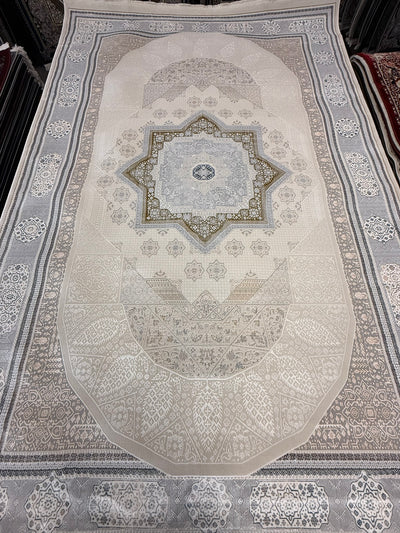
- An all-over pattern is more forgiving than a big center medallion. A medallion wants to be centered on something. An all-over or repeating design looks intentional whether the sofa is centered or pushed into a corner.
- Two or three main colors. It is easier to build the next room around a rug with a clear palette than around one with ten competing colors.
Budget like a renter
A rug is one of the few pieces of furniture that doesn't care how many times you move. It doesn't need assembly, it doesn't lose screws, and it rolls into a moving truck in two minutes. That makes it a good place to spend a little more than you would on, say, a bookcase you'll leave on the curb. A dense, machine-woven rug in polypropylene or polyester pile also handles move-in, move-out and the stretch in between without the worry that comes with a delicate fiber.
Moving out: get the deposit back
- Lift the rug a week before move-out and look underneath. Vacuum the floor where it sat.
- Check for uneven fading: on sunny floors, the area under the rug can be a different shade from the area around it. Shifting the rug a few inches every few months while you live there makes that line much softer.
- Roll the rug, don't fold it, and keep it off a damp garage floor while you clean.
Quick checklist
- Read the lease for a floor-coverage clause and for damage language.
- Default to 6.5×10 ft for a living room and 5×7.5 ft for everything else.
- On vinyl or laminate, avoid rubber or latex backings and rubber gripper mats not rated for vinyl.
- No tape, no adhesive, ever.
- Mid-tone colors and an all-over pattern travel best.
- Rotate or shift the rug a few times a year to avoid a fade line.
Browse all sizes in our rug collection, or go straight to the 6.5×10 ft rugs, a size that works in most rentals. Shipping is free in the US and Canada on orders over $110.
See them in Sacramento
If you rent in the Sacramento area, the easiest way to judge a rug against your floor is to bring a photo of the room and see the rugs in person. Our showroom is at 3423 Watt Avenue, Sacramento, CA 95821, open daily 10 AM–7:30 PM, and we're happy to unroll a few sizes so you can see what 5×7.5 ft actually looks like next to 6.5×10 ft.