
Short answer: a high-reed machine-woven rug can be washed, hosed, blotted and scrubbed by anyone. A hand-knotted wool rug usually cannot — not safely, not by a non-professional. That single difference decides more buying decisions in our Sacramento showroom than price, pattern or origin.
This is not an argument that hand-knotted rugs are bad. We sell genuine hand-knotted Afghan carpets ourselves, by appointment. It is an honest account of what happens to each construction when water, tea and time get involved — because that is the part nobody tells you until it has already happened.
What happens when you wash a hand-knotted rug at home
1. The dye can bleed
Traditional wool rugs are dyed with madder root, indigo, walnut husk and pomegranate, or with early synthetic dyes on older pieces. Those dyes sit in the wool fibre rather than being locked into it. Warm water, ordinary detergent and an alkaline pH all loosen them. The classic result is a red field running pink into an ivory border — and once it has run, it does not come back out. Professional washers use cold water, acidic rinses and dye-trapping agents precisely because of this.
2. The rug can go out of square
A hand-knotted rug is wool pile tied onto a cotton warp and weft. Cotton shrinks when it gets wet and does not shrink evenly — the edges draw in faster than the middle, and the selvedges pull harder than the ends. A rug that went into the bathtub rectangular can come out trapezoidal, with waves that never lie flat again. Correcting it means re-stretching on a frame, which is specialist work.
3. Wool holds what it absorbs
Wool takes on roughly 16–18% of its own weight in moisture. That is what makes it feel warm and breathable underfoot — and it is also why spilled tea does not sit on the surface waiting to be blotted. Tannin in tea and coffee binds to the protein in wool. Left for an hour it is a stain; left overnight it is usually permanent without professional treatment.
4. Drying is where most damage happens
A wet wool rug that is not dried fast enough and flat enough grows mildew in the foundation. The smell comes from the foundation, not the pile, which is why surface sprays never fix it. This is the single most common reason a rug arrives at a specialist beyond saving.
What happens when you wash a high-reed machine-woven rug
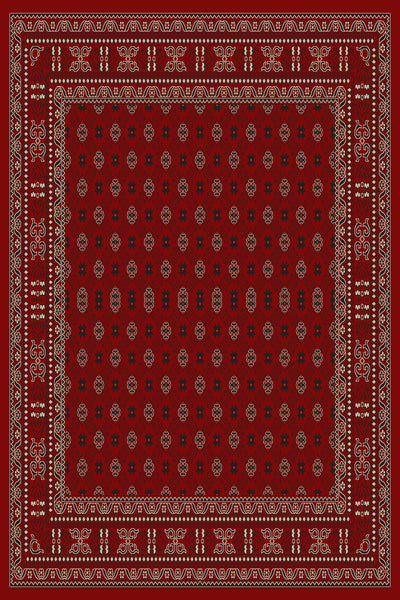
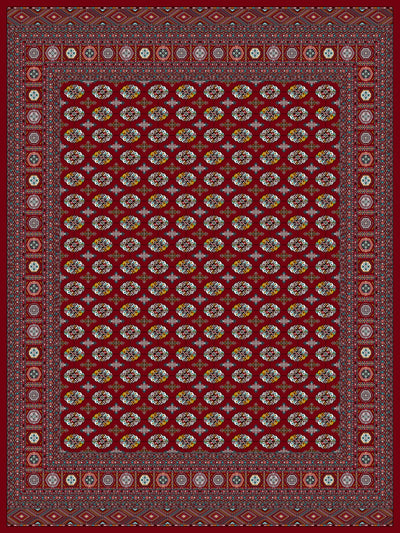
Our rugs are woven in Türkiye at 1200 reeds — about 3 million points per square metre — in heat-set polypropylene on a woven jute backing. Each of the four problems above is answered by the construction itself:
- The colour is locked in before weaving. Heat-set polypropylene is coloured as the fibre is made, then heat-twisted so the twist and the colour are permanent. There is no loose dye to migrate. It does not run into the cream border, because there is nothing to run.
- It absorbs essentially nothing. Polypropylene takes on under 0.1% of its weight in moisture, against wool's 16–18%. Spilled tea beads on the surface for long enough to blot it up. Water does not reach the backing and does not stay there.
- It does not shrink out of square. The pile is heat-set and the backing is woven jute rather than a hand-tensioned cotton foundation. It goes back down the shape it came up.
- It dries in hours, not days. Because the fibre holds no water, there is no wet foundation to grow mildew in.
In practice that means you can take a rug outside, lay it on a clean driveway, hose it, brush it with mild soap, rinse it and hang it over a railing. We tell customers to do exactly that, and we do it to our own showroom pieces.
Hand-finished: the fringes are sewn on, not glued
There is one part of our rugs that no machine makes. When a rug comes off the loom, the fringes and the side edges are finished by hand — the fringe is sewn onto the end of the rug, and the selvedges are bound, by people, one rug at a time.
That detail matters most at exactly the moment this article is about. On cheap machine-made rugs the fringe is glued on, or simply printed as part of the backing. Wash one of those and the fringe lifts, curls and peels away in strips — and once it goes, the end of the rug begins to unravel. A hand-sewn fringe is stitched through the foundation. You can hose the rug, brush it and hang it to dry without the ends letting go.
The same is true of the sides. A hand-bound selvedge holds the outermost rows of pile in place; a machine-serged edge frays as soon as the thread is cut anywhere along its length. We overlock our own rugs here in Sacramento for that reason — it is the one finishing service we offer, and only on rugs we sold.
Worth checking on any rug you are considering, ours or anyone else's: turn the end over and look at whether the fringe passes through the rug, or merely sits on top of it. Thirty seconds of looking tells you how the rug will survive its first wash.
Side by side
| Hand-knotted wool | 1200-reed machine-woven, hand-finished | |
|---|---|---|
| Wash at home | Not advisable | Yes — hose, blot, mild soap |
| Dye bleed risk | Real, especially reds on ivory | None — colour is locked in the fibre |
| Moisture absorbed | 16–18% of its weight | Under 0.1% |
| Tea & coffee | Tannin binds to wool protein | Beads on the surface; blot and rinse |
| Shape after washing | Can shrink unevenly, go off-square | Dimensionally stable |
| Fringe | Part of the warp, structural | Hand-sewn through the foundation, not glued |
| Drying | Days; mildew risk in the foundation | Hours |
| Professional wash | Effectively required | Optional |
| Pattern detail | Depends entirely on knot density | ~3 million points per m² |
The one place polypropylene is the weaker fibre
We would rather you heard this from us. Polypropylene is oil-loving. Water-based spills — tea, coffee, juice, wine, pet accidents — it shrugs off. Oily and greasy stains are its weakness: salad dressing, butter, cosmetics and oil-based paint bond to the fibre in a way that water-based spills never do. Treat those with a solvent-based spot cleaner quickly rather than with soap and water. Wool, for all its trouble with water, handles oil no better, but it is worth knowing where the fibre actually gives way.
So is hand-knotted worse?
No — it is different, and it wins on things washing has nothing to do with. A finely knotted Persian or Afghan carpet can carry 4 to 5 million knots per square metre, above anything a loom produces. It can last three generations where a machine-woven rug is built for ten to twenty years of honest use. It holds resale value; machine-woven does not. It carries the hand of the person who tied it.
What hand-knotted asks in return is care: no beater bar, no home washing, a professional clean every few years, and attention to sunlight and moisture. That is a reasonable trade for a piece bought to be inherited. It is an unreasonable one for a dining room with a four-year-old, a dog and a glass of tea that is going to go over at some point.
Who should buy which
Buy high-reed machine-woven if the room is used — dining rooms, family rooms, hallways, anywhere with children, pets, or guests sitting on the floor. Buy it if you want the Persian medallion detail without organising your life around protecting it, and if you would rather spend the difference on size: the same budget buys a 10x13 machine-woven or a small hand-knotted scatter rug.
Buy hand-knotted if the rug is for a formal room, you intend to keep it for decades, you are comfortable with professional cleaning, and the object itself — not just the pattern — is the point.
Common questions
Can you put a machine-woven rug in a washing machine?
Small sizes marked washable, yes, on a cold gentle cycle. Anything over about 5x7 is too heavy wet and should be washed flat outdoors instead. Never tumble dry a rug of any construction.
Will a Persian-design rug bleed if I wash it?
If it is machine-woven in heat-set polypropylene, no. If it is hand-knotted wool, assume yes until a professional tells you otherwise — test a hidden corner with a damp white cloth first.
Do the fringes come off when you wash a machine-made rug?
If they were glued on, yes — that is the usual failure. If they were sewn on by hand through the foundation, as ours are, they stay. Check which kind you have before the rug ever gets wet.
How do you get tea out of a rug?
Blot immediately with a dry white towel, pressing rather than rubbing. Use cold water, never hot — heat sets tannin. On polypropylene this almost always lifts the stain completely. On wool, blot cold and call a professional the same day.
Does a higher reed count make a rug easier to clean?
Yes, indirectly. A denser weave at 1200 reeds has less space between the tufts for liquid and grit to travel down into, so spills stay nearer the surface and vacuuming lifts more of what settles.
See both in Sacramento
We keep both on the floor at 3423 Watt Avenue. Bring a cup of tea if you like — we have poured it on our own rugs to show people what happens. Open daily 10 AM – 7:30 PM, or call us before you come if you want a specific size pulled out.
Related reading: Machine-made vs hand-knotted: an honest comparison · Reed count and density explained · How to wash a rug at home, by fibre