
The short answer: Comfortable floor seating is mostly about the back, not the seat. Put the pads against a wall or a solid piece of furniture, use back pillows thick enough to keep your spine off the skirting board, and give yourself three weeks of hip adjustment before judging it. Most complaints about floor seating are really complaints about an arrangement with nothing to lean on.
The mistake almost everyone makes first
People buy floor cushions, put them in the middle of the room facing the television, sit down, and discover there is nothing behind them. Twenty minutes later they conclude floor seating is uncomfortable.
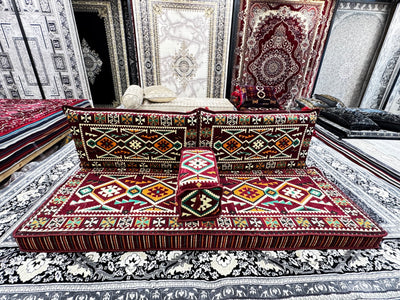
It is not. It is that a seat without a back is not a seat — it is a mat. Every floor-seating tradition in the world solves this the same way: the seating goes against the walls. That is what a majlis is, structurally. Pads around the perimeter of the room, backs supported, the middle left open.
If you cannot use a wall
Sometimes the wall you want is taken by a window, a radiator or a doorway. The workable substitutes, in order of how well they actually work:
- The back of a sofa. If you already own one, turning it to face the other way and putting floor seating along its back edge is the single best hybrid in a small room.
- A low bookcase or a sideboard. Anything solid at roughly 60–80 cm high.
- The side of a bed. Works well in a bedroom reading corner.
- Large firm bolsters stacked against each other. The weakest option — they slide — but better than nothing.
Back pillows: the part that decides everything
A back pillow has one job: keep your spine off the hard vertical surface behind you, at an angle you would choose. Too thin and you are leaning on a skirting board. Too soft and you compress straight through to the same skirting board, which is the same failure arriving more slowly.
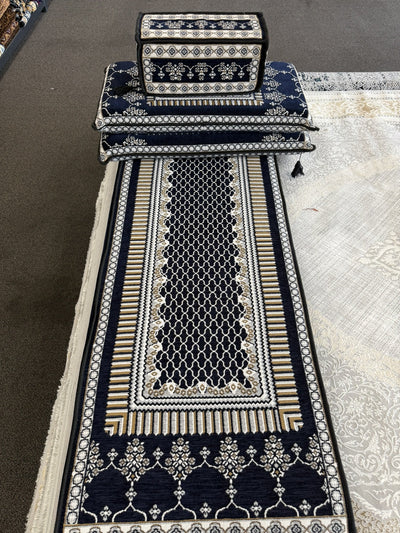
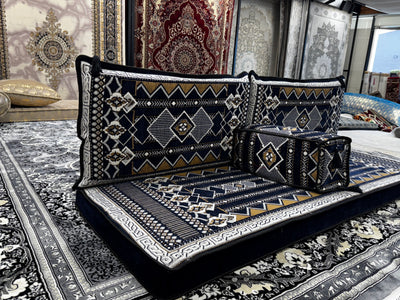
This is why our sets come with a specific count rather than a vague "cushions included". The Arabic majlis foam set is two toshak, four back pillows and two side pillows, and the Afghan toshak foam set is two toshak and four pillows. The side pillows matter more than people expect — they are what you put under an elbow, and they are what turns a ninety-minute evening into a three-hour one.
The corner rule
In any room with floor seating, the corner seats go first. Always. Two surfaces to lean against instead of one means you can turn sideways, put an arm up, and face into the room rather than straight ahead.
If you are arranging a set for the first time, build outward from the corners rather than centring on a wall. It is how majlis rooms are laid out, and the reason is not ceremonial.
The first three weeks
If you have not sat on the floor regularly as an adult, your hips are not going to like it immediately. This is worth saying because people interpret the discomfort as a verdict on the furniture.
What usually happens: the first few evenings you shift constantly and your hip flexors ache afterwards. By the second week you find two or three positions that work. By about the third week you stop thinking about it. The adjustment is real, it is temporary for most people, and it is also genuinely not going to happen for someone with a knee replacement or hip arthritis — that is a different situation and no amount of pillows fixes it.
Positions that help in the meantime
- Sit on the front edge of the pad rather than the middle, so your knees drop below your hips. This is the single most effective adjustment and it works immediately.
- One leg out, one folded. Alternate. Symmetry is overrated at floor level.
- A firm pillow under one hip raises you by a few centimetres and takes most of the strain out of cross-legged sitting.
The floor itself
At sofa height, the rug is decoration. At floor height, it is part of the seat. Bare tile or laminate under a foam pad transmits hardness and cold straight through, and it is the difference between a set that gets used every evening and one that gets used when guests come.
Size the rug so the whole seating arrangement sits on it. A pad half on and half off creates a ridge directly underneath you, which you will feel every time you shift.
Laying out a whole room
If you are setting up a full majlis rather than a corner, the arrangement, the flow and where to leave gaps for serving are covered properly in our guide to setting up an Arabic majlis at home. For the format comparison — toshak against majlis against a Western floor sofa — see the honest floor-couch guide.
Seeing it in Sacramento
Foam firmness is the one thing a photograph cannot tell you. Our showroom at 3423 Watt Avenue, Sacramento, CA 95821 has the covers and the foam sets out on the floor, open daily 10 AM–7:30 PM, so you can sit on a set before deciding how firm you want it. Call or text (916) 890-4077 if you want a particular colour pulled out before you arrive.
Common questions
Why is my floor seating uncomfortable?
Most often there is nothing solid behind you. Floor seating belongs against a wall, the back of a sofa, or a low bookcase. A pad in the middle of a room with no back support is a mat, not a seat.
How many back pillows do I need?
Roughly two per seated adult, plus side pillows for elbows. Our majlis foam set includes four back and two side pillows for that reason; the toshak foam set includes four pillows.
How long does it take to get used to sitting on the floor?
About three weeks for most adults who have not done it regularly. The ache is in the hips rather than the back. If you have a knee replacement or hip arthritis, it is unlikely to resolve and floor seating may not be the right format.
What is the best position for sitting on the floor?
Sit on the front edge of the pad so your knees drop below your hips - it helps immediately. Then alternate: one leg out, one folded, and move often. Floor seating works because you shift.
Do corner seats really matter?
Yes. Two surfaces to lean on instead of one lets you turn sideways and face into the room. In any majlis arrangement the corners are taken first, and that is not ceremonial.