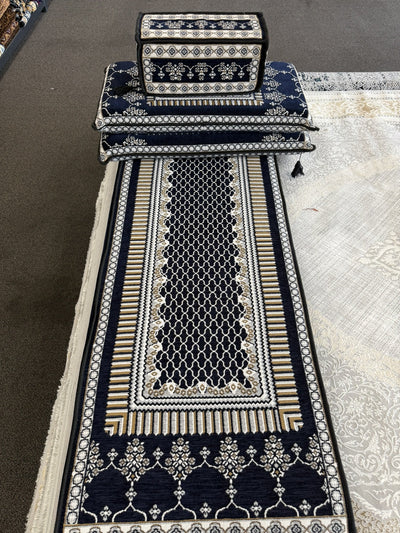

The short answer: Foam for floor seating has to do a harder job than foam in a sofa, because there is no frame and no springs underneath it — only the floor. That means density matters more than softness. A pad that feels plush in the first minute is usually one that has compressed to the floor by the thirty-minute mark, and firm foam is what makes long evenings possible.
Why floor seating foam is a different problem
In a sofa, the foam is the last layer in a system. Underneath it there is webbing or springs, and under that a frame. The foam only has to handle the final few centimetres of give; everything else is absorbed before your weight reaches it.
Floor seating has none of that. The foam is the suspension. Every bit of load-bearing a sofa frame would do has to be done by the foam core, over a hard floor, with a human sitting on a contact area far smaller than a sofa cushion.
That single structural fact explains most of what follows, and it is why foam that would be perfectly good in a sofa cushion is often inadequate in a toshak.
Density versus softness — they are not the same thing
People use "firm" and "dense" interchangeably, and they are different properties. Density is how much material is packed into the volume. Firmness is how much it resists the first push of your hand.
A low-density foam can be made to feel firm when new. It will not stay that way, because there is not enough material to carry the load repeatedly — the cells break down, and the pad develops a permanent hollow where people sit. That hollow is the end of the pad's useful life, and it usually arrives long before the cover wears out.
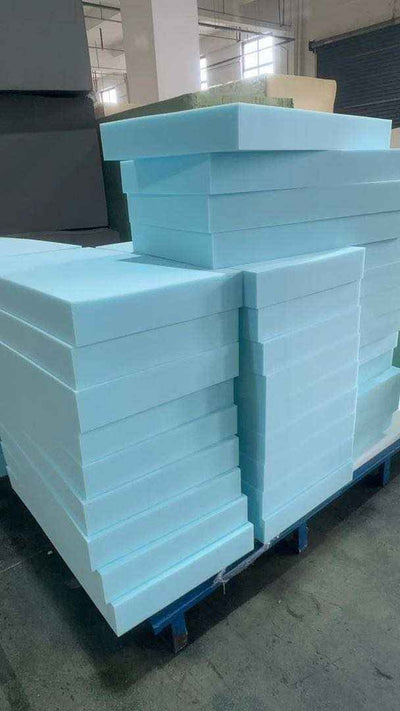
A high-density foam feels less dramatic in the shop. It carries weight by distributing it rather than by collapsing, which is precisely what you want when the only thing below is hardwood.
The thirty-minute test
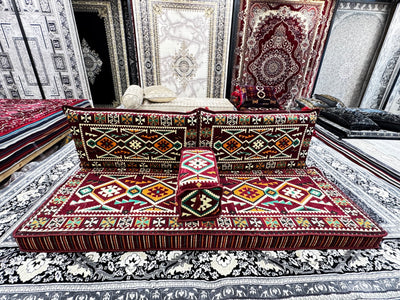
Here is the test we tell people to run in the showroom, and it is the reason we keep foam sets out on the floor rather than stacked.
Sit down. Soft foam feels better — it always does, for about a minute. Then stay there. Somewhere between fifteen and thirty minutes, soft foam bottoms out: your sit bones find the floor through the pad, and you start shifting constantly, not because you want to move but because no position stays comfortable. Firm foam does the opposite. It feels unremarkable at first and then stops registering at all, which is what a good seat is supposed to do.
Thirty seconds of sitting will tell you the wrong answer with high confidence. This is the single biggest reason people buy floor seating online, are disappointed, and conclude floor seating is not for them.
Thickness: useful, but secondary
Thickness helps, but it cannot rescue bad foam. Ten centimetres of dense foam outperforms fifteen centimetres of soft foam on a hard floor, every time, because the soft version simply has further to compress before it reaches the same dead end.
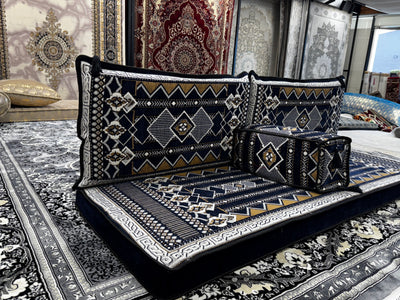
Our Arabic majlis pieces are 70 × 10 × 190 cm each and an Afghan toshak is 85 × 200 cm. Those depths are not arbitrary — they are what generations of floor-seating households converged on, with firm fill.
Where the rug comes in
A rug under floor seating is not decoration. It is the layer that takes the edge off the floor, and it changes how the foam performs. The same pad on bare tile and on a rug feels like two different products.
This is also why our rugs need no separate pad at normal room sizes — the cotton backing and the weight do that work already. If you want the detail, our rug pad guide covers when a pad helps and when it is a waste of money.
Buying foam once
The reason we sell covers and foam as separate decisions is this: they have completely different lifespans and completely different jobs.
Covers take the spills, the sun, the dog and the kids. They are meant to be replaced, which is why they start at $49.99. Foam is meant to last through several sets of covers. Buying cheap foam and good covers is the wrong way round — you end up with a beautiful set nobody sits on.
If you are starting from scratch, see the floor cushion sizing guide for the dimensions, and the toshak care guide for keeping both parts alive.
Seeing it in Sacramento
Foam firmness is the one thing a photograph cannot tell you. Our showroom at 3423 Watt Avenue, Sacramento, CA 95821 has the covers and the foam sets out on the floor, open daily 10 AM–7:30 PM, so you can sit on a set before deciding how firm you want it. Call or text (916) 890-4077 if you want a particular colour pulled out before you arrive.
Common questions
What foam density is best for floor seating?
Higher density than you would choose for a sofa cushion, because there is no frame or spring underneath - the foam is the entire suspension. Prioritise a dense core over a thick soft one.
Why does my floor cushion feel hard after an hour?
It has bottomed out. The foam has compressed far enough that your weight is reaching the floor through it. This is a density problem, not a thickness problem, and it does not improve with use.
Is thicker foam always better?
No. Ten centimetres of dense foam beats fifteen centimetres of soft foam on a hard floor, because soft foam simply has further to travel before it reaches the same dead end.
Can I replace just the foam later?
Yes, and that is how the sets are designed - foam and covers are sold separately because they wear out on completely different schedules.
Does the rug underneath change how the foam feels?
Noticeably. The same pad on bare tile and on a rug behaves like two different products, because the rug takes the hardest edge off the floor before the foam has to.