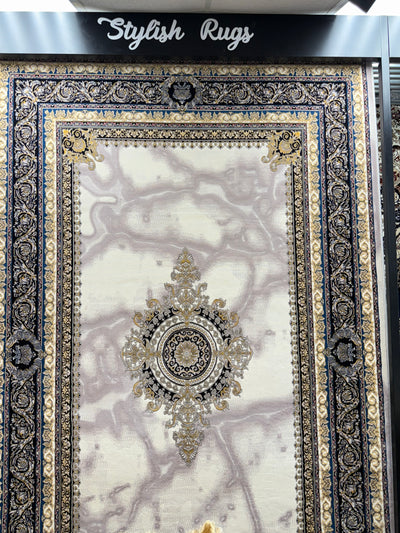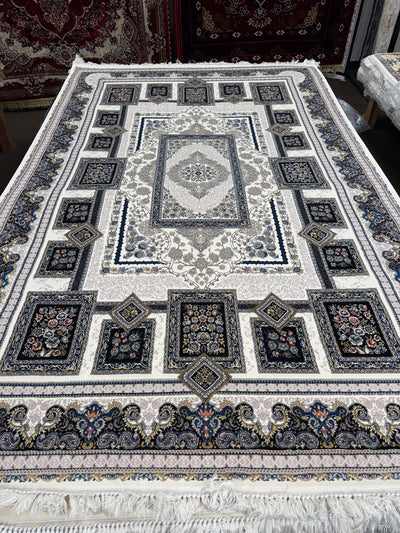

We sell machine-woven rugs. So treat everything below as what it is — a shop telling you honestly where its own product wins and where it loses, because you will work it out anyway once the rug is on your floor.
Here is the short answer. A hand-knotted rug is a hand-made object that can last a century and can be worth money later. A machine-woven rug is a floor covering that looks very good, costs a fraction, and will be worn out in ten to twenty years. Neither is the “better” rug. They are answers to different questions.
What each one actually is
Hand-knotted. A weaver ties individual knots onto a stretched warp, one at a time, by hand. A 9×12 at a decent knot density is somewhere between a year and two years of one person's work. That is the entire explanation for the price. Nothing about the materials costs thousands of dollars; the labour does.
Machine-woven. A power loom weaves the pile into the foundation at speed, following a digital pattern file. The loom does not tie knots — it inserts pile yarn and binds it in. A rug comes off the loom in hours rather than years, which is why a 10×13 can sell for a few hundred dollars instead of several thousand.
Our own rugs are woven in Türkiye and finished by hand at the edges and fringes. The pile is 66% polypropylene / 34% polyester on a cotton warp, about 10 mm deep, and it is solution-dyed — the colour is inside the fibre rather than applied to the surface, which is why it resists fading and why spills sit on top instead of soaking in.
The differences that actually matter
| Hand-knotted | Machine-woven | |
|---|---|---|
| Typical price, 9×12 | $3,000 – $30,000+ | $200 – $600 |
| Realistic life | 50–100+ years | 10–20 years |
| Resale value | Can hold or gain value | None. It is a consumable |
| Pattern | Slight irregularities; the weaver's hand is visible | Exact and repeating |
| Colour | Often abrash — gentle banding from dye lots | Even throughout |
| Spills | Wool absorbs; act fast, often needs a professional | Synthetic sheds water; most things blot out with cool water |
| Sunlight | Natural dyes soften over years | Solution-dyed, strongly fade-resistant |
| Repair | Repairable by a specialist, almost indefinitely | Not economically repairable |
| Replacing it | A decision | An errand |
How to tell them apart in ten seconds
You do not need an expert. Do these three things to any rug, in any shop:
- Fold the pile back against itself. A hand-knotted rug shows individual knots sitting on the foundation, slightly irregular, like tiny beads in rows. A machine-woven rug shows a perfectly even mechanical grid.
- Look at the back. On a hand-knotted rug the pattern on the back is as sharp as the front, and you can usually see the knots. A machine-woven rug has a flatter, more uniform back, often with a backing material over it.
- Check the fringe. On a hand-knotted rug the fringe is the warp — the threads the whole rug is tied onto, coming out of the ends. It was never attached. On most machine-woven rugs the fringe is woven or sewn on afterwards. If someone offers to glue a new fringe onto a rug, walk away.
If a seller is vague when you do this, that tells you something on its own.
What “1200 reeds” means, and why we keep saying it
Reed count is the machine-woven equivalent of knot count — it measures how many vertical threads sit across the width of the loom. More reeds means a finer grid, which means the drawing in a medallion stays sharp instead of going blocky, and the pile packs densely enough to spring back underfoot.
1200 reeds works out at over three million points per square metre. It is the tier most of our catalogue sits in. Above it we carry 1.5-million-point and 2-million-point weaves, which are denser again — thicker in the hand, deeper colour saturation, and noticeably better at holding a crisp outline in a complex Tabriz or Kashan layout. The full breakdown is in our reed count and density guide.
This is the honest version of “quality” in a machine-woven rug. Not the brand, not the story — the density, the fibre and the finishing.
Where hand-knotted genuinely wins
- You want it to outlive you. A good hand-knotted rug is a sixty-year object. Nothing machine-woven is.
- You want the irregularity. The slight wander in a hand-drawn medallion, the abrash where one dye lot met the next — a loom cannot fake that, and some people want exactly that.
- You might sell it one day. A machine-woven rug is worth nothing second-hand. A good hand-knotted one can be worth more than you paid.
- It is going somewhere it will be seen closely. At arm's length, under a lamp, the difference in a fine Isfahan is real and it is not subtle.
Where machine-woven genuinely wins
- Children, dogs, and a room that gets used. A synthetic pile sheds water instead of drinking it, and a tea or juice spill usually blots out with cool water. Doing that to a wool heirloom is a different afternoon.
- You want the right size now. A 10×13 is in stock and on the floor today. A hand-knotted one in that size, in your colour, is a hunt.
- Direct sunlight. Solution-dyed synthetic holds its colour through years of a south-facing window far better than natural dyes do.
- You are not sure yet. If you are testing a colour, a layout, or a room you may redo in three years, spending $300 instead of $6,000 is not a compromise — it is the correct decision.
- The budget is the budget. Most people buying a rug for a real room are choosing between a good machine-woven rug and no rug. That is the actual comparison, and it is not close.
So which should you buy?
Buy hand-knotted if it is going in a formal room, you want it for decades, the budget genuinely stretches, and you care about the object as much as the floor it covers.
Buy machine-woven if the room is lived in, the size matters more than the provenance, you would rather spend the difference on the rest of the room, or you want to be relaxed about what happens on it.
There is also a reasonable third answer that nobody in this trade says out loud: buy machine-woven for the living room and the hallway, and save for one good hand-knotted piece for the room where it will be seen. That is what a lot of our customers actually do.
If you also want hand-tufted in the comparison — the third construction, and the one most often mislabelled — see hand-knotted vs hand-tufted vs machine-woven.
Honestly, about what we sell
Our online collection is machine-woven in Türkiye in classic Persian designs — Tabriz, Kashan, Isfahan, Kheshti medallion layouts. Design names describe the pattern, not the country of manufacture, and we do not claim otherwise anywhere on this site.
We also keep genuine hand-knotted Afghan carpets at the Watt Avenue showroom, shown by appointment. They are not in the online catalogue, because photographs of a hand-knotted rug are close to worthless — you need to see one in daylight, from two directions, and put your hand on it.
A few other things worth saying plainly:
- Sizes are quoted at the loom. A cotton-backed rug settles slightly smaller once it is finished, so the piece we list as 10×13 (300×400 cm) measures closer to a 9×12 on your floor. If an exact figure matters, call and we will put a tape across the actual rug.
- You probably do not need a rug pad. From roughly 3 m² upwards, the cotton backing and the rug's own weight hold it in place. We do not sell pads and we are not going to invent a reason for you to buy one.
- We overlock edges — that is the only service we offer, and only on rugs bought from us. We do not wash, repair, reweave, re-fringe, restore or appraise rugs, in-house or through anyone else. If you need that, bring the rug in and we will tell you who in Sacramento does it properly.
Seeing them side by side in Sacramento
If you are anywhere near Sacramento, the quickest way to settle this question is to stand on both. We are at 3423 Watt Avenue, open daily 10am to 7:30pm. Bring the room dimensions and a photo of the space. Ask to see a 1200-reed and a hand-knotted piece next to each other and judge for yourself — there is nothing to buy and no appointment needed for the machine-woven floor.
Online, every rug ships free across the US and Canada on orders over $110, with 30-day returns — because colour and scale are genuinely hard to judge from a screen, and that is what the return window is for. For what each size actually costs, see how much an area rug should cost.
Common questions
Are machine-made rugs bad quality?
No — but the range is enormous. A loose, thin, 300-reed rug from a discount bin and a 1200-reed rug with a cotton foundation and hand-finished edges are both “machine-made” and have almost nothing else in common. Judge the density, the fibre and the finishing, not the method.
How long will a machine-woven rug last?
In a normal household room, ten to twenty years before the pile flattens in the traffic lanes. In a hallway or under a dining table, less. Rotating it 180° twice a year makes a genuine difference and costs nothing.
Is polypropylene the same as plastic?
It is a synthetic polymer, yes. It is also the reason the rug survives a toddler. Solution-dyed polypropylene resists fading, water and most stains better than wool does — it simply will not age into something beautiful the way wool does.
Can a machine-woven rug be repaired?
Rarely worth it. A snagged loop can be trimmed level with scissors — never pulled, or you will run a line across the whole rug. Beyond that, the economics do not work: the repair costs more than the rug.
Where are your rugs actually made?
The online collection is woven in Türkiye. The hand-knotted carpets at the showroom are Afghan. “Persian” on this site always describes a design tradition — a medallion layout, a Tabriz or Kashan drawing — never a country of manufacture. If a shop will not give you a straight answer to this question, that is your answer.
What is the largest size you carry?
10×13 ft (300×400 cm). For a larger room, two rugs defining separate zones usually reads better than one oversized rug anyway.